
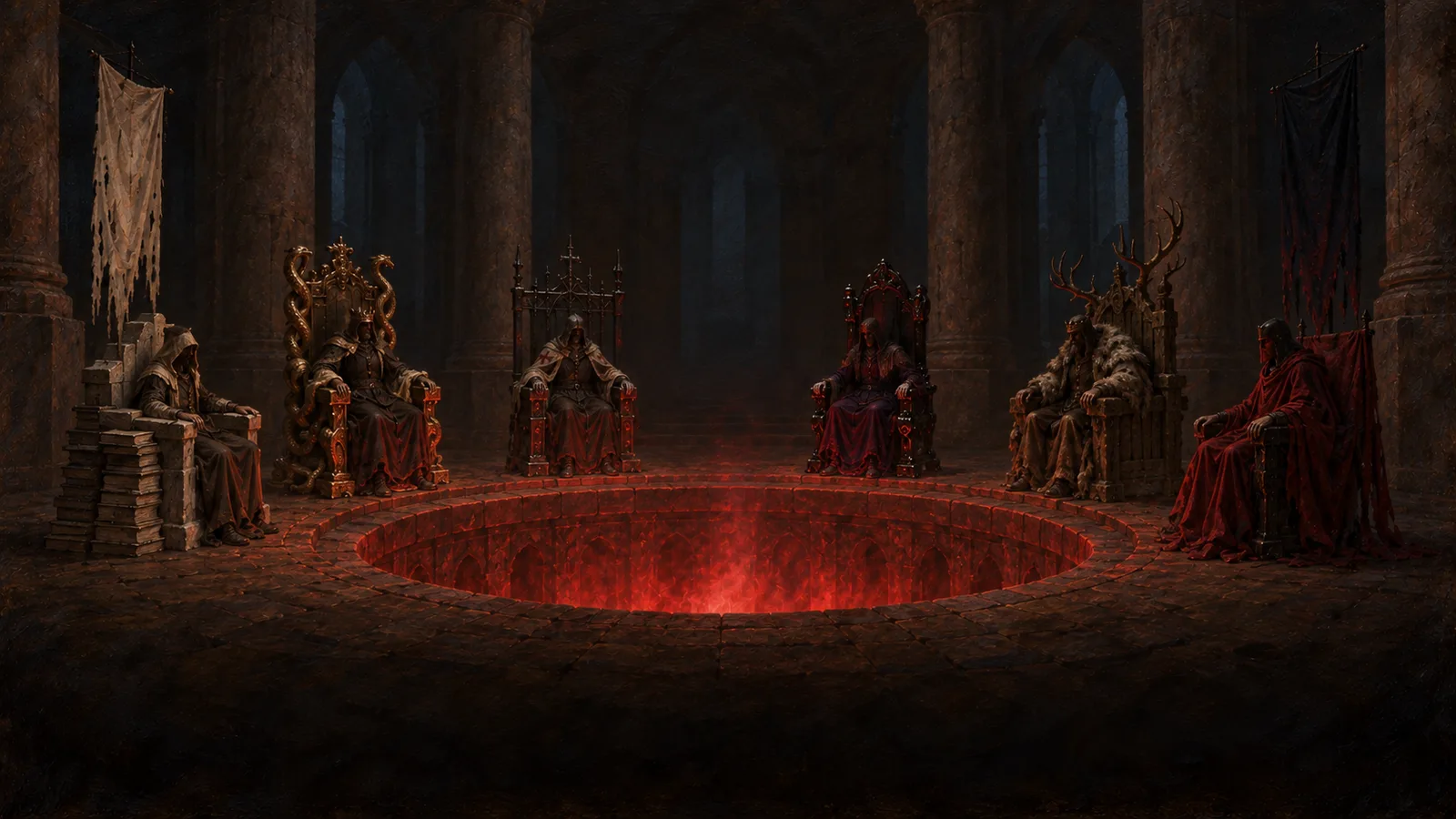

Version 1.0 — first edition.
Introduction
These are the Comprehensive Rules of No Dawn: the complete, authoritative reference for how the game works. They are written for judges, deck-builders, developers, and players who need a precise answer to an exact question — not as a teaching guide. If you are learning to play, start with a quickstart or a starter set; return here when a ruling is in dispute.
No Dawn is a game of immortal war. Each player is a Master Vampire of one of the six ancient lineages, ruling from a Haven while the world turns endlessly from Night to Day and back. At Night the Master and its night-bound servants stalk the field; at Day they withdraw into shelter while day-walkers besiege the enemy's refuge, racing to drag a sleeping Master into the sun. Blood — Vitae — is the only currency, and a Master that spends its own blood stains its soul toward damnation. No Dawn rewards the patient schemer over the quick reflex: traps are laid in advance, Powers are set and sprung, and the longest plans win.
How to read these rules
- The rules are organized into nine numbered sections plus a glossary. Each section is divided into numbered rule groups (for example, rule 506 covers the Combat Phase), and each rule group into individual rules and sub-rules (506.1, 506.1a, and so on). A reference like "rule 704.5" means section 7, rule group 704, rule 5.
- The Golden Rule (see rule 101): when a card's text contradicts these rules, the card wins. These rules are the default; every card is written knowing it may carve an exception.
- Status tags. A rule tagged (※ proposed) extends the current No Dawn design beyond what its source specifications settle; it is offered for ratification and may change. A rule tagged (deferred — content-gated) is designed but awaits the cards or the game mode that will use it. Untagged rules are ratified.
- Reserved numbers. Unused rule-group numbers remain as one-line Reserved entries so future NoDawn expansions have a stable home.
- Examples appear in blockquotes and are illustrative, not exhaustive. Card names in examples may be real first-edition cards or plausible inventions used only to show a rule in motion.
Contents
- 1. Game Concepts — the game and its object; players; starting and ending the game; the six lineages; Vitae and the Blood pool; numbers and symbols; cards, objects, and permanents; tokens; spells, abilities, and targets; special actions; timing and priority; costs; the Master's Vitae; damage; drawing; counters; Suspicion and the Veil.
- 2. Parts of a Card — name and epithet; the four-part cost block; the phase glyph; the type line; the text box; Attack and Vigor; Companion Vigor; Haven and Master statistics; the Blood Seal.
- 3. Card Types — Relics and Weapons; Entities; Rituals, Contracts, and Terrains; Powers and Caprices; Blood; Companions; Traps; Races and Classes; Mortals; Havens and Estates; the Master; the Rooms and their functions.
- 4. Zones — the Domain; the Hand; the Battlefield; the Spoils; the Stack; the Void; the Pit of Blood; the Command Areas.
- 5. Turn Structure — rounds and the world cycle; the phases and steps of a turn; Replenish, Upkeep, Draw, Main, Combat, and the Ending phase; sheltering and return.
- 6. Spells, Abilities, and Effects — casting spells; activating abilities; triggered and static abilities; Vitae abilities; resolving; continuous effects and the layer system; replacement and prevention effects.
- 7. Additional Rules — keyword actions and keyword abilities; turn-based and state-based actions; copying; face-down cards; the Second Death and the rites of disposal; the Formula; Contracts and Liturgies; Great Works; controlling another player's choices; the Feast Calendar; the world cycle and binding; shortcuts and illegal actions.
- 8. Multiplayer Rules — the free-for-all; a player leaving the game; one shared world cycle for the table.
- 9. Game Modes — one-versus-one constructed; multiplayer; Limited (Draft and Sealed); campaign play.
- Glossary — an alphabetical reference to every term of art in these rules.
1. Game Concepts
100. General
100.1. These rules govern any game of No Dawn with two or more players. A game with exactly two players is a duel. A game that begins with more than two players is a multiplayer game; see section 9, "Game Modes," for the rules that extend a duel to the full table.
100.1a In a duel, a player's opponent is the other player. In a multiplayer game, every other player is an opponent; No Dawn multiplayer is a free-for-all (see section 9).
100.2. To sit down at the table, each player needs: a Domain (their deck), the two anchors of their lineage — a Master card and a Haven card — markers for tokens and counters, and a means of tracking each player's Vitae, Corruption, Wrath, and each Haven's Defense.
100.2a A constructed Domain contains a minimum of sixty cards. There is no maximum Domain size.
100.2b A Domain and its sideboard together may contain no more than three copies of any card with a particular name.
100.2c The lineage Master and lineage Haven are not part of the sixty-card Domain. They are designations: each player selects exactly one Master and one Haven of a single lineage before the game, and both begin the game in play (see rule 103.2). In a best-of-three match a player may exchange the pair between games for a spare pair kept in their sideboard (see rule 901.5a). Estates — additional Haven cards — are ordinary Domain cards, not designations (see rule 103.2b).
100.3. A player may keep a sideboard of up to fifteen cards, used to alter their Domain between the games of a match. The three-copy limit of rule 100.2b counts the Domain and sideboard together. A sideboard may also hold a spare Master and Haven of a single lineage; they are two of its fifteen (see rule 901.5a).
100.4. Some cards may be lineage-locked: their text permits playing them only if your Master belongs to a named lineage (see rule 105.4). Apart from such printed restrictions, deck construction imposes no lineage requirement — a Domain may mix cards of any lineages.
100.5. In the first edition, every card is legal in every game mode. Formats, drafts, and multiplayer variants are described in section 9, "Game Modes."
Example: A player brings a sixty-two-card Domain led by a Kaelite Master and its Gilded Haven. The Domain holds three copies of Gilded Emissary and two of Sell the Bones — legal. A fourth Gilded Emissary in the sideboard would not be.
101. The No Dawn Golden Rules
101.1. When the text of a card directly contradicts these rules, the card wins. The card sets aside only the specific rule it conflicts with, in the specific situation it addresses; the game then continues from the state the card created. The one exception: no card can prevent a player from conceding the game (see rule 104.3a).
101.1a Foundational structure — the order of turns, the win and loss conditions, the advance of the world cycle — yields only to a card that explicitly changes it. A card that merely brushes against such a rule does not overturn it.
101.1b A card-driven change of state persists until something changes it again. A one-time instruction remains one-shot.
Example: The default game begins on Night 1, "The Hunt" (rule 103.6). A game-initiating card reading "This game begins on The Assault" starts the world cycle at Day 2, and the cycle proceeds from there: Day 2, Day 3, Night 1, and onward.
101.2. When one rule or effect permits something and another says it can't happen, the "can't" prevails.
Example: One effect reads "You may seal the Pit a second time this turn," and another reads "You can't seal the Pit this turn." The player can't seal.
101.2a Granting an ability to an object and stripping an ability from an object are not a "can/can't" pair; they interact by timestamp instead (see rule 113.10).
101.3. Any part of an instruction that is impossible to perform is simply ignored. Many cards state what happens in that case; if a card doesn't, nothing happens for that part.
101.4. If several players would make choices or take actions at the same time, the active player (the player whose turn it is) makes all required choices first, then each nonactive player in turn order does the same; then everything happens simultaneously. This is the APNAP rule (Active Player, Nonactive Player).
101.4a If an effect has each player choose a card from a hidden area such as their hand or Domain, the chosen cards may stay face down, but each player must make unmistakably clear which card they chose.
101.4b A player making a choice knows every choice made before theirs, except as rule 101.4a hides them.
101.4c A player owing several simultaneous choices makes them in the stated order; if no order is stated, that player picks the order.
101.4d If a nonactive player's choice forces a new choice on the active player or on an earlier nonactive player, APNAP order restarts for all outstanding choices.
101.4e While the game is being set up, the starting player is treated as the active player for APNAP purposes.
Example: Sacramental Fire reads, in part, "Each player sacrifices an Entity." The active player chooses an Entity they control, then each opponent in turn order does the same; then all the chosen Entities are sacrificed at once.
102. Players
102.1. A player is one of the people in the game. Each player commands a Master Vampire of one of the six lineages; the Master is the player's being in the world — what strikes the Master strikes the player (see rules 119 and 120).
102.2. The active player is the player whose turn it is. All other players are nonactive players.
102.3. In a duel, a player's opponent is the other player. In a multiplayer game, all other players are that player's opponents.
102.4. The first edition has no team play.
103. Starting the Game
103.1. The first player is chosen at random by any method all players accept. In a match of several games, the loser of the previous game instead chooses who takes the first turn. The player who takes the first turn is the starting player; turn order proceeds clockwise from them.
103.2. The anchors enter. Each player puts their lineage Master into the Master area and their lineage Haven into play as their refuge. Both are in play from before the first turn; neither is ever part of the Domain. The lineage Haven's printed Vitae cost is not paid for this setup placement.
103.2a The Master enters with no Corruption and no Wrath, and its Haven enters with no damage counters — its Defense is whole.
103.2b Estates remain in the Domain; they are cast during the game like other cards (see section 3, "Card Types").
103.3. Sideboard cards are set aside. Each player then shuffles their Domain into a random order; each player may shuffle or cut an opponent's Domain.
103.4. Each player's starting Vitae is their Master's printed Initial Vitae. That printed value is also the Master's Vitae cap (see rule 119.1). Each player's Vitae pool begins empty.
103.5. Each player draws an opening hand of seven cards. A player displeased with their hand may take a mulligan, using the London method: the starting player declares first, then each other player in turn order; all who mulligan do so at once. To take a mulligan, a player shuffles their hand back into their Domain, draws a new hand of seven, then puts a number of those cards equal to the number of mulligans they have taken this game on the bottom of their Domain in any order. Once a player keeps, they may not mulligan again. The process repeats until every player has kept. A player may not mulligan below a hand of zero cards.
103.5a In a multiplayer game, a player's first mulligan is free: it doesn't count toward the cards bottomed or the mulligans taken.
103.6. The game begins on Night 1, "The Hunt." The world cycle initializes there and thereafter advances once per round through its six named rounds — Night 1 The Hunt, Night 2 The Arise, Night 3 The Vanish, Day 1 The Preparation, Day 2 The Assault, Day 3 The Retrieve — wrapping forever (see section 5, "Turn Structure"). A game-initiating card may set a different starting round (rule 101.1); the cycle continues from wherever it starts.
103.7. If any cards permit actions from a player's opening hand before the first turn, the starting player takes any such actions first, in any order, then each other player in turn order does the same.
103.8. The starting player takes the first turn.
103.8a The starting player skips the draw step of their first turn.
103.8b During each other player's first turn, that player's draw step draws exactly one card. Each player's printed Enlightenment governs their draw step from their second turn onward (see rule 121.2).
104. Ending the Game
104.1. The game ends immediately when a player wins or when the game is a draw.
104.2. There are these ways to win:
104.2a A player still in the game wins when every opponent has left it. This is immediate and overrides anything that would prevent that player from winning.
104.2b An effect may state that a player wins the game.
104.2c Ascension through Damnation. This is a card rule, not a game rule — the Master card bends rule 104.3d for its controller, and the number below is printed on that card rather than set by the rules (see rule 101.2 on cards taking precedence). A Garethean Master is not liquidated at Corruption 10: it passes through that threshold and goes on gathering the rot. Its controller wins the game when their Corruption reaches 15 or more. When it happens, every other player still in the game is eliminated simultaneously. If a Garethean's ascension and another player's liquidation would occur in the same state check, the ascension prevails — the ascender wins. (※ threshold raised from 10 to 15, and the liquidation immunity made explicit, 2026-08-02: at a shared 10 the same instant was both the ascender's death and its victory.)
Example: A Liamite hits Corruption 10 and is liquidated. A Garethean at 10 is untouched — it keeps climbing, and only at 15 does it ascend and win.
104.3. There are these ways to lose:
104.3a A player may concede at any time. That player leaves the game immediately and loses. Nothing can forbid this.
104.3b A player whose Master's Vitae is 0 or less loses the game the next time a player would receive priority. (This is a state-based check; see section 7.) The Master does not go to the Spoils — its death ends the game for its player, not the card's residence.
104.3c A player instructed to draw more cards than remain in their Domain draws what remains and then loses the game the next time a player would receive priority — the Domain has run dry (deck-out). (This is a state-based check.)
104.3d A player whose Corruption is 10 or more is liquidated and loses the game the next time a player would receive priority — unless their Master's card exempts them, as a Garethean's does, in which case rule 104.2c applies instead and no liquidation occurs at any Corruption. (This is a state-based check.)
104.3e Sunlight death. A Master caught in daylight with no Haven to shelter in dies, and its player loses:
- If the Master's refuge is destroyed during a Day turn while the Master shelters there, the Master dies immediately.
- If a player has no Haven when Day comes, the Master has nowhere to hide and dies at that sunrise — the Night→Day flip that begins the Day round (rule 731.2) — unless a Haven has been restored first. (The governing state-based check is rule 704.5f.)
- A Master travelling in a Procession (see rule 116.2f) is exempt from sunlight death while it travels, unless it is struck and revealed.
104.3f An effect may state that a player loses the game.
104.3g If a player would win and lose the game simultaneously, that player loses — except that a Garethean ascension (rule 104.2c) prevails over a simultaneous liquidation.
104.4. There are these ways for the game to be a draw:
104.4a If all players remaining in the game lose simultaneously, the game is a draw.
104.4b If the game enters a loop of mandatory actions that repeats with no way to stop, the game is a draw. A loop containing an optional action is not a draw.
104.4c An effect may state that the game is a draw.
104.5. A player who loses, or for whom the game is a draw, leaves the game. What happens to a departed player's cards and effects in a multiplayer game is handled in section 9.
105. Lineages & Clans
105.1. No Dawn has no colors. The identity that colors carry in other games is carried here by lineage — the six ancient bloodlines at war. Each lineage bears a story name and a clan name; either name identifies it in card text:
| Lineage | Clan | Epithet |
|---|---|---|
| Kaelite | Nobles | The Gilded Serpents |
| Garethean | Scholars | The Ink-Stained Covenant |
| Orionite | Warriors | The Iron Brotherhood |
| Theronite | Beast-blood | The Feral Hunt |
| Elian | Plague-bearers | The Crimson Pestilence |
| Liamite | Shadows | The Silent Coin |
105.2. A Master and a Haven each belong to exactly one lineage. A player's lineage is the lineage of their Master.
105.3. Cards may reference lineage ("if your Master is a Theronite," "each Kaelite Entity"). An object referenced this way has a lineage only if its text, type line, or the effect that created it gives it one; most Domain cards belong to a lineage's pool as a design matter without carrying a rules-relevant lineage mark.
105.4. A lineage-locked card states that it can be played only while your Master belongs to a named lineage. This is a per-card restriction checked as the card would be played; it is not a deck-construction identity, and it does not restrict what a Domain may contain.
105.5. If a player is asked to choose a lineage, they must choose one of the six. "None" is not a lineage.
105.6. Costs are never lineage-marked. No Dawn's cost system is generic Vitae (see rule 106); nothing about lineage changes what resource pays a cost.
106. Vitae and the Blood Pool
106.1. Vitae — blood — is the game's one currency. Players spend Vitae to cast cards and activate abilities. A Vitae cost is a plain number; there are no cost types.
106.2. Each player holds Vitae in two distinct vessels:
106.2a The Vitae pool — the player's per-turn purse. Vitae produced by the drop and by field sources goes here. The pool carries across the steps and phases of a turn but empties at the end of each turn; blood not spent by nightfall of the turn is lost, and each unspent unit costs its owner's Master 2 Vitae and puts 2 Wrath on it (rule 514.2b).
106.2b The Master's Vitae — the Master's own persistent life-blood, which doubles as the player's life (see rule 119). It may be spent on any cost, but spending it is taxed (rule 106.5b).
106.3. Blood sources. An Entity's Race subtype (Noble, Sacred, Innocent, Vampire — an open set) names the source of its blood. Vitae produced by draining or sacrificing an Entity, or by dropping an Entity card, carries that Entity's Race as a source tag. Vitae without a tag is generic.
106.4. Source-restricted costs. Most costs accept Vitae from any source. A card may restrict a cost in its rules text — "the Vitae spent to cast this must come from a Noble source." Such a cost is satisfied only by Vitae bearing that source tag, or by the Master's own Vitae, which is universal: the Master's ancient blood counts as every source.
Example: Apostate's Bargain demands Vitae from a Sacred source. Draining a drained-out Lauds Cantor (an Entity — Sacred Cleric) yields Sacred-tagged Vitae that pays it; so does opening the Master's own vein. Blood from a dropped Iron Column does not.
106.5. The three sources of Vitae.
106.5a The drop. Once per turn, during their own main phase, a player may seal a batch of any number of cards from their hand into the Pit of Blood; each sealed card yields Vitae equal to its printed Blood Seal value (see rules 107.6 and 116.2a). This is the everyday engine, and it is untaxed.
106.5b Open the vein. A player may pay any Vitae cost, or any part of one, from their Master's own Vitae. It is universal (rule 106.4) — and taxed: +1 Corruption for each action that uses Master Vitae, plus +1 Wrath for every 3 Master Vitae spent in a turn (rounded up). See rules 118.6 and 119.4. The vein is closed while the Master shelters in its Haven (a Day round, not on a Procession): no Vitae may be drawn from it then (rule 304.6).
106.5c Field sources. During their own main phase, and only then, a player may, as a special action (not a Vitae ability — rule 106.7): drain an undrained Entity they control — it becomes drained — to add 1 Vitae tagged with its Race; or sacrifice an Entity they control — the full drain — to add Vitae equal to that Entity's printed Vitae cost, tagged with its Race. Because these are main-phase special actions and not Vitae abilities, they cannot fund an instant-speed cast; a player casting off-turn or in response pays only from Vitae already in their pool. Blood tokens (rule 111.7) and printed abilities ("Drain this: add 1 Vitae") are also field sources, and those are Vitae abilities (rule 106.7). Draining and sacrificing one's own Entities exact the blood-price of rule 106.5d; Blood tokens and printed abilities are untaxed. A newly turned Entity can't be drained for Vitae unless it has Bloodlust (rule 110.5d).
106.5d The blood-price of the field. To bleed one's own kind for power stains the Master. Each time a player drains an Entity they control as a field source (rule 106.5c), that player's Master gains 1 Wrath — feeding the every-five cascade into Corruption (rule 122.2c). Each time a player sacrifices an Entity they control — the full drain — that player's Master gains 1 Corruption. This price is exacted once per Entity, at the moment of the drain or sacrifice, and only for draining or sacrificing one's own Entities; Blood tokens and printed Vitae abilities do not carry it.
106.6. The Pit of Blood. The Pit is public: every player may see what rests in it. At the end of the turn, the Pit flushes to the bottom of its owner's Domain, in an order that player chooses. Nothing dwells in the Pit past the turn it was sealed.
106.7. Vitae abilities. An ability that produces Vitae is a Vitae ability. Vitae abilities don't use the stack: they resolve immediately and can't be responded to. A player may use a Vitae ability whenever they have priority, and also in the middle of casting a spell or activating an ability when a rule or effect calls for a Vitae payment. The intrinsic drain and sacrifice field actions of rule 106.5c are not Vitae abilities — they are special actions usable only during the player's own main phase, and so cannot be used mid-cast or in response. (A printed "Drain this: add Vitae" ability on a card is a Vitae ability and is unaffected by this restriction.)
106.8. If an ability would produce Vitae of an undefined amount or from an undefined source, it produces none.
106.9. Some effects that produce Vitae restrict what it may be spent on or attach a rider to its spending. Such restrictions and riders travel with that Vitae in the pool.
106.10. Combat damage dealt to the Master reduces its Vitae, but it is not spending. No tax attaches to blood taken by force (see rule 119.4c).
Example: On The Hunt, a player seals Slip the Knife (Blood Seal 1) and Siege-Ladder Serjeant (Blood Seal 2) into the Pit — 3 Vitae, no tax — then casts Sell the Bones for 3. At end of turn the empty pool loses nothing, and the two sealed cards flush to the bottom of the Domain in the order their owner chose.
107. Numbers and Symbols
107.1. No Dawn uses only integers.
107.1a No fractional value can be chosen, dealt, gained, or paid. If an effect could produce a fraction, the effect says whether to round up or down.
107.1b Most values are zero or positive. A calculated game value (such as an Entity's Attack after penalties) may be negative; calculations and comparisons use the negative value, but a negative result applied as an effect's output is treated as zero unless the effect doubles or sets a value.
107.1c "Any number" means any non-negative integer.
107.2. A number that can't be determined is 0.
107.3. X. Cards may use X as a placeholder for a number chosen or defined later. If X appears in a cost and the card's text doesn't define it, the player casting or activating chooses X as part of announcing it (see rule 118.7); the choice is fixed while the object is on the stack. If the card's text defines X, that definition governs and no choice is made. An X in the cost of a card in any area other than the stack is 0. Powers can't bear X costs; X-cost spells live with the Caprice (see rule 112.5).
107.4. The cost block. A card's costs stack in a fixed column, top to bottom, each a distinct resource — never one number repeated:
107.4a The Vitae cost (the blood-drop numeral) — generic Vitae, payable from any source (rule 106).
107.4b The Master-Blood cost — the diamond, ◇N. An additional cost of N Vitae payable only from the Master's own Vitae; pool and field blood cannot cover it. Because it opens the vein, it is automatically taxed (rules 106.5b, 118.6) — and, like any vein payment, it cannot be paid while the Master shelters (rule 304.6), so ◇ costs and abilities are unavailable through the Day.
107.4c The Corruption cost — the cross, ✚, always signed. ✚+N: casting incurs N Corruption. ✚−N: casting spends N Corruption the player must already have.
107.4d The Wrath cost — the triangle, ▷, always signed. ▷+N: casting gains N Wrath (feeding the cascade, rule 122.2c). ▷−N: casting spends N accumulated Wrath, which the player must have.
107.4e Signed meter costs (✚/▷) are cast costs: they are paid or incurred at casting and they stick even if the spell is countered (see rule 118.5).
107.5. Phase glyphs. A sun ☀ marks a day-bound card; a moon ☾ marks a night-bound card; no glyph means unbound. Binding gates when a card may be played (a day-bound card on a Day turn, a night-bound card on a Night turn, an unbound card any turn) and governs its lifecycle at sunrise (rule 107.5a) and its combat (rule 107.5b). Card text overrides.
107.5a Binding lifecycle (asymmetric — designer rule B). Once a card is on the battlefield its binding no longer gates play, but night-bound and day-bound cards persist differently:
- A night-bound Entity, when a Day turn begins, must shelter in one of its controller's Havens' rooms (section 5). A night-bound Entity that cannot shelter (no free room) dies — it is put into the Spoils. A sheltered Entity takes no actions and is out of combat until nightfall.
- A day-bound card, once in play, remains normally on a Night turn — it is never sheltered, and it acts and fights as usual. Only its play was Day-gated.
- An unbound card is unrestricted in every phase.
107.5b Day/Night combat matrix. Every turn has a combat phase. At Night, night-bound, day-bound, and unbound Entities may all be declared as attackers or blockers. At Day, only day-bound and unbound Entities may (night-bound Entities are sheltered or have died at daybreak, rule 107.5a).
107.6. The Blood Seal. The medallion of three teardrops in the card's upper corner shows its drop value — the Vitae the card yields when sealed into the Pit (rule 106.5a). Filled drops count the value, 1 to 3. Every Haven bears a Blood Seal. The lineage Master bears none.
107.7. Identity numerals. An Entity's combat line reads Attack / Vigor. A Master prints Initial Vitae (its life and cap), Attack (a stat cards may reference; the Master does not fight — see rule 110.4b), and Enlightenment (its draw-step count, rule 121.2). A Haven prints Defense (its stronghold meter), Rooms (shelter capacity), and Wards (Trap slots).
107.8. Clause numerals. The text box of a Contract is striated into clauses (a Liturgy's, into verses) marked with Roman numerals I, II, III…; each numeral is a keyword ability representing a triggered ability that fires as the matching Lore counter arrives (see section 3, "Card Types").
108. Cards
108.1. A card's authoritative wording is its current official text in the game's card reference, not any particular printing.
108.2. When a rule or card says "card," it means a No Dawn card or an object represented by one. Tokens are not cards (rule 111.6).
108.3. The owner of a card is the player who started the game with it — in their Domain, their sideboard, or as one of their designated anchors (Master and Haven). If a card enters the game from outside it, its owner is the player who brought it in.
108.4. A card has a controller only while it is a spell or a permanent; the rules for those determine who (rules 110.2, 112.2). Where something asks for the controller of a card that has none, use its owner.
109. Objects
109.1. An object is an ability on the stack, a card, a copy of a card, a token, a spell, a permanent, or an Edict.
109.2. When a spell or ability describes an object by card type or subtype without naming an area or using the word "card," "spell," or "source," it means a permanent of that type on the battlefield.
109.2a A description using the word "card" plus a named area means a card of that description in that area ("an Entity card in your Spoils").
109.2b A description using the word "spell" means a matching spell on the stack.
109.2c A description using the word "source" means a matching source of damage, of an ability, or of Vitae, in any area.
109.3. An object's characteristics are: name, cost block (Vitae, Master-Blood, Corruption, Wrath), lineage, card type, supertype, subtypes (Race and Class), rules text, abilities, Attack, Vigor, Initial Vitae, Enlightenment, Defense, Rooms, Wards, Blood Seal value, and binding. Anything else about an object — whether it's drained, what it targets, who owns it, what it's bound to — is not a characteristic.
109.4. Only objects on the stack or on the battlefield have a controller, with these exceptions: a Vitae ability's controller is determined as though it were on the stack; a triggered ability waiting to be put on the stack is controlled by the player who controlled its source when it triggered; an Edict is controlled by the player it was issued to (rule 114).
109.5. "You" and "your" on an object refer to its controller, to the player attempting to play or activate it, or — lacking either — to its owner.
110. Permanents
110.1. A permanent is a card or token on the battlefield. It remains there indefinitely: a card or token becomes a permanent as it enters the battlefield and stops being one as it leaves.
110.2. A permanent's owner matches the card that represents it (for tokens, see rule 111.2). Its controller is, by default, the player under whose control it entered. Every permanent has a controller.
110.2a An effect that puts an object onto the battlefield puts it there under that effect's controller's control unless it says otherwise.
110.3. A nontoken permanent's characteristics are those printed on its card, as modified by continuous effects (see section 6).
110.4. The permanent kinds are: Entity, Companion, Relic, Weapon, Ritual, Contract, Terrain, Trap (while set — a face-down permanent sealed to its Haven's Ward slot), Haven (including Estates), Blood, and the Master. Power and Caprice cards never enter the battlefield and can't be permanents; a Set Power occupies the Master's Power slot and is not a permanent (rule 116.2c).
110.4a "Permanent card" means a card that could be put onto the battlefield.
110.4b The Master stands at its Haven's side. It never attacks, never blocks, and never bears a Weapon; it has no Attack and no Vigor — damage dealt to it drains its controller's Vitae (rule 119.2). It can be attacked as the player only while its controller controls no Companion. A Master engages only through its abilities (rule 208.5).
110.4c A Companion shields the Master: while a player controls a Companion, the Master can't be attacked. A Companion never attacks or blocks; an attack that strikes it removes that much Vigor from it, and it strikes nothing back (see rule 120.3c).
110.5. Status. A permanent's status is its physical state, along four axes, each with two values: drained/undrained, face down/face up, sheltered/afield, and newly turned/settled. A permanent always has one value on each axis.
110.5a Status is not a characteristic, though it can affect characteristics. Permanents enter the battlefield undrained, face up, afield, and — if Entities — newly turned, unless an effect says otherwise. A permanent keeps its status until a rule or effect changes it.
110.5b Drained. A drained permanent has spent itself — turned to act, attack, or feed. It replenishes (un-drains) during its controller's Replenish step. A drained Entity can't be drained again for a cost, and it defends only at the price combat sets (see section 5).
110.5c Face down. Set Traps, Set Powers, Transmute and Masquerade guises, Evidence, and Procession pieces are face down: hidden information with defined stand-in characteristics (see sections 3 and 7). Turning a face-down permanent face up is a special action (rule 116.2d).
110.5d Newly turned. An Entity is newly turned unless it has been under its controller's control continuously since that player's most recent turn began. A newly turned Entity can't attack and can't be drained to pay a cost or produce Vitae — unless it has Bloodlust. Exhumed Entities rise hungry: they ignore this restriction (see section 7, "Keywords").
110.5e Sheltered. A sheltered unit has withdrawn into a Haven's Rooms or the Master's shelter (see section 5, "Sheltering"). While sheltered, it can't act, can't attack or block, and can't be attacked. Its damage-clearing and return costs are given in the sheltering rules.
110.6. Binding. Every card is night-bound (☾), day-bound (☀), or unbound. Binding is a usage restriction — a day-bound card can't act at Night, a night-bound one shelters at sunrise — and card text overrides it. Binding does not transform anything; the card stays what it is through Day and Night.
111. Tokens
111.1. Some effects create tokens: markers standing for permanents not represented by cards.
111.2. The player who creates a token owns it, and it enters the battlefield under that player's control.
111.3. The effect that creates a token defines its characteristics — that is the token's text. A token has no characteristics its creator didn't give it.
111.4. The creating effect sets the token's name and subtypes; if it names none, the token's name is its subtypes plus "Token."
111.5. On the battlefield, a token is a real object: it attacks, blocks, drains, carries keywords and binding, and its Race subtype tags the Vitae it yields when drained.
111.6. A token is not a card. It can't be Recalled, retrieved, sealed, or drawn.
111.7. A Blood token is a Relic-kinded token with "Sacrifice this: add 1 Vitae." Being a permanent rather than pool Vitae, it survives the end-of-turn pool empty — stored blood for a later turn. A Blood token may be created with a Race source tag ("a Noble Blood token"); by default its Vitae is generic.
111.8. A token that is in any area other than the battlefield ceases to exist. This is a state-based check; abilities that trigger on the token's zone change trigger before it vanishes.
111.8a A token that has left the battlefield can't move again or come back; it stays where it is and ceases to exist at the next state check.
111.9. Night-bound tokens die at sunrise. The shelter lies off the battlefield, so a token cannot shelter: a night-bound token that would withdraw at the shelter step (as the first Day turn begins; rule 514.4) dies instead (rule 514.4e) — it is put into its owner's Spoils, where it ceases to exist (rule 111.8) once its dies-triggers have seen it go. Day-bound and unbound tokens simply remain afield.
Example: Duskcaller Shaman has raised two 2/2 night-bound Wolf tokens. When The Vanish ends and the players shelter, the Wolves cannot follow into the Haven's Rooms — both are lost to the coming light. A Blood token, unbound, waits out the Day untouched.
112. Spells
112.1. A spell is a card on the stack. As the first step of being cast, the card moves from wherever it is (usually its owner's hand) to the top of the stack and becomes a spell. It stays there until it resolves, is countered, or otherwise leaves the stack (see section 6).
112.1a A copy of a spell is also a spell, even with no card behind it.
112.2. A spell's owner matches the card's owner; its controller is, by default, the player who put it on the stack. Every spell has a controller.
112.3. A noncopy spell's characteristics are those printed on its card, as modified by continuous effects.
112.4. A permanent-kinded spell becomes a permanent as it resolves. A Power or Caprice follows its instructions as it resolves and then goes to its owner's Spoils.
112.5. The two instants. A Power is the stored instant: castable from hand at any priority window, or pre-Set into the Master's Power slot and later Fired (rule 116.2c); a Power can't be a counter-spell and can't bear an X cost. A Caprice is the spontaneous instant: cast from hand at any priority window, fully respondable — counters and X costs live here. The Fired announcement of a Set Power is itself an object on the stack and may be responded to or countered (see rule 116.2c).
112.6. Powers require your Master on the battlefield to cast or Fire, unless the card itself says otherwise (some are castable through a Mage while the Master shelters). Powers are the only card type playable during The Preparation (Day 1). (See section 3, "Card Types.")
113. Abilities
113.1. An ability is one of three things: a characteristic of an object that lets it affect the game (defined by rules text or by the effect that made the object); a quality granted to a player by an effect; or an activated or triggered ability on the stack, which is itself an object.
113.2. Abilities can help or harm. An object may have several; each paragraph break in a card's text marks a separate ability, apart from keyword strings on one line. Multiple instances of the same ability function independently.
113.3. The four general categories:
113.3a Spell abilities — the instructions followed as a Power or Caprice resolves.
113.3b Activated abilities — written "[Cost]: [Effect]." A player may activate one any time they have priority, unless the ability restricts its own timing; it goes on the stack. All costs pay through the single cost menu of rule 118. (Engine: enforced in actions::abilities::activate since 2026-07-25 — the act() side channel bypasses the stock priority machinery, so the rule is asserted there; the AI asserts it again at its own decision point in ai::activate_plays.)
113.3c Triggered abilities — written "when," "whenever," or "at." When the event occurs, the ability waits and is put on the stack the next time a player would receive priority. Ward (Trap) fires are triggered abilities (see section 5).
113.3d Static abilities — statements that are simply true, generating continuous effects while the object is in the appropriate area (see section 6). Command anthems and binding restrictions work this way.
113.4. Vitae abilities are activated or triggered abilities that produce Vitae. They don't use the stack and resolve immediately (rule 106.7).
113.5. Abilities of Powers and Caprices ordinarily function only on the stack; abilities of other objects ordinarily function only on the battlefield. Exceptions: characteristic-defining abilities function everywhere; an ability stating what areas it works from works from those; an ability that modifies how its own object may be cast, or its cost, functions from wherever that object can be cast and on the stack; an ability whose cost or effect moves its object out of a particular area functions from that area (Recall functions from the Spoils; Bleed from the hand); Edict abilities function from where the Edict sits (rule 114).
113.6. The source of an ability is the object that generated it. Once on the stack, an ability exists independently of its source; destroying the source doesn't touch the ability. If the ability makes its source act ("this Entity deals 1 damage…") and the source is gone, its last known information is used.
113.7. The controller of an activated ability is the player who activated it; of a triggered ability, the player who controlled its source when it triggered.
113.8. Activated and triggered abilities on the stack are not spells: a counter that counters only spells can't touch them. Static abilities never use the stack and can't be countered at all.
113.9. Effects can grant abilities ("gains," "has") or strip them ("loses"). Stripping removes every instance. Where grants and strips collide, the latest prevails, per the continuous-effect rules of section 6.
113.10. An effect that states a quality of an object ("this Entity can't block") or sets a characteristic is not granting an ability, and can't be stripped as one.
114. Edicts
(※ proposed — the emblem analog; name and machinery await ratification)
114.1. Some effects issue Edicts: standing decrees in a player's Master area that carry one or more abilities and nothing else.
114.2. An effect that issues an Edict reads "[Player] receives an Edict with [ability]." That player owns and controls it.
114.3. An Edict has no characteristics beyond its abilities — no name, no type, no cost.
114.4. An Edict's abilities function from the Master area.
114.5. An Edict is neither a card nor a permanent. Nothing destroys, banishes, or steals an Edict; only an effect that expressly removes it can.
115. Targets
115.1. Some spells and abilities require targets — the objects or players they will strike. Targets are declared as the spell or ability is put on the stack, and can't be changed except by an effect that explicitly says so.
115.1a A spell or ability is targeted if it uses the phrase "target [something]." A Ritual cast as a binding (its Bind to X ability) is always targeted as a spell; the permanent it becomes targets nothing.
115.2. Only permanents are legal targets unless the spell or ability says it can target an object elsewhere or a player.
115.3. The same object or player can't be chosen twice for one instance of the word "target"; separate instances may each choose it once.
115.4. Targets that receive damage may be Entities, Companions, Havens, or players (their Masters), as the text allows. A player is a legal target only as the text names a player or "any target."
115.5. A spell or ability on the stack is an illegal target for itself.
115.6. Target legality is checked twice: when the object is put on the stack (all targets must be legal then) and again as it begins to resolve. A target illegal at resolution is untouched by the effect — the effect fizzles for that target; if every target is illegal, the spell or ability doesn't resolve at all and goes to the Spoils having done nothing.
115.6a The same discipline governs combat: a declared strike whose mark has vanished fizzles; it is never re-aimed (see section 5).
Example: Sacramental Fire targets a Risen Pallbearer. In response, its controller returns the Pallbearer to hand with Slip the Knife. When Sacramental Fire would resolve, its only target is gone — it fizzles and goes to the Spoils with no effect.
115.7. Spells and abilities affect things they don't target; anything not marked by the word "target" is chosen, if at all, at resolution. The word "you" never indicates a target.
116. Special Actions
116.1. Special actions are actions a player takes while they have priority that don't follow the casting process. With two stated exceptions (the drop and the calling of a Debt, whose announcements ride the stack), special actions don't use the stack.
116.2. The special actions are:
116.2a The drop (sealing the Pit). Once per turn, during their own main phase while they have priority, a player may seal a batch of any number of cards from their hand into the Pit of Blood. The seal is announced onto the stack and may be responded to and countered; the batch is revealed by the announcement. When the announcement resolves, each sealed card goes to the Pit and yields its Blood Seal value to the sealer's pool (source-tagged per rule 106.3). If the announcement is countered, the sealed cards stay in hand but the player's drop for the turn is spent — they can't seal again that turn.
116.2b Setting a Trap. During their own turn, while they have priority, a player may pay a Trap card's Vitae cost and set it face down from hand into an open Ward slot of a Haven they control, up to that Haven's printed Wards. A set Trap is a face-down permanent sealed to that Haven, secret until sprung; one Ward may spring per attack against that Haven, chosen by its owner, resolving before the attack's damage, then going to the Spoils (see section 5).
116.2c Setting a Power. During their own turn, while they have priority, a player may pay a Power card's full cost and Set it face down into their Master's Power slot. There is one slot; it must be empty. The card's binding gates the Set. Later, at any priority window, the player may Fire the Set Power: the fire is announced onto the stack, where it may be responded to and countered; the slot frees at the announcement, and the fire is committed — the Power resolves when the announcement does, at no further cost.
116.2d Turning a face-down permanent face up. A player who controls a face-down permanent with a Transmute or Masquerade cost may pay it and turn the permanent face up. This may be done any time that player has priority and doesn't use the stack.
116.2e Shelter assignment. At the sunrise shelter step (as the first Day turn begins; rule 514.4), each player assigns their shelter: the Master picks its refuge; its possessions — Companions, Relics, Rituals, Set Power — shelter with it freely, without limit; night-bound Entities are assigned to Rooms, and any beyond capacity die — they are put into the Spoils (rule 107.5a). (Full sheltering rules in section 5.)
116.2f Procession departure. On a Day round, a player who controls two or more Havens may send their Master travelling: the Master departs face down among up to three face-down decoy cards from its owner's hand, bound for a destination Haven that player controls. Opponents may strike one hidden piece per turn (a strike lands only if it meets the convoy's crack value, rule 408.5f): the true Master, struck, is revealed and dies to the light; a decoy, struck, kills the striking Entity and is spent to the Spoils. Pieces neither attack nor block. At the start of the third Day round counting the departure, the Master arrives: it is revealed at its new refuge and recovers 10 Vitae (capped, rule 119.1); unspent decoys return to hand. If Night falls before arrival, the travel ends safely.
116.2g Calling a Debt. (※ adopted 2026-07-24.) During their own main phase, while they have priority, a creditor may call a Debt an opponent owes them (rule 702.48b). The call is announced onto the stack and may be responded to and countered (rule 405.6); as it resolves, the debtor honors or refuses (rules 702.48c–d).
116.3. A player who takes a special action receives priority afterward.
117. Timing and Priority
117.1. Except while a spell or ability is instructing players, who may act is governed by priority. The player with priority may cast spells, activate abilities, and take special actions.
117.1a A player may cast a Caprice, cast or Fire a Power, or activate an ability any time they have priority. Any other card may be cast only at non-Power speed: during that player's own main phase, while they have priority and the stack is empty.
117.1b A player may use a Vitae ability whenever they have priority and whenever a cost or effect calls for Vitae, even mid-casting or mid-resolution.
117.2. Some things bypass priority: triggered abilities trigger whenever their event occurs and wait to be stacked the next time a player would receive priority; static abilities apply continuously; turn-based actions (draws, the Replenish, the cycle's advance, the shelter step) happen as their steps begin or end; state-based checks run whenever a player would receive priority (see section 7).
117.3. The active player receives priority at the start of most steps and phases, after turn-based actions are done and beginning-of-step triggers are stacked, and again after each spell or ability resolves. No player receives priority during the Replenish step, and normally none during cleanup.
117.3a A player who casts, activates, or takes a special action receives priority again afterward.
117.3b A player with priority who declines to act passes; priority proceeds to the next player in turn order.
117.4. When all players pass in succession: if the stack holds anything, its top object resolves and the active player gets priority; if the stack is empty, the step or phase ends.
117.5. Each time a player would receive priority, the game first performs all state-based checks, repeating until none apply, then stacks waiting triggered abilities in APNAP order; the cycle repeats until nothing more happens, and only then does the player receive priority.
117.6. Casting or activating while something waits on the stack is acting in response; the newer object resolves first (last in, first out).
118. Costs
118.1. A cost is an action or payment required to take another action. To pay a cost, carry out exactly what the card, ability, or effect demands.
118.2. A player can't pay a cost without meeting it in full. Partial payment is no payment; a player with 2 Vitae in every vessel can't pay 3.
118.3. The cost block is fourfold (rule 107.4). Casting a card pays, in one act: its Vitae cost, from any of the player's Vitae (rule 106); its Master-Blood cost ◇N, from the Master's own Vitae only; and its signed meter costs — ✚±N Corruption and ▷±N Wrath — incurred or spent as printed. A minus-signed meter cost can't be paid without the meter points to spend.
118.4. Paying zero is always possible; a cost of 0 still must be acknowledged and the object still cast or activated normally.
118.5. Cast costs stick. The Corruption and Wrath components of the cost block, in both directions, and the tax of rule 118.6 belong to casting, not resolving: they take effect when the spell is cast and are not undone or refunded if the spell is countered.
Example: Palimpsest Whispers is cast for 2 Vitae, ✚+1. An opponent counters it. The caster's Corruption is 1 higher all the same — the ink is already in the blood.
118.6. The Master-Blood tax. Every action whose payment draws on the Master's own Vitae — whether covering a plain Vitae cost by opening the vein, or a printed ◇ cost — incurs +1 Corruption for that action; and each 3 Master Vitae a player spends within one turn adds +1 Wrath (rounded up, counted across the whole turn). The tax is automatic and is not part of the printed cost.
Example: With an empty pool, a player casts Marginalia (2 Vitae) and later Vigil of Three Nights (2 Vitae), both from the Master's vein. Two actions: +2 Corruption. Four Master Vitae this turn: ceil(4/3) = +2 Wrath. The vein always remembers.
118.7. Some costs contain X (rule 107.3): the value is announced as the spell or ability is put on the stack and holds while it's there.
118.8. Some cards and effects impose additional costs, paid along with the cost block; others offer alternative costs, paid instead of it. Only one alternative cost may apply to a casting. Keywords that reshape costs include: Tribute (an optional surcharge purchasing a rider; a countered spell earns no rider), Backlash (a synthesis cost that may go unpaid — the spell still resolves, and the caster takes the printed Corruption or damage), Muster N (drain your Entities, each covering 1 Vitae of the cost, up to N), and Despoil N (banish cards from your Spoils, each covering 1 Vitae, up to the printed N). See section 7, "Keywords."
118.9. Costs written "[do something] unless [a player] [does something else]" mean the second player may pay; if they don't, the first thing happens.
118.10. One payment buys one thing. A single sacrifice can't answer two abilities that each demand a sacrifice; a resolving effect that happens to match another cost's demand pays nothing.
118.11. If effects change what paying a cost actually does, the cost is still considered paid.
119. The Master's Vitae
119.1. Each player's life is measured by their Master's Vitae. It begins at the Master's printed Initial Vitae, which is also its cap; effects can raise the cap, and nothing recovers Vitae above it.
119.2. Damage dealt to the Master drains that much of its controller's Vitae (see rule 120.3a).
119.3. Effects that grant or drain Vitae adjust the total accordingly, never above the cap.
119.4. Spending. The Master's Vitae is a resource as well as the Master's life (rule 106.5b).
119.4a A player may pay a Vitae amount from the Master's Vitae only if the Master has at least that much; the payment drains it.
119.4b Every such payment is taxed per rule 118.6.
119.4c Blood taken is not blood spent: combat and effect damage drains Vitae without tax.
119.5. If an effect sets a player's Vitae to a number, the Master gains or is drained the difference (still capped).
119.6. Recovery is scarce. The Master recovers 1 Vitae at each Day round it rests through in a safe refuge, up to the cap. Arrival from a Procession recovers 10 (capped; rule 116.2f). Beyond these, only explicit effects restore Vitae. Replenish does not heal, and no Vitae returns on its own.
119.7. An Entity's Feed ability grants its controller Vitae equal to the damage it deals (capped). Feed exists only where printed or granted — there is no universal Feed in the dark. (See section 7, "Keywords.")
119.8. A player whose Master's Vitae is 0 or less loses the game as a state-based check (rule 104.3b).
119.9. If an effect says a player can't gain Vitae, no exchange, recovery, or Feed may raise their total, and any cost requiring them to gain Vitae can't be paid. If an effect says a player can't lose Vitae, no exchange may lower their total, and they can't pay Vitae costs from the Master.
120. Damage
120.1. Sources deal damage to Entities, Companions, Havens, and players (through their Masters). An object that deals damage is that damage's source. Damage can't be dealt to anything else.
120.2. Damage arises in combat — a striking or blocking Entity deals combat damage equal to its Attack — or as the effect of a spell or ability, which names its source.
120.3. What damage does depends on what receives it:
120.3a Damage dealt to a player or their Master drains that player's Vitae by that much. It is untaxed (rule 119.4c).
120.3b Damage dealt to an Entity is marked on it as that many damage counters.
120.3c Damage dealt to a Companion removes that much Vigor from it — the shield wears down, and the Companion strikes nothing back. A Companion with no Vigor left is destroyed.
120.3d Damage dealt to a Haven is marked on it as damage counters, reducing its remaining Defense. A Haven whose Defense is reduced to 0 is destroyed and goes to the Spoils — and its residents fare as the sheltering rules dictate (rule 104.3e; section 5).
120.3e Damage from a source with Venom is lethal in any amount to an Entity. Damage from a source with Feed additionally grants its controller that much Vitae. Combat damage from a source with Contagion additionally places a Corruption counter, and spreads through blocking. (See section 7, "Keywords.")
120.4. Damage endures. Damage counters never leave at end of turn — this is No Dawn's law of scars, and the sharpest divergence from other games' cleanup. An Entity whose damage counters equal or exceed its Vigor is destroyed as a state-based check. Damage counters leave only by: an explicit healing effect; or, for a night Entity, sheltering through a Day — its counters clear as it returns at Nightfall (see section 5). Replenish does not heal.
Example: Iron Column, a 3/6, takes 4 damage on The Arise. The wound stays. Two rounds later, 2 more damage would finish it — unless it shelters through the Day and returns whole at the next Hunt.
120.5. Damage doesn't itself destroy anything, and neither does its source; the state-based checks read the results of damage and destroy what they find wanting. Effects that interact with damage or destruction see the difference.
120.6. A source that would deal 0 damage deals none: nothing triggers, and nothing is there to replace.
120.7. If an effect asks a player to choose a source of damage, they may choose any permanent, any spell on the stack, or any object referenced by something waiting to act.
121. Drawing a Card
121.1. To draw a card is to put the top card of your Domain into your hand.
121.2. Enlightenment. Each player's draw step draws a number of cards equal to their Master's printed Enlightenment — not a fixed one. Exceptions in the opening round: the starting player skips the draw step of their first turn entirely, and every other player draws exactly one card on their first turn; Enlightenment governs from each player's second turn onward (rule 103.8).
121.3. Cards are always drawn one at a time; "draw three cards" is three separate draws.
121.3a If several players draw at once, the active player completes all their draws first, then each other player in turn order.
121.4. A player who attempts to draw from an empty Domain loses the game the next time a player would receive priority (deck-out, rule 104.3c). If an effect merely offers a draw, a player with an empty Domain may decline.
121.5. An effect that moves cards from the Domain to the hand without the word "draw" is not a draw: it doesn't trip draw triggers and can't deck a player out.
121.6. Effects may modify how many cards a draw instruction draws; such modifications apply before the individual draws begin.
122. Counters
122.1. A counter is a marker on an object or player that modifies it or interacts with a rule or ability. Counters are not objects and are not tokens; counters of the same name are interchangeable. Vitae is not a counter (it is a resource), and a Haven's Wards and Rooms are printed slots and capacity, not counters.
122.2. The standing counter kinds:
122.2a Damage counters — on Entities and Havens; the persistent record of harm (rule 120.4). An Entity dies at damage ≥ Vigor; a Haven is destroyed at damage ≥ Defense.
122.2b Corruption counters — on players; the soul's rot. Ten or more is liquidation (rule 104.3d) — except for a Garethean, whose card exempts it from liquidation entirely and turns 15 or more into Ascension (rule 104.2c).
122.2c Wrath counters — on players; the ferocity meter. Whenever a player has 5 or more Wrath, 5 are removed and 1 Corruption is added, the remainder carrying over. This conversion repeats until fewer than 5 remain, and is checked as a state-based action. The commonest source is wasted blood: each unspent Vitae at cleanup adds 2 Wrath and drains 2 Master Vitae (rule 514.2b).
Example: A player at 4 Wrath gains 3 more. At 7, the cascade takes 5 and stains the soul: the player now has 2 Wrath and 1 more Corruption.
122.2d Growth counters — on Entities; the counter placed by effects such as Devour. Each adds 1 to the Entity's Attack and 1 to its Vigor, and stays until removed.
122.2e Reckoning counters — the Shadows' countdown. A marked victim's doom removes one Reckoning counter at the marker's upkeep; at zero, the kill completes. (See section 7, "Keywords.")
122.2f Decay counters — the Pestilence's rot. An Entity with Decay counters loses 1 Vigor per counter at each of its controller's upkeeps. (See section 7, "Keywords.")
122.2g Lore counters — on Contracts and Liturgies; they advance the clauses and verses (rule 107.8; section 3).
122.2h Card-defined counters — any card may mint its own named counter kind; such counters do what that card says and nothing else.
122.2i Debt markers — on players, each owed to a specific creditor: the Ledger of Favors. (See rule 702.48.) (※ adopted 2026-07-24.)
122.2j Count counters — on Entities; the counting compulsion. An Entity bearing any cannot attack, block, or strike; one is removed at each advance of the world cycle. (See rule 702.45.) (※ adopted 2026-07-24.)
122.3. Counters on an object are not retained when it changes areas; they cease to exist with the move. Counters on a player — Corruption, Wrath, Debts — endure for the game.
122.3a A night Entity's damage counters clearing as it returns from shelter (rule 120.4) is an explicit exception, granted by the sheltering rules, not by the zone-change rule.
122.4. If an effect says to "move" a counter, remove it from one object and put it on a second; if either half is impossible, neither happens.
122.5. Effects that put counters on an object include objects that arrive with counters as they enter the battlefield.
123. Suspicion and the Veil
(※ adopted 2026-07-24.)
123.1. The Veil is mortal ignorance: the clans rule only while the daylight world does not believe in them. (The keyword formerly of this name is now Shroud, rule 702.34.) Suspicion is the measure of its fraying — a single, shared, public world meter, like the world cycle itself (rule 500.9c). It begins the game at 0 and is bounded at 10. Suspicion is world state, not a counter (cf. rule 122): there is one value for the whole table.
123.2. Only effects raise Suspicion. An effect that says "raise Suspicion N" raises the shared meter by N, and those N points are attributed to the player whose effect raised them — that player's share. The base rules themselves attribute two events: a Mortal entering the battlefield raises Suspicion 1, attributed to its controller (rule 309.3), and a refused Debt raises Suspicion 2, attributed to the debtor (rule 702.48d).
123.3. The leading instigator is the player with the greatest share. If two or more players tie for the greatest share, each of them is a leading instigator — the Church is not precise.
123.4. The interventions. The daylight world answers at its own pace: the thresholds are weighed as the world cycle advances (rule 703.4t), never mid-turn.
123.4a The Watch (Suspicion 4 or more). While Suspicion is 4 or more, every spell and ability whose text would raise Suspicion costs its controller 1 more Vitae. Boldness is priced once the town is watching.
123.4b The Inquest (Suspicion 7 or more). When a cycle advance finds Suspicion at 7 or more, the Inquest sits — once per crossing: it does not repeat until Suspicion has first fallen below 7 and risen again. A Purge, which sets Suspicion to 5, re-arms the Inquest like any other fall below 7. Each leading instigator's secrets are dragged into the light: that player reveals their set Traps and their set Power to all players. The cards stay where they lie, but their identities are known until they leave their slots.
123.4c The Purge (Suspicion 10). When a cycle advance finds Suspicion at 10, the torches come: each Haven controlled by a leading instigator is dealt 4 damage. Then the mob's memory burns out — Suspicion falls to 5 and every player's share resets to 0.
123.5. The world forgets slowly. At each wrap of the world cycle — the advance that returns to The Hunt — Suspicion falls 1 (to a minimum of 0). Shares do not fade; they reset only at the Purge (rule 123.4c) or by an effect.
123.6. Cards may read Suspicion ("while Suspicion is 4 or more"), raise it as a cost or a consequence, lower it, or shield a player's share. Effects that lower Suspicion do not lower any player's share unless they say so.
Example: A Plague-bearer's engineered epidemic prints "raise Suspicion 2." At Suspicion 7, the next cycle advance seats the Inquest: the Plague-bearer, leading instigator at 5 of the 7 points, reveals the two Traps warding the Charnel Abbey. The Traps stay set — but the besieger now knows exactly which knife waits behind which door.
2. Parts of a Card
200. General
200.1. The parts of a card are: the name and epithet; the cost block (comprising the Vitae cost, the Master-Blood cost, the Corruption cost, and the Wrath cost); the illustration; the phase glyph; the type line; the set symbol; the text box; Attack and Vigor; Companion Vigor; the Haven statistics (Defense, Rooms, and Wards); the Master statistics (Initial Vitae, Attack, and Enlightenment); the Blood Seal; the illustration credit; and the legal text. Each frame carries only the parts appropriate to it — no single card bears them all.
200.1a The lineage Master and the lineage Haven are the two designated cards that begin the game in play outside the sixty-card Domain. The Master carries no cost block and no Blood Seal. The Haven carries both; its cost is simply not paid when setup places it. See rule 210.
200.1b An Estate is a Haven card built into the Domain rather than designated for setup. Like every Haven, it carries a full cost block and a Blood Seal alongside its Haven statistics. See rule 210.7.
200.2. Some parts of a card are also characteristics of the object that has them: name, the four cost-block values, binding (shown by the phase glyph), card type, supertype, and subtypes, rules text and the abilities it defines, Attack, Vigor, Defense, Rooms, Wards, Initial Vitae, Enlightenment, and the Blood Seal value. (See rule 109.)
200.3. Some objects that aren't cards — tokens, copies of cards, and copies of spells — have some of the parts of a card, but only those parts that are also characteristics.
200.4. The illustration credit, the legal text, and any collector information printed on a card have no effect on game play.
201. Name and Epithet
201.1. A card's name is the title printed on the banner beneath the illustration.
201.2. The epithet is the smaller line printed beneath the name on the same banner — a role or byname, such as "Warrior Nun" or "the Gilded Serpent." The epithet is not part of the card's name and has no rules meaning unless an effect refers to epithets explicitly.
Example: Aurelio Torretti, whose banner reads "Aurelio Torretti" over the epithet "the Gilded Serpent," has the name Aurelio Torretti. An effect that instructs a player to name a card can be satisfied by "Aurelio Torretti," not by "the Gilded Serpent."
201.3. Two or more objects have the same name if they have at least one name in common. An object with no name doesn't have the same name as any other object, including another object with no name.
201.3a A face-down guise (for example, a card played with Transmute or Masquerade, or put onto the battlefield with Evidence or Shroud) has no name while it remains face down. It shares a name with nothing.
201.3b An instruction that counts objects "with different names" counts only objects that each have at least one name and no two of which share a name. A nameless object never contributes to such a count.
Example: A Liamite conspiracy requires four Entities with different names. Its controller commands Gilded Emissary, Scriptorium Drudge, Risen Pallbearer, and a face-down Transmute guise. The guise has no name, so only three Entities with different names stand — the condition is not met.
201.4. (※ proposed) If an effect instructs a player to choose a card name, that player must choose the name of an actual NoDawn card as recorded in the official card reference. The name of a token may be chosen only if it is also the name of a card. If the instruction requires a name with certain characteristics, the chosen card's recorded text must match them.
201.5. Rules text that refers to its own card by name means only that particular object, not any other object that happens to bear the same name — regardless of name changes caused by effects.
201.5a (※ proposed) If an ability grants a second ability to another object and that second ability refers to the first ability's source by name, the name means only that specific source object, not any other object with the same name.
201.5b (※ proposed) If an object gains an ability whose text names a different card, each instance of that name in the gained ability that refers to the ability's original bearer is read as the gaining object's own name.
201.5c Some cards refer to themselves by a shortened form of their name. A shortened name used this way is treated as the card's full name.
202. The Cost Block
202.1. The cost block is the column of up to four stacked cost icons in the card's upper left corner. Its reading order is fixed, top to bottom: the Vitae cost (a banner numeral), the Master-Blood cost (a diamond, ◇), the Corruption cost (a signed cross, ✚), and the Wrath cost (a signed triangle, ▷). Each icon is a cost in a distinct resource. An icon a card doesn't print is simply absent: nothing of that kind is owed.
202.2. The Vitae cost is the generic Vitae a player must pay to play the card. NoDawn has no typed cost symbols: every Vitae cost is a plain number, payable from any source — the Vitae pool (filled by the drop and by field sources) or the Master's own Vitae. (See rule 118.)
202.2a A source restriction — a requirement that the Vitae paid for a card come from a particular blood source, such as "the Vitae spent to cast this card must come from a Noble source" — is always printed as rules text in the text box, never as a cost icon. See rule 207.4.
202.2b Some objects have no Vitae cost: the Master and tokens, unless the effect creating them says otherwise. An object with no Vitae cost can't be cast by paying a Vitae cost. Where a rule or effect needs a number for such an object's cost, that number is 0. A lineage Haven does have a printed cost even though rule 103.2 places it without payment.
202.3. The Master-Blood cost is an additional Vitae cost, owed on top of the Vitae cost, that may be paid only from the Master's own Vitae — its life-pool. Vitae from the pool, from drops, or from field sources can never cover a Master-Blood cost.
202.3a Paying Master Vitae is automatically taxed by the core economy (Corruption per action, Wrath per Master Vitae spent in a turn; see rule 118). This automatic tax applies to Master-Blood payments and is separate from any explicit Corruption or Wrath cost printed in the block.
Example: Apostate's Bargain prints Vitae 5 and Master-Blood ◇5. Casting it costs 10 Vitae in total: 5 from any source, plus 5 that must be opened from the Master's own vein — and that vein-payment incurs the standard tax.
202.4. The Corruption cost is signed; the sign is always shown. +N means casting the card incurs N Corruption — the caster's Corruption meter rises by N. −N means casting the card spends N Corruption: the caster must have at least N Corruption, and their meter falls by N. Both directions exist, card by card.
202.5. The Wrath cost is signed; the sign is always shown. +N means casting the card gains the caster N Wrath (which feeds the every-five cascade into Corruption; see rule 122.2c). −N means casting the card spends N accumulated Wrath: the caster must have at least N Wrath, and their meter falls by N.
202.6. Corruption and Wrath cost components, and the automatic Master-Blood tax, are costs of casting. They are incurred or spent when the spell is announced and they stand regardless of what becomes of the spell — a countered spell refunds none of them.
Example: A Caprice printing Corruption +2 is cast and then countered by Slip the Knife. The caster's Corruption meter rose by 2 at the casting and stays risen; the counter undoes the spell, not the stain.
202.7. Where a rule or effect refers to an object's "cost" without qualification, it means the number printed as the Vitae cost. The Master-Blood, Corruption, and Wrath components are referred to by name.
202.7a (※ proposed) While an object with {X} in its cost is on the stack, X is the value chosen for it; anywhere else, X is treated as 0. Only Caprices may carry an X cost; a Power never does. (See section 3.)
202.8. NoDawn cards have no color. The identity that stands where color would is lineage: each card may belong to one of the six lineages, and some cards are lineage-locked. Lineage affiliation is not a property of the cost block; where it binds anything, it does so through rules text or deck-construction rules.
203. Illustration
203.1. The illustration fills the art window on the upper portion of the card and has no effect on game play. An Entity painted aloft does not have Flying unless its rules text grants it.
203.2. Alternate-art printings of a card differ only in illustration and ornamentation. For every rule and effect they are the same card.
204. The Phase Glyph
204.1. The phase glyph is a small diamond printed near the card's upper right corner, just left of the Blood Seal. It declares the card's binding: a sun (☀) marks the card day-bound, a moon (☾) marks it night-bound, and the absence of a glyph marks it unbound.
204.2. Binding is a characteristic and a usage restriction. A night-bound card may be played, and its abilities used, only during Night turns; a day-bound card only during Day turns; an unbound card at any time. A card's own text overrides its glyph where the two disagree.
204.3. A binding restricts use, not existence. A day-bound permanent on the battlefield during Night remains on the battlefield; it simply can't act until Day returns.
204.4. Binding governs sheltering: at sunrise, night-bound forces withdraw into a Haven's Rooms while day-walkers (day-bound and unbound cards) hold the field. (See the sheltering rules.) The Master is always night-bound.
Example: Duskcaller Shaman bears the moon glyph (☾). It may be cast only on a Night turn, and when Day breaks it must be assigned a Room or be lost. Lauds Cantor bears the sun glyph (☀): it stands the daylight watch but can neither be cast nor act at Night.
205. Type Line
205.1. The type line is the dark bar printed below the name banner. It reads, in order: [Supertype] Type — Race Class. The supertype and the subtypes appear only where the card has them.
Example: "Eminent Entity — Noble Cleric" names an Eminent-tier Entity whose Race is Noble and whose Class is Cleric.
205.2. Card Types.
205.2a The card types are: Entity, Companion, Relic, Weapon, Ritual, Contract, Terrain, Power, Caprice, Trap, Blood, Haven, and Master. See section 3, "Card Types."
205.2b Every being on the board is an Entity — the type line of any fighting permanent reads "Entity — …". Non-being cards print their own category (Relic, Ritual, Power, Trap, Blood, Haven, and so on) in the type slot instead.
205.2c (※ proposed) If an object somehow has more than one card type, it satisfies any effect that applies to any of its types.
205.2d Tokens and copies have card types even though they aren't cards.
205.3. Subtypes.
205.3a Subtypes are printed after the long dash. An Entity's subtypes are its Race followed by its Class; each word is a separate subtype.
205.3b The Race is the Entity's blood source. The Races are Noble, Sacred, Innocent, and Vampire — an open list to which future cards may add. Vitae produced by draining or sacrificing an Entity carries that Entity's Race as its source tag, and it is this tag that satisfies a source-restricted cost (see rules 202.2a and 207.4).
205.3c The Class is the Entity's role — Cleric, Warrior, Mage, Hunter, and the like. Classes carry no rules weight of their own; cards key off them by name.
Example: Siege-Ladder Serjeant's type line reads "Entity — Innocent Warrior." Draining it yields Innocent-tagged Vitae; a cost demanding Sacred blood cannot be fed from it.
205.3d Some Entity subtypes mark station rather than blood or trade: Servant marks the rank-and-file, and Influencer marks an Entity that another Master may co-opt at the price its card names.
205.3e Card types other than Entity may carry their own subtypes. In particular, a Haven card with the subtype Estate is a deck-built Haven (rule 210.7).
205.3f An object can't gain a subtype that doesn't correspond to one of its card types.
205.3g If an effect instructs a player to choose a subtype, the player must choose exactly one existing subtype of the appropriate kind — a Race where a Race is asked for, a Class where a Class is asked for. "Noble Cleric" is two subtypes and is not a legal single choice.
205.4. Supertypes.
205.4a A supertype is printed before the card type. NoDawn's supertype is Eminent.
205.4b An Eminent permanent is one of a kind: if a player ever controls two or more Eminent permanents with the same name, all but one are put into the Spoils as a state-based action. (See rule 704.) Any Entity may be printed Eminent; it is a tier, not a separate type.
205.4c A supertype is independent of card type and subtype. Changing an object's type or subtypes leaves its supertypes untouched, and the reverse holds equally.
205.4d Every Master is Eminent.
206. Set Symbol
206.1. The set symbol is a small icon identifying the release a card was printed in; its finish or color may mark the card's rarity. It has no effect on game play, and no effect ever refers to it.
207. Text Box
207.1. The text box occupies the lower portion of the card. It holds the card's rules text: its abilities, its keywords, and any conditions or costs stated in words.
207.2. The text box may also carry italicized text with no game function.
207.2a Reminder text is italicized text in parentheses restating a rule that bears on the card. It changes nothing.
207.2b Flavor text is italicized text that, like the illustration, serves the story alone. Some cards carry only flavor.
207.3. Keywords printed in the text box are shorthand for the abilities the keyword rules define (see section 7). A keyword followed by a cost in braces — Recall {cost}, Bleed {cost}, Wield {cost}, Toll {cost} — carries that cost as part of the keyword's meaning.
207.4. Costs stated in rules text are in-text costs. They are not part of the cost block, but they are paid at the same time as the card's other casting costs. In-text costs include:
207.4a Additional costs a card imposes on its own casting ("As an additional cost to cast this card, sacrifice an Entity").
207.4b Source restrictions on the Vitae cost. A source restriction is satisfied only by Vitae whose source tag matches the named Race — or by the Master's own Vitae, whose ancient blood is universal and counts as every source. A source restriction never appears as a cost icon.
Example: Sacramental Fire costs 3 Vitae and its text reads "The Vitae spent to cast this card must come from a Sacred source." Its caster may pay with Vitae drained from a Sacred Entity, or open the Master's vein for it — but Vitae dropped from an Innocent card will not serve.
207.5. Decorative icons or watermarks in the background of a text box have no effect on game play.
208. Attack and Vigor
208.1. An Entity card prints two numbers at the right end of its name banner: Attack in the gem, then Vigor in the spiked sunburst. Attack is the damage the Entity deals in combat. Vigor is what it can endure: an Entity whose damage counters equal or exceed its Vigor is put into the Spoils as a state-based action. (See rule 704.)
208.1a Damage in NoDawn is persistent: damage counters never clear at end of turn. They are removed only by healing effects or by sheltering through a Day. (See the damage rules.)
Example: Siege-Ladder Serjeant is a 3/2. It takes 1 damage on the third Night and carries that counter into the following rounds; a single further damage will end it, however many turns later.
208.2. Effects can modify an Entity's Attack or Vigor or set them to particular values.
208.3. (※ proposed) Some Entity cards define Attack and/or Vigor by an ability rather than a fixed number ("This Entity's Attack is equal to …"). Such an ability functions everywhere. If a value it needs can't be determined, use 0 in its place.
208.4. A permanent that isn't an Entity has no Attack and no Vigor, even if numbers are printed on its card.
208.5. (Amended 2026-07-26.) A Master has no Attack and no Vigor. The Master never attacks and never blocks; it engages only through its abilities. The printed Attack was previously retained "to feed abilities and conditions", but no rule and no card ever read it — while the HUD displayed it as a statistic, which invited players to plan around a number that did nothing. It is removed from the card frame, the data and the interface. Damage dealt to the Master drains its controller's Vitae (see rule 210.5 and the combat rules). Combat keywords printed on a Master card remain ornament with no combat function.
208.6. If an Entity somehow has no value for its Attack, its Attack is 0. The same is true for Vigor.
208.7. A face-down guise is a nameless 2/2 Entity: its Attack and Vigor are each 2 while it remains face down, whatever its hidden face prints.
209. Companion Vigor
209.1. A Companion card prints a single Vigor number in place of an Entity's combat line. That number states its Vigor while it isn't on the battlefield, and the Companion enters the battlefield bearing that much Vigor.
209.2. A Companion's Vigor is spent, not weathered: damage dealt to a Companion removes that much Vigor directly, and the Companion strikes nothing back. A Companion with 0 Vigor is put into the Spoils as a state-based action. (See rule 704.)
209.3. A Companion never attacks and never blocks. While a player controls at least one Companion, that player's Master can't be chosen as the target of an attack — the guardians must fall first. (See the combat rules.)
Example: A Companion with Vigor 4 stands before its Master. An enemy Entity with Attack 3 strikes it: the Companion drops to 1 Vigor and deals no damage in return. Until it reaches 0 and falls, the Master behind it cannot be struck.
210. Haven and Master Statistics
210.1. A Haven card prints three statistics: Defense, Rooms, and Wards.
210.2. Defense is the stronghold's meter, and only Havens have one. Damage dealt to a Haven — after any sprung Ward has resolved — is marked with damage counters that lower its Defense. Haven damage is persistent: nothing repairs it save effects that say so. A Haven at Defense 0 is destroyed and put into the Spoils as a state-based action. (See rule 704 and the combat rules.)
210.2a A Haven's destruction is not, by itself, a loss. A player loses only when their Master stands in daylight with no Haven to shelter in — sunlight death. (See rule 104 and the sheltering rules.)
210.3. Rooms is the Haven's shelter capacity: the number of night Entities it can house through a Day. A player's total capacity is the sum of Rooms across the Havens they control. The Master and its possessions never occupy a Room.
210.4. Wards is the number of Trap slots the Haven offers — the face-down snares its owner may set into it. (See the Trap rules.)
210.5. (Amended 2026-07-26, with 208.5.) A Master card prints two statistics: Initial Vitae and Enlightenment. It printed a third — Attack — until 208.5 removed it "from the card frame, the data and the interface"; this rule kept listing it, and a card tool followed the stale half and printed an Attack of 0 on every Master. A rule amended in one place and not the other is a rule that will be obeyed in its wrong form.
210.5a Initial Vitae, printed where an ordinary card shows its Vitae cost, is the Master's starting Vitae total and also its cap: recovery can never carry the Master's Vitae above it, though cards can raise the cap itself.
210.5b (Struck 2026-07-26, with 208.5.) This rule described the Master's printed Attack as "ability and display data only". 208.5 removed the statistic outright, so there is nothing left for it to describe; it is kept as a struck entry rather than deleted so the numbering of 210.5a and 210.5c is stable and the amendment is legible to anyone holding an older printing.
210.5c Enlightenment is the number of cards its controller draws at each of their draw steps, in place of a fixed one. The opening round is the exception: the first player skips their first draw, and the player on the draw draws exactly one card; Enlightenment governs from each player's second turn onward. (See the turn-structure rules.)
210.6. The two designated cards — the lineage Master and the lineage Haven — begin the game in play, outside the Domain. The Master frame carries no cost block and no Blood Seal. Every Haven frame carries both. Setup does not pay the lineage Haven's printed cost; if a Haven card is sealed into the Pit, it yields its printed Blood Seal value.
210.7. An Estate is a Haven card shuffled into the Domain and cast from it by paying its printed cost. Once it resolves, an Estate is a Haven in every respect: a refuge, a shelter, and a bearer of its own Wards.
Example: The lineage Haven "Iron Column" starts in play with Defense 12, Rooms 3, Wards 3, Vitae cost 4, and Blood Seal 2; setup pays none of that cost. Its owner later casts the Estate "Tollhouse of the Nine Gates" — Vitae 6, Blood Seal 3, Defense 8, Rooms 2, Wards 2 — and thereafter controls two refuges between which the Master may travel.
211. Reserved
Reserved for future NoDawn rules.
212. Reserved
Reserved for future NoDawn rules.
213. The Blood Seal
213.1. The Blood Seal is the gold-ringed medallion in the card's upper right corner, mirroring the Vitae-cost banner at the upper left. It holds three teardrops in a downward triad; the filled drops show the card's drop value, from 1 to 3.
213.2. The drop value is the Vitae the card yields when its owner seals it into the Pit of Blood as part of their once-per-turn drop. Each card in the sealed batch adds its drop value to its owner's Vitae pool; the batch rests in the Pit, public, until end of turn, when it flushes to the bottom of its owner's Domain in an order that player chose. (See rule 118 and the Vitae economy rules.)
213.2a If the sealed card is an Entity card, the Vitae it yields carries that Entity's Race as its source tag (see rule 205.3b) and can pay a source-restricted cost of that source.
Example: Marginalia is sealed alongside Risen Pallbearer in one batch. Marginalia's Seal shows one drop and Risen Pallbearer's shows two: the pool gains 3 Vitae, the Pallbearer's share tagged with its Race. Both cards lie in the Pit for all to see until, at end of turn, they slide to the bottom of the Domain in the order their owner set.
213.3. The drop value is derived from the Vitae cost, not set freely: it is the cost halved, clamped between 1 and 3. A cost of 1–3 yields one drop, 4–5 yields two, and 6 or more yields three. A card may be deliberately printed off this curve; the medallion as printed is always authoritative.
Example: Slip the Knife (Vitae 2) seals for 1. Sacramental Fire (Vitae 5) seals for 2. Iron-frame engines of cost 6 and up seal for the full 3. Thus every card in hand poses the same wager: play it, or feed it to the Pit.
213.4. The Master bears no Blood Seal (rule 210.6), and tokens have none. Every Haven bears one. An object with no Blood Seal can never be sealed for Vitae.
3. Card Types
300. General
300.1. The card types are Blood, Caprice, Companion, Contract, Entity, Haven, Master, Power, Relic, Ritual, Terrain, Trap, and Weapon.
300.1a The Master and the Haven are the two anchors: lineage cards that begin the game in play and are never part of the 60-card Domain (see rules 310 and 311). Every other card type is an ordinary card — it lives in the Domain, is drawn to hand, and is played from there. An Estate is the one exception among Havens: it is a Haven card built into the Domain (see rule 310.3).
300.2. (※ proposed — deferred.) An object may bear more than one card type at once (for example, a card that is both an Entity and a Relic). Such an object carries the traits of each of its types, and anything that affects one of those types affects it. As built, each card has exactly one type; dual-type cards await a data-model change (a kinds list), so no card is multi-type today. This rule is written for that future capability.
Example: Iron Column is an Entity — Construct that is also a Relic. A Caprice that shatters "target Relic" can strike it; so can one that wounds "target Entity."
300.3. Words printed after the long dash on a type line are subtypes. An Entity's subtypes are its Race (the blood source — Noble, Sacred, Innocent, Vampire, and any Race a card introduces), its Class (a calling such as Cleric, Warrior, or Mage), and any flavor subtypes; type lines read "Entity — ⟨Race⟩ ⟨Class⟩." Other types carry their own subtypes the same way (for example "Caprice — Riposte," "Haven — Estate"). See rule 308.
300.4. Supertypes are printed before the card type. The one supertype is Eminent: an Eminent permanent is one-of-a-kind, and a player may keep only one Eminent permanent of a given name — if a player controls two or more, all but the newest are sent to the Spoils as a state-based check (see rule 704).
Example: Two copies of Eminent Entity Aurelio Torretti, the Gilded Serpent come under one player's control. That player keeps the one that arrived last; the other goes to its owner's Spoils.
300.5. There is no single default speed in No Dawn. Each card type carries its own timing rule, stated in that type's rule group below. A card's own text always narrows or widens its type's timing.
300.5a (※ proposed) Where neither a card's type nor its text states a timing, the card is played at non-Power speed (see rule 307.1).
300.6. Every card also carries a day/night binding: it is night-bound, day-bound, or unbound. A night-bound card may be played and used only on Night turns; a day-bound card only on Day turns; an unbound card on any turn. Binding also governs what shelters at sunrise. A card's text overrides its binding.
300.7. Every non-Master card bears a printed Blood Seal: the Vitae it yields if its owner seals it into the Pit of Blood as part of the once-per-turn drop. The Blood Seal is not a cost and is not paid — it is what the card is worth as blood. The Master bears no Blood Seal.
300.8. Casting any ordinary card as a spell uses the stack (see rule 601), with two exceptions stated in their own groups: a Trap is set, not cast (rule 307.3 — the set still announces; only the spring bypasses the stack), and a set Power is Fired (rule 304.4) — though the Fire itself is announced onto the stack and may be answered.
301. Relics and Weapons
301.1. A Relic is a treasured object of the lineage — persistent, passive or awakened at a price. Relics form the treasure family; anything that counts, seeks, or protects "Relics" means cards of the Relic type and them alone.
301.2. Each Relic prints its own timing: playable on any turn, only at Night, or only by Day, as its card states. When a Relic spell resolves, its controller puts it onto the battlefield in the Relic dock at their Master's side.
301.3. A Relic is a possession of the Master: when the Master shelters at sunrise, its Relics shelter with it, freely and without limit (see the sheltering rules).
301.4. A Weapon is an armament borne by an Entity. Weapons occupy the same slot of the game as Relics — forged things — but they are deliberately excluded from the treasure family: a card that speaks of "Relics" does not touch Weapons, and one that speaks of "Weapons" does not touch Relics.
301.5. A Weapon spell is cast like any other spell and enters the battlefield unattached. The Wield {cost} keyword lets its controller attach it to an Entity they control at non-Power speed (see the keyword rules). Other effects may also attach a Weapon to an Entity.
301.5a The Entity a Weapon is attached to is called its wielder. The Weapon rides its wielder — it goes where the wielder goes on the battlefield and shelters where the wielder shelters.
301.5b A Weapon can be attached only to an Entity. The Master never bears a Weapon (see rule 311.4). (※ proposed) If an effect would attach a Weapon to something it cannot legally arm, the Weapon does not move; if the thing it arms stops being a legal wielder or leaves the battlefield, the Weapon comes loose and stands unattached on the battlefield (a state-based check, rule 704).
301.5c (※ proposed) A Weapon cannot arm itself, cannot arm more than one Entity at once, and — should a Weapon somehow also be an Entity — cannot be wielded at all. If a spell or ability would attach one Weapon to two Entities, its controller picks one.
301.5d (※ proposed) A Weapon's controller and its wielder's controller need not be the same player; changing control of one does not change control of the other. Only the Weapon's controller may activate the Weapon's own abilities, but an ability the Weapon grants to its wielder belongs to the wielder's controller.
Example: Siege-Ladder Serjeant wields the Weapon Pallbearer's Maul ("Wielder gets +2/+0"). The Serjeant is co-opted by an enemy Master. The Maul stays put and keeps granting its bonus — now to the enemy's profit — while its Wield ability still answers only to its original controller.
302. Entities
302.1. An Entity is a being under a Master's sway — thrall, beast, soldier, or worse. Entities are the army: they attack, they block, and their blood is currency.
302.2. An Entity is cast at non-Power speed unless its text says otherwise (an Entity with Ambush, for instance, may be cast at any priority window). When an Entity spell resolves, its controller puts it onto the battlefield under their control.
302.3. An Entity's subtypes are its Race, its Class, and any flavor subtypes (see rules 300.3 and 308).
302.4. Attack and Vigor are traits only Entities carry (a Companion's Vigor is a different thing — see rule 306; the Master has neither — see rule 311).
302.4a An Entity's Attack is the damage it inflicts when it strikes in combat.
302.4b An Entity's Vigor is how much wounding it takes to destroy it.
302.4c To find an Entity's current Attack and Vigor, begin from the printed values and apply every continuous effect that touches them, in the proper order (see the continuous-effects rules).
302.5. Entities attack and block (see rules 508 and 509). Only Entities block. A drained Entity may still block, but doing so costs it one damage counter.
302.6. An Entity is newly turned for the whole of the turn it comes under a player's control — its blood has not yet settled. A newly turned Entity can't attack and can't be drained for Vitae. (※ proposed) Nor may its controller pay any cost that would drain it. Bloodlust lifts all of these restrictions.
302.7. Damage dealt to an Entity is marked on it as damage counters, and damage counters never leave at end of turn — wounds in No Dawn are persistent. An Entity whose marked damage equals or exceeds its Vigor is destroyed as a state-based check (see rule 704). Damage counters leave only by explicit healing effects, or when a night Entity returns from shelter at nightfall (see the sheltering rules).
Example: Scriptorium Drudge (1/3) takes 2 damage on Night 1 and shrugs it off — but the counters remain. On Night 2 a single further point finishes it.
302.8. Every Entity is a vessel of blood; its Race names the source of that blood (see rule 308.2). A Master may drain that vessel two ways:
302.8a Partial drain: drain an Entity you control (turn it sideways) to add 1 Vitae, tagged with that Entity's Race, to your pool. This is a Vitae ability — it uses no stack. The Entity replenishes as normal and may be drained again on a later turn; a partial drain is a renewable well. A newly turned or already-drained Entity can't be partially drained.
302.8b Full drain: sacrifice an Entity you control to add Vitae equal to its cost, tagged with its Race, to your pool. The vessel is emptied; the Entity goes to the Spoils.
302.9. Most Entities are Servants — the rank and file of the army, marked as such among their subtypes. A Servant has no special rules beyond being the standard Entity; it fights, it shelters, and it is drained.
302.10. Some Entities are Influencers — beings of leverage rather than muscle, marked as such among their subtypes. An Influencer can be co-opted: an enemy Master may take control of it by paying the price its card names. The card states the price and the duration; the rule here is only that the door exists.
Example: Gilded Emissary, an Entity — Noble Influencer, prints "Any Master may co-opt this Entity: pay 3 Vitae. That player controls it until end of turn." The Kaelite player pays 3 on their own turn and turns the Emissary's court intrigues to their own ends until the turn closes.
303. Rituals, Contracts, and Terrains
303.1. Three card types are ongoing workings — magic that stays: the Ritual (rite laid upon the Master's sanctum or bound onto another thing), the Contract (a bargain read out clause by clause), and the Terrain (worked ground around the strongholds).
303.2. A Ritual is an ongoing rite. Most Rituals are night-bound and may be begun only during a Night turn; each card prints its timing. When a Ritual spell resolves, its controller puts it onto the battlefield in the Ritual dock at their Master's side. A Ritual is a possession of the Master and shelters freely with it at sunrise.
303.3. Some Rituals bear the keyword Bind to ⟨X⟩ — they are laid upon a particular object or player rather than standing alone.
303.3a A Ritual spell with Bind requires a target of the kind its Bind names, chosen when the spell is announced and checked again as it resolves.
303.3b The object or player a bound Ritual is laid upon is called the bound object or player. (※ proposed) If the bound object leaves play, stops being something the Ritual may legally bind, or the bound player leaves the game, the Ritual is sent to its owner's Spoils as a state-based check (rule 704).
303.3c (※ proposed) A Ritual can't bind itself and can't bind two things at once; if an effect would bind it to more than one, its controller picks one. If a bound Ritual would enter the battlefield with nothing legal to bind, it stays where it is — or, if it was on the stack, it goes to its owner's Spoils instead of entering.
303.4. A Contract is No Dawn's staged bargain: its text is written as clauses (on Liturgy cards, verses), honored one at a time. A Contract enters the battlefield with a Lore counter marking clause I; at each of its controller's upkeeps another Lore counter falls and the next clause is read; after the final clause is honored, the Contract is discharged to the Spoils. The full clause machinery — triggering, catch-up, removal of counters — is rule 714.
Example: Vigil of Three Nights, a Contract, reads clause I "Foresee 2," clause II "each opponent's Entities get −1/−0 until end of turn," clause III "draw two cards." It enters honoring clause I at once, reads II and III at the next two upkeeps, and then is spent.
303.5. A Terrain is worked ground guarding the strongholds — stakes, moats, consecrated earth. Each Terrain prints its own timing. When a Terrain spell resolves, its controller puts it onto the battlefield. A Terrain is not a possession of the Master; it stands on the land through Day and Night per its binding.
303.5a Terrains speak in class-general effects: taxes on the approach (costs or penalties laid on enemy Entities that attack your Havens) and strengthenings of your Wards and Traps. Whatever a Terrain does, its card states in full; the type imposes no effect of its own.
Example: Field of Broken Stakes, a Terrain, reads "Entities attacking Havens you control get −1/−0" — an approach tax paid in blood by every besieger.
304. Powers and Caprices
304.1. No Dawn has two instants, split along one axis — patience against whim. A Power is hoarded might: it may be laid down in advance, cold and waiting, and loosed later. A Caprice is the sudden impulse of a being long past patience: cast from hand in the moment, here and gone. Both are one-shot spells; neither ever stands on the battlefield; both are spent to the Spoils when they resolve.
304.2. A player may cast a Power from their hand at any time they have priority, subject to the card's binding. Casting a Power uses the stack like any spell.
304.3. Alternatively, a Power may be Set: during a main phase of your own turn, pay the Power's full cost and place it face down into your Master's Power slot. A Master has one Power slot. The Set is gated by the card's binding; the payment is complete at the Set and is never refunded.
304.3a A set Power is secret: face down, its identity hidden from opponents. Its owner may look at it at any time.
304.4. A set Power may later be Fired at any priority window, on any turn — the Fire itself is never phase-gated and does not require the Master's presence. The Fire is announced onto the stack: opponents may respond to it, and it can be countered. The moment the Fire is announced, the Power slot is empty again, and the Fire is committed — it cannot be taken back. If the Fire is countered, the Power goes to the Spoils and the cost, paid long ago at the Set, stays paid.
304.5. By default, a Power may be cast or Set only while its controller's Master is on the battlefield. A card may open another door — most commonly, a Power that states it may be cast while a Mage you control is on the battlefield, even with the Master sheltered.
304.6. While a Master is sheltered in its Haven — on a Day round, not out on a Procession (see rule 500.16 and the sheltering rules) — its blood cannot be tapped: open-the-vein funding and Master-Blood ◇ costs are unavailable (rule 106.5b). Anything that requires the Master on the battlefield is therefore unavailable while it shelters — its ◇ activated abilities, and Powers by default (rule 304.5). Any card that does not require the Master may still be played on a Day turn, but it must be funded from the Pit (the drop) and field sources — the everyday pool — never from the vein. This is why Day play leans on filling and spending the Pit rather than on the Master's life.
Example: Day breaks on The Preparation. The Orionite's Master is sheltered, so it cannot cast Powers from hand — but the Power it Set two nights ago waits in the slot, and Fires the moment an opening shows. Its rival, holding Sacramental Fire ("castable while you control a Mage"), casts it across the sunlit hours through the Lauds Cantor, a Mage still standing in the open.
304.7. No Power counters a spell or a Fire, and no Power has an X in its cost. Effects of those kinds belong to the Caprice.
304.8. A Caprice is cast from hand at any time its controller has priority — their turn or another's, empty stack or in response — subject only to the card's binding. It requires no Master on the battlefield, and it cannot be Set: the Power slot does not hold Caprices.
304.8a A Caprice goes on the stack: its targets are chosen at announcement and checked again at resolution, and any player may respond before it resolves.
304.8b Caprices may counter spells and Fires, and may carry X in their costs. This is the type's purpose: it is the answer held in hand.
304.8c A Caprice does not require the Master, so it may be cast on a Day turn like any unbound card — funded from the pool (the Pit and field), since the vein is closed while the Master shelters (rule 304.6).
Example: The Liamite attacks and casts Slip the Knife to swell the assassin's Attack. In response the defender fires a set Power; in response to that, the Liamite casts the Caprice Not Tonight — "Counter target Caprice or Fired Power" — and the stack unwinds last-in, first-out.
304.9. When a Power or Caprice resolves, follow its instructions, then put it into its owner's Spoils. If either would somehow be put onto the battlefield, it stays where it is instead.
304.10. Some Powers and Caprices print a Recall {cost}: a spent copy may be cast again from the Spoils for that cost, and is then consigned to the Void. Only cards that print Recall have it; there is no blanket return.
304.11. Text that permits an act "any time you could cast a Caprice" asks only that you have priority — you need not actually hold a Caprice, and effects that forbid you from casting one do not forbid the act itself.
305. Blood
305.1. Blood is the resource card type: cards whose whole purpose is Vitae. No Dawn has no once-per-turn play tied to this type — the once-per-turn restriction in this game belongs to the drop, the sealing of hand cards into the Pit of Blood (see the Vitae economy rules), and any card may feed the Pit. Blood cards are cast and played by their own printed timing, like any ordinary card.
305.2. Each Blood card works in one of two modes, and the card itself says which:
305.2a A field source is a Blood permanent: it resolves onto the battlefield and yields Vitae over time by whatever means it prints (draining itself, sacrifice, an upkeep trickle). Producing Vitae this way is a Vitae ability — it uses no stack and cannot be answered.
305.2b Hand fuel is a Blood card whose chief worth is a high Blood Seal: it is meant to be sealed into the Pit, not cast. Such a card may print little or no other function.
Example: Cask of the Old Vintage, Blood, reads "Drain this: add 2 Vitae" — a field source that keeps giving, turn after turn. Sell the Bones prints a Blood Seal of 4 and nothing else worth casting: pure fuel, four Vitae the moment it is sealed into the Pit.
305.3. A Blood token is a created permanent with the built-in ability "Sacrifice this: add 1 Vitae." Because it is a permanent and not pool Vitae, it survives the emptying of the pool at end of turn — blood stored against a future need. A Blood token may carry a Race as a source tag ("Noble Blood" yields Noble-sourced Vitae); by default its Vitae is generic. Like all tokens, it ceases to exist once it leaves the battlefield.
305.4. Vitae drained or sacrificed from a Blood permanent satisfies source-restricted costs only if the permanent carries the named Race (see rules 302.8 and 308.2).
306. Companions
306.1. A Companion is the Master's sworn guardian — a being that stands between its lord and the knife. Companions are their own card type; they are not Entities.
306.2. (※ proposed) A Companion is cast at non-Power speed unless its card states otherwise. When a Companion spell resolves, its controller puts it onto the battlefield in the Companion dock at their Master's side.
306.3. A Companion's printed Vigor is its devotion, and it is spent like coin: a Companion enters the battlefield with a number of Vigor counters equal to its printed Vigor, and while on the battlefield its Vigor is the number of those counters.
306.4. Damage dealt to a Companion removes that many Vigor counters from it. A Companion whose Vigor is 0 dies — it is put into its owner's Spoils as a state-based check (see rule 704).
306.5. A Companion never attacks and never blocks. It cannot be declared as an attacker or a blocker for any reason.
306.6. A Companion can be attacked (see rule 508). An attack that strikes a Companion removes Vigor and takes nothing in return: the Companion deals no combat damage back.
306.7. Companions shield the Master: while a player controls at least one Companion, that player's Master cannot be chosen as the target of an attack. The guardian must fall — or be cleared aside — before the lord can be struck (see rules 311.5 and 508).
Example: The Elian player controls one Companion, Sister Perpetua, at Vigor 3. The Theronite's 4-Attack hunter cannot strike the Master; it strikes Perpetua instead. Four damage removes her three counters, she dies at 0 — and the excess is gone with her, not carried through. Next turn, the Master stands unshielded.
306.8. A Companion is a possession of the Master: it shelters freely with the Master at sunrise and occupies no Room.
306.9. A Companion may print any abilities its card states, paid and activated as written; the type grants none of its own beyond the shield.
307. Traps
307.1. No Dawn has no sorcery card type. What survives of that idea is a timing class, not a card class: non-Power speed means "during a main phase of your own turn, while the stack is empty." Text that permits an act "only at non-Power speed" asks exactly that and nothing more — no particular card need be in hand, and nothing that stops you casting cards stops the act itself.
307.2. In the place where other games keep their slow spells, No Dawn keeps its patience: the Trap, a card set in secret and sprung on the attacker.
307.3. A Trap is never cast as a spell. Instead, during a main phase of your own turn, you may set it: pay its Vitae cost and place it face down into an empty Ward slot of a Haven you control. Setting a Trap announces onto the stack and may be answered, like any other announcement (※ ratified 2026-07-28, resolving a contradiction). An earlier proposal made the set a special action that used no stack; it was never adopted, the engine has always announced it (traps::set_trap mints a hidden marker via announce_stack_action), and the clause sat beside ratified text that said the opposite. What does NOT use the stack is the spring — a sprung Trap resolves as it is sprung (rule 307.4).
307.3a Each Haven prints its number of Wards; each Ward slot holds at most one Trap. A set Trap is bound to that Haven.
307.3b A set Trap is secret: face down, hidden from opponents. Its owner may look at it at any time.
307.4. A Trap springs at the moment its printed condition occurs; a Trap that prints no condition of its own springs on an attack against the Haven it wards, which is the default window. When a Haven is attacked, its controller may spring exactly one Trap set in that Haven's Wards — one per attack, of the defender's choosing. The sprung Trap turns face up and resolves before the attack's damage: it may wound the attacker, blunt or wholly prevent the blow, or work whatever its text states. The defender chooses its targets as it is sprung, unless the Trap is global. A sprung Trap resolves as it is sprung — the spring does not use the stack and cannot be responded to; the Trap was the answer, and it lands whole (designer ruling 2026-07-24).
307.4a. A Trap printing a Ruse condition springs on an announcement instead: when an opponent's spell or ability is announced targeting its controller's Master or a Haven they control, that controller may spring it. Because the Master is the player (rule 102.1), "targets your Master" and "targets you" name the same event. A Ruse defends its controller rather than one building, so it may spring from any of their Havens' Wards, not only a besieged one. As with a siege, the spring is the controller's choice and at most one Trap springs per announcement; a Ruse that is not sprung is not spent. A Ruse never answers its own controller's announcement, nor an effect that does not target (rule 603.14c).
307.5. A sprung Trap is spent: after it resolves, it goes to its owner's Spoils, and its Ward slot stands empty again. A Trap is one-shot; no rule re-sets a used slot, though a card may.
307.6. (※ proposed) If a Haven leaves the battlefield, every Trap set in its Wards goes to its owner's Spoils, unsprung and unrevealed to opponents.
Example: Two attackers besiege the Kaelite Haven, which holds Traps in two of its three Wards. The first attack springs Apostate's Bargain, which turns the lead attacker against its own line; only one Trap may spring per attack, so the second blow lands answered by nothing but the walls.
308. Races and Classes
308.1. No Dawn has no separate "kindred" card type. Where subtypes matter, they matter directly: cards reference Races and Classes by name, on Entities and off them.
308.2. A Race is a blood-source subtype. The known Races are Noble, Sacred, Innocent, and Vampire, and the set is open — new cards may introduce new Races. An Entity's Race tags every drop of Vitae drained or sacrificed from it (see rule 302.8).
308.2a A source-restricted cost ("the Vitae spent must come from a Noble source") is satisfied only by Vitae tagged with the named Race — or by the Master's own Vitae, which is universal (and taxed; see the Vitae economy rules).
Example: Palimpsest Whispers demands 2 Vitae from a Sacred source. Its caster drains the Lauds Cantor, an Entity — Sacred Cleric, for 1 Sacred-tagged Vitae, and opens the Master's own vein for the second — universal blood, at the usual price to the soul.
308.3. A Class is a calling: Cleric, Warrior, Rogue, Mage, and whatever else cards print. Classes sit beside the Race on the type line and carry no built-in rules — except where a card grants one.
308.3a The Mage Class is the standing exception worth naming: certain Powers state they may be cast while you control a Mage, letting sheltered Masters work through living hands in daylight (see rule 304.5).
308.4. Flavor subtypes (Wolf, Rat, Construct, and the like) work like Classes: they mean nothing until a card asks about them.
308.5. Any card of any type may reference a Race, Class, or flavor subtype ("Sacred Entities you control get +0/+1"; "Whenever a Wolf attacks…"). Such a card affects exactly the objects bearing that subtype.
309. Mortals
(※ adopted 2026-07-24.)
309.1. Mortal is a supertype, borne chiefly by Entities: the daylight world's own — the sexton, the witch-finder, the plague doctor, the dhampir. A Mortal belongs to no lineage.
309.2. Mortals are hirelings of every court: deck-building treats a Mortal card as belonging to every lineage — it may be included in any Domain that its other characteristics allow.
309.3. Mortal tongues wag. Mortals are day-bound by default (day-walkers, rule 731.4), and when a Mortal enters the battlefield, Suspicion rises 1, attributed to its controller (rule 123.2). Their price is not blood but notice.
309.4. The seers. Some Mortals — the dhampir above all — bear abilities that look at hidden cards: set Traps, set Powers, Procession pieces, face-down permanents. Such sight is a look, not a reveal (cf. rules 408.3a and 708): what the Mortal's controller learns, the table does not.
Example: The Dhampir of the Toll-Road, a Mortal Entity, prints "Drain this: look at target Procession piece." Its controller learns which box holds the Master — and says nothing. The convoy's owner only knows that someone, now, knows.
310. Havens and Estates
310.1. A Haven is a stronghold — the place, where the Master is the being. It stands on the battlefield, it shelters the night's forces by day, and it can be besieged and broken.
310.2. Each player's lineage Haven begins the game in play: one per player, particular to their lineage, and never part of the Domain. It prints a Vitae cost and a Blood Seal like every Haven; setup places it without paying that cost.
310.3. An Estate is a Haven card built into the Domain (subtype Estate). A player may cast an Estate during a main phase of their own turn by paying its printed Vitae cost; when it resolves, it enters the battlefield as a true refuge in its own right, with its own Rooms and Wards. A player may control any number of Havens.
310.4. Defense is the Haven's trait: its printed Defense is its whole endurance.
310.4a Damage dealt to a Haven is struck from its Defense, and the wound is persistent — no Defense returns at end of turn or by any baseline rule. Only explicit effects restore a Haven's Defense.
310.4b A Haven whose Defense is 0 is destroyed: it is put into its owner's Spoils as a state-based check (see rule 704). Destruction of a Haven is not, by itself, a loss — but a Master left in daylight with no refuge dies of sunlight (see the loss rules), and residents of a Haven broken mid-Day stand exposed in the open.
310.5. Havens can be attacked (see rule 508); the Haven's controller is its defender. When a Haven is attacked, its controller may spring one Trap from its Wards per attack, which resolves before damage (see rule 307.4); the damage that survives the Trap then falls on the Defense.
310.6. Each Haven prints its Wards — the number of Trap slots it offers (a lineage Haven around three; Estates usually fewer). See rule 307.
310.7. Each Haven prints its Rooms — its shelter capacity (a lineage Haven around three; Estates around two). At sunrise, only night Entities occupy Rooms, one Entity per Room; the Master and its possessions shelter without occupying any. Night Entities beyond a player's total Rooms die — they are put into the Spoils (rule 107.5a) — the player choosing which to save. The full retreat and return procedure is in the sheltering rules.
310.8. A player's Master rests in exactly one of that player's Havens each Day — its current refuge. The player's other Havens are garrisoned: they keep their Defense, hold their Traps, and shelter what is assigned to their Rooms, but not the Master. To be safe the Master's own refuge must stand; breaching a garrisoned Estate spills its residents but does not touch the Master. Moving the Master between Havens by daylight is the Passage (see the travel rules); a strigoi's Passage is called the Procession.
310.8a The law of the seat. (※ adopted 2026-07-24; generalized 2026-08-21.) A Master may take refuge only in a Haven that holds its seat — the ground, or the thing standing for ground, in which that Master may rest. Its lineage Haven always holds one; another Haven gains the Master's seat when a Passage arrives there (the vessel travels with the Master — rule 408.5i) or when an effect says so. A Haven without the Master's seat may still be cast, garrisoned, warded, and roomed; it simply cannot bed the Master. This is why the road exists: a lineage grows by carrying its seat.
310.8b The seat is kindred-specific. (※ adopted 2026-08-21.) What the seat IS is named by the Master's card, not by this rule. A strigoi's seat is grave-earth, and a Haven holding it is a soil-home — the term every strigoi card uses and continues to mean exactly what it meant. A lich's seat is its phylactery's vault; a malefica's is the hearth whose fire never went out; a lycanthrope's is the scent-marked den. A dhampir has no seat at all and may take refuge nowhere — which is not a penalty but the shape of that kindred: it never needed a refuge, because the sun was never its enemy.
Design note (2026-08-21).soil-homewas NOT renamed away. It is now the strigoi form of a general term, exactly as the Procession is the strigoi form of the Passage — which keepsSalt the Grave-Earthand every other printed card reading true while the general rule stops assuming that every Master was buried.
Example: A Kaelite casts the Estate Gilded Counting-House on a Night turn. At sunrise it cannot serve as refuge — no Kaelite earth lies in its vault. The Master shelters at its lineage Haven, and on the next Day block departs by Procession; on arrival the Counting-House takes its soil, and every Day thereafter may bed the Serpent.
310.9. Each lineage Haven grants a passive lineage bonus — an ongoing benefit printed on the card, particular to its lineage. The bonus is card text; the type adds none of its own.
310.10. The Threshold. (※ adopted 2026-07-24.) A Haven's door is warded against the uninvited. What rests within a Shelter cannot be targeted, damaged, or touched by an opponent's spells or abilities (rule 408.2b) — unless that opponent is Invited. An Invited opponent's spells and abilities may reach the sheltered as though they stood in the open. Invitation opens the door to magic and knives, never to armies: the shelter's combat protections (no attacking the sheltered, no acting from shelter) are untouched.
310.11. Earning an Invitation. A player becomes Invited across another player's thresholds when that other player accepts a gift of theirs: an effect that offers a benefit and prints the rider "…and its giver is Invited" grants the Invitation only if the benefit is accepted — a declined "may" grants nothing. A refused Debt also opens the door (rule 702.48d), and card text may grant or revoke Invitations outright. An Invitation, once given, endures — folk law knows no taking-back — until an effect cleanses it. Invitations are per inviting player: being Invited crosses all of that player's thresholds, present and future.
310.12. On St. George's Eve the thresholds fail for everyone (rule 730): that one night, the dead need no invitation.
Example: "Gain 3 Vitae. If you do, its giver is Invited." The besieged player, two Vitae from death, takes the gift — and every Shelter they will ever raise now stands open to one rival's knives, until something cleanses the door.
Example: The Liamite lineage Haven, The Counting-House Dark, prints Defense 12, Wards 3, Rooms 3, and the passive "Traps you set cost 1 less." Its player later casts the Estate Bricked-Up Chapel (Defense 6, Wards 1, Rooms 2) — a second refuge, and at need a decoy destination for the Procession.
311. The Master
311.1. The Master is the player's very being: one per player, particular to their lineage, beginning the game in play and never part of the Domain. It has no cost and no Blood Seal. The Master is Eminent.
311.2. The Master is a battlefield permanent — public, present, and the anchor around which the player's docks (Companion, Relic, Ritual, Power) are arranged. It is not an Entity; for effects that sort permanents by kind, the Master is a permanent of the enchantment kind, alongside Rituals, Contracts, and Terrains.
311.3. The Master prints three attributes:
311.3a Initial Vitae — the player's starting Vitae and its cap. The Master's Vitae is the player's life; it falls to combat and to spending, and recovers only by rest and explicit healing, never above the cap (though cards may raise the cap).
311.3b Attack — the Master's might as a number. It does not strike in combat (rule 311.4); it feeds conditions and abilities that read it, and nothing more.
311.3c Enlightenment — the number of cards its player draws at each draw step, in place of any fixed one (see the turn rules for the opening round's exceptions).
311.4. The Master does not fight. It never attacks, never blocks, and never bears a Weapon. Keywords printed on a Master card (Vigilance, Celerity, and the like) grant it nothing in combat; they are heraldry.
311.5. The Master has no Vigor and takes no damage counters. Damage dealt to the Master — combat or otherwise — drains that much of its controller's Vitae instead. This draining is not spending: it incurs no Corruption and no Wrath.
311.6. The Master can be attacked, as the player, only while its controller controls no Companion (see rule 306.7) — and never while it is sheltered. An attack declared at an unshielded Master resolves as combat damage to it, draining Vitae per rule 311.5.
Example: At The Vanish, the Duskcaller Shaman (3 Attack) attacks the Garethean Master, whose last Companion fell the night before. No block is made; the Master's player loses 3 Vitae — persistent, untaxed, and one night closer to the end.
311.7. The Master is night-bound. When Day comes it must shelter in one of its Havens — its refuge — and while sheltered it cannot be attacked, cannot cast or Set Powers, and cannot bind Relics or Rituals. It returns freely at nightfall. A Master resting through a Day round in a safe refuge recovers 1 Vitae per Day round (capped at its Initial Vitae); a Master with no refuge when daylight finds it dies of sunlight (see the loss rules). A Master mid-Procession is hidden from the sun unless a strike finds it (see the travel rules).
311.8. The Master acts by spending blood. Spending the Master's own Vitae is universal — it satisfies any source restriction — and taxed: the soul pays in Corruption and Wrath, as the Vitae economy rules state. The Master's printed abilities cost Vitae, Corruption, or Wrath as written, including Master-Blood ◇ costs payable only from its own vein.
311.9. The Master's ruin is the player's: its Vitae falling to 0, or its Corruption reaching 10, ends the game for its player (the Garethean Master alone inverts the second — see the loss rules and the lineage rules).
312. Rooms and their Functions
(※ adopted 2026-07-24.)
312.1. A Haven's Room may bear a function — a craft printed by the Haven or granted by a card. The six lineage crafts are the Laboratory (Elian), the Scriptorium (Garethean), the Forge (Orionite), the Vault (Kaelite), the Kennel (Theronite), and the Confessional (Liamite); what each craft does is card text, not rule. A Room holds at most one function.
312.2. A functioned Room is occupied by its craft: it shelters no Entity at sunrise (rule 310.7). Beds are traded for workshops — a Haven given over to industry saves fewer of the night's forces.
312.3. A function operates only while its Haven stands on the battlefield. If the Haven leaves the battlefield, every card stored by its functions falls to its owner's Spoils with it — the siege takes the workshop and everything on its benches.
312.4. Storage. A function that stores cards holds them face down in its player's Command Areas, bound to that Room (cf. the set Trap, rule 408.3a): the owner may inspect them at any time; opponents see only their count. The Laboratory's storage feeds the brewing of Formulas (rule 710).
Example: The Charnel Abbey prints Rooms 3, one of them a Laboratory. Its Elian master shelters at most two night Entities there — the third Room is given to the stills and the strains, where two Components wait face down for the brewing.
313. Reserved
Reserved for future NoDawn rules.
314. Reserved
Reserved for future NoDawn rules.
315. Reserved
Reserved for future NoDawn rules.
4. Zones
400. General
400.1. A zone (also called an area) is a region of the game in which objects can exist. No Dawn has eight zones: the Domain, the hand, the battlefield, the Spoils, the stack, the Void, the Pit of Blood, and the Command Areas. Each player has their own Domain, hand, Spoils, Pit of Blood, and Command Areas; the battlefield, the stack, and the Void belong to the whole table.
400.1a Rules and card text use "zone" and "area" interchangeably. The named sub-areas layered over the battlefield (the Master dock, the Haven anchors) are described in rule 403; the holdings that make up the Command Areas (the Shelter, the Ward slots, the Power slot, the Procession) are described in rule 408.
400.2. Every zone is either public or hidden. In a public zone, each player is entitled to see the face of every card there, except cards a rule or effect specifically keeps face down. The battlefield, the Spoils, the stack, the Void, and the Pit of Blood are public. The Domain, the hand, and the Command Areas are hidden: no player is entitled to see the faces of cards there, even if some of those faces happen to be known.
400.2a What is known about the Command Areas differs by holding — see rule 408. For instance, all players know exactly which cards rest in each Haven's Shelter, while a Trap set in a Ward slot is known only to its owner.
400.3. A card that would be put into a Domain, a hand, a Spoils pile, or a Pit of Blood belonging to someone other than its owner is put into its owner's corresponding zone instead.
Example: An Entity you own that your opponent has taken with Conscript dies while under their control. The card is put into your Spoils, not theirs.
400.4. A card's type can bar it from a zone.
400.4a A Power or Caprice card never becomes a permanent. If one would enter the battlefield, it stays in the zone it occupies. (A set Power rests in the Power slot — a Command Area holding, not the battlefield; see rules 403.5 and 408.4.)
400.4b The lineage Master and the lineage Haven are never part of any deck, Domain, or hand. They begin the game on the battlefield (see rule 403.1).
400.4c The Master never changes zones when its player is defeated. Reaching Vitae 0, Corruption 10, or sunlight death is a loss of the game (see rule 104), not a zone change; the Master card leaves with the rest of that player's cards when the player leaves the game.
400.5. The sequence of cards in a Domain, the sequence of cards in a Spoils pile, and the order of objects on the stack are fixed; nothing may rearrange them unless a rule or effect permits it. The same is true of any face-down pile. Objects in other zones may be laid out however their owner finds convenient, so long as it remains evident to every player who controls each object, which objects are drained, which are face down, and what is bound or docked to what.
400.6. When an object would move from one zone to another, first identify the event that is moving it. Zone moves are replacement-aware: any applicable "instead"-style replacement effects — whether printed on the moving object or granted from elsewhere — modify that event before it happens, and only the modified event occurs.
400.6a If the object is headed to a public zone, its owner may look at it while this rule is applied, to see whether any of its own abilities bear on the move. (※ proposed)
400.6b If two or more effects would modify the move in contradictory or mutually exclusive ways, the object's controller — or its owner, if it has no controller — chooses which one applies and how. (※ proposed)
400.7. An object that moves from one zone to another arrives as a brand-new object. The game treats it as having no memory of, and no connection to, whatever it was before the move. The following exceptions apply. (※ proposed as a group — adopted continuity machinery)
400.7a Effects that altered the characteristics or the controller of a permanent-spell while it was on the stack keep applying to the permanent that spell becomes.
400.7b An ability that triggers on a zone move itself (such as "When this Ritual is put into the Spoils from the battlefield") can locate the new object the card became in its destination zone, provided that zone is public.
400.7c If an effect grants permission to cast or play a card from a zone other than the hand, that effect's other instructions can track the new object the card becomes on the stack — and, if it is a permanent, on the battlefield.
400.7d If a cost or an effect moves a card to a public zone, the remaining instructions of that same spell or ability can find it there.
400.8. A card that leaves one of the No Dawn areas — a slot of the Master dock, a Shelter, a Ward slot, the Power slot, or the Procession — is put into its owner's Spoils by default. It goes to the Void only when a rule or card says so.
Example: A Trap sprung from a Ward slot resolves and then falls into its owner's Spoils. A night Entity that finds no Room at sunrise likewise dies into its owner's Spoils (rule 107.5a); the Void claims a card only when a rule or card names it — Recall's consignment, Despoil's feeding, an Exhumed Entity's departure.
400.9. Tokens exist only on the battlefield. The moment a token is in any other zone, it ceases to exist; this is a state-based check (see rule 704). A token therefore never persists in a Spoils pile, the Void, a hand, a Domain, or a Pit of Blood, and it can never be Recalled, Exhumed, or otherwise retrieved.
400.9a Because a Shelter is not the battlefield, a token cannot shelter. A night-bound token sent to shelter at the shelter step dies instead (rule 514.4e).
Example: Duskcaller Shaman has spawned two Wolf tokens. One takes lethal damage: it touches the Spoils only notionally and ceases to exist — Sell the Bones cannot fetch it back. At sunrise the surviving night-bound Wolf cannot enter the Haven and is lost with the dark.
400.10. An object that is in none of the game's zones is outside the game; "outside the game" is not itself a zone. Cards in a player's sideboard are outside the game. A card outside the game can't be affected by spells or abilities, other than those that bring it into the game.
400.11. An instruction aimed at a whole zone ("shuffle your hand into your Domain") is carried out on every card in that zone. The zone itself is not altered.
401. The Domain
401.1. As the game begins, each player's shuffled deck becomes their Domain. The Tome is a synonym for the Domain; card text may use either name.
401.2. A Domain is kept as a single face-down stack. No player may inspect the cards in a Domain or change their order, except as a rule or effect allows.
401.3. Any player may count the cards in any Domain at any time.
401.4. A player instructed to draw a card while their Domain is empty loses the game — the deck-out loss, a state-based check (see rules 104 and 704).
Example: Scriptorium Drudge's owner must draw three at their draw step (Enlightenment 3) with only two cards left in the Tome. The third draw finds nothing, and the scholar's line is extinguished.
401.5. When an effect puts two or more cards into a specific position of a Domain at once, their owner arranges them in an order of their choosing and need not reveal that order.
401.6. If an effect would place a card "Nth from the top" of a Domain holding fewer than N cards, the card is placed on the bottom instead.
401.7. Effects may place cards on the top or the bottom of a Domain; a placement of several cards together is ordered under rule 401.5. The nightly flush of the Pit of Blood (rule 407.4) is the most common bottom placement.
401.8. Some effects let a player look at, reveal, or reorder the top cards of a Domain — chief among them Foresee (see rule 702), which lets its player view the top cards and divide them between the top and the bottom. Cards being looked at this way remain in the Domain, and the Domain remains a hidden zone: looking is not revealing, and other players learn nothing unless an effect says the cards are revealed.
Example: Palimpsest Whispers grants "Foresee 2." Its caster peers at the top two cards of their Tome, banishes neither, buries one beneath the deck, and returns the other to the top — the opponent sees only the motion of hands.
402. Hand
402.1. The hand is where a player holds the cards they have drawn; effects can put cards there as well. Each player begins the game with an opening hand of seven cards, subject to the London mulligan (see rule 103). At each of their draw steps, a player draws a number of cards equal to their Master's printed Enlightenment, rather than a fixed one (see rules 120 and 504).
402.2. The maximum hand size is seven. A player may hold any number of cards during a turn, but as part of their cleanup step they must discard down to seven.
Example: Lauds Cantor's controller ends the turn holding nine cards. At cleanup they discard two of their choosing; both fall to their Spoils.
402.3. A player may arrange their hand however they like and look at it at any time. A player may count another player's hand at any time but may not see its faces.
402.4. The hand is fuel as well as options: the once-per-turn seal feeds hand cards to the Pit of Blood (rule 407.2), and a departing Master draws its decoys from the hand (rule 408.5).
403. Battlefield
403.1. The battlefield is the shared field between the players. It does not begin empty: each player's lineage Master and lineage Haven start the game there, outside the sixty-card Domain (see rule 103).
403.2. Every object on the battlefield is a permanent, and permanents exist nowhere else (see rule 110).
403.3. A spell or ability concerns itself only with the battlefield unless it names a player or another zone.
403.4. A permanent entering the battlefield arrives as a new object, with no ties to any earlier object the same card represented, except as rule 400.7 provides.
403.5. The Master dock. Each player's Master anchors four docked slots layered over the battlefield: the Companion slot, the Relic slot, the Ritual slot, and the Power slot. A docked possession in the Companion, Relic, or Ritual slot is an ordinary battlefield permanent — it may be targeted, damaged, and destroyed, and its abilities function normally; the dock merely records what belongs to the Master. The Power slot instead holds at most one set Power, face down; its contents are a Command Area holding, not a permanent (see rule 408.4).
403.5a Each slot of the Master dock has a default capacity of one card per player. Card effects can raise a slot's capacity; the raise lasts as long as the effect says.
Example: Relic of Twins reads "Your Master may carry any number of Relics." While it operates, its controller's Relic slot has no cap; if it leaves the battlefield, the cap returns to one.
403.6. The Haven anchors. Each Haven a player controls is a battlefield permanent: it bears Defense (damage worn as counters), prints a number of Wards (Trap slots — rule 408.3) and Rooms (shelter capacity — rule 408.2), and can be attacked in combat (see section 5). A player controls at least their lineage Haven and may control more by establishing Estates from their Domain. A Haven whose Defense reaches 0 is destroyed and put into its owner's Spoils.
403.7. Permanents on the battlefield carry statuses. A permanent is either replenished or drained (turned aside after acting; see rule 110), and either face up or face down (a guise created by Transmute, Masquerade, Evidence, or Shroud — see rule 702). A permanent's controller, its statuses, and whatever is bound or docked to it must remain evident to all players at all times (rule 400.5).
404. The Spoils
404.1. A player's Spoils is their discard pile. Cards that are discarded, destroyed, or sacrificed go there, as do Entities dead of lethal damage, spells that are countered, Powers and Caprices that finish resolving, sprung Traps, and spent Procession decoys. Each new arrival is laid on top. Every Spoils pile starts the game empty.
404.2. The Spoils is a single face-up pile. Any player may examine any Spoils pile at any time. The pile keeps its order, and that order may not be changed. (※ proposed — an ordered Spoils is adopted so effects that care about the topmost card function.)
404.3. If a rule or effect puts several cards into the same Spoils at once, their owner stacks them in an order of their choosing.
404.4. Effects may count, inspect, or consume the Spoils. An ability may reference how many cards a Spoils holds or what kinds rest there, and costs such as Despoil (see rule 702) feed on its cards, banishing them to the Void.
Example: Risen Pallbearer grows stronger "as long as four or more Entity cards rest in your Spoils." Any player may verify the count at any time.
404.5. Recursion leads to the Void. A card cast from the Spoils by Recall is banished as it finishes; an Entity raised by Exhume is banished at end of turn, and banished in place of any earlier departure (see rule 702). A card that leaves the Spoils by these keywords does not return there.
Example: Sell the Bones is cast from the Spoils for its Recall cost. When it resolves, it falls into the Void — the bones are sold once.
404.6. Tokens pass through the Spoils only notionally; they cease to exist there at once (rule 400.9).
404.7. The Spoils are restless. What lies there may return — and may be laid to rest or stilled so that it cannot. See rule 709, "The Second Death and the Rites of Disposal." (※ adopted 2026-07-24.)
405. The Stack
405.1. When a spell is cast, the card itself is placed on the stack (see rule 601). When an ability is activated or triggers, it is placed on the stack as an object with no card behind it (see rules 602 and 603).
405.2. The stack preserves arrival order: each new object is placed atop everything already there, and the last placed is the first to resolve.
405.3. If an effect places several objects on the stack at once, the active player's objects are placed lowest, then each other player's in turn order (APNAP — see rule 101). A player who owns more than one of them chooses their relative order.
405.4. A spell on the stack has all the characteristics of its card. An activated or triggered ability on the stack has the text that created it and nothing else. A spell's controller is its caster; an activated ability's controller is its activator; a triggered ability's controller is whoever controlled its source when it triggered.
405.5. When every player passes priority in succession, the top object of the stack resolves. If the stack is empty when every player passes, the current step or phase ends and the next begins.
405.6. No Dawn's own announcements ride the stack alongside spells and abilities. They are: the Pit seal (405.6a), the fired Power (405.6b), the set Power and the set Trap (their hidden markers — rules 116.2b–c), the Procession departure (rule 500.16), the called Debt (rules 116.2g, 702.48), a Recall or Exhume or Pit-marked cast (rules 601.9, 702.22a, 407.6), and No Dawn's announced triggers — Liturgy verses and Contract clauses, Dusk and Dawn rites, and drop-rites (rules 107.8, 603.14a–b).
405.6a The Pit seal. Sealing a batch into the Pit of Blood (rule 407.2) is announced onto the stack and may be responded to and countered. If the seal resolves, the batch enters the Pit and yields its Vitae. If the seal is countered, nothing is sealed, no Vitae is produced, the batch stays in its owner's hand — and the player's once-per-turn drop is spent all the same.
405.6b The fired Power. Firing a set Power (rule 408.4) is announced onto the stack and may be responded to and countered. The Power slot frees at the announcement, and the firing is committed: whether the Power resolves or is countered, it is not re-set.
405.6c Their object class. Every No Dawn announcement is counterable as if it were a spell: an effect that counters "target spell" (or "spell or ability") may answer it. This is a deliberate No Dawn divergence — even an announced rite may be answered before it resolves. Countering an announcement runs its stated countered consequence (the seal's drop stays spent, a countered Recall is still consigned to the Void, a countered rite simply never fires); costs paid at the announcement stay paid (rule 118.5).
Example: Aurelio's rival announces the seal of a three-card batch. In response, Apostate's Bargain counters the seal: the cards never touch the Pit, the pool gains nothing, and the rival may not drop again this turn.
405.7. Some things never use the stack. Effects are the results of resolution, not stack objects. Static abilities operate continuously. Vitae abilities resolve the moment they are used (see rule 605). Turn-based actions and state-based checks (see rules 703 and 704) happen automatically, before any player would receive priority. A player may concede at any time and leaves the game at once.
406. The Void
406.1. To banish an object is to put it into the Void from wherever it is. The Void is removal from the game's economy: it is one-way, and nothing returns from it unless a card explicitly retrieves it.
406.2. Banished cards lie face up by default and may be examined by any player at any time. A card "banished face down" may be inspected by no one except as its banishing instruction allows; a player once permitted to look at such a card may keep looking at it until it leaves the Void or is shuffled into a pile.
406.3. Banished cards that might return, or that a lingering ability still watches, are kept in separate piles according to what banished them and how they might come back. (※ proposed)
406.4. An ability that refers to "the banished cards" or to cards "banished with" a particular object sees only the cards that object's own banishing ability sent to the Void; the two abilities are linked. (※ proposed)
406.5. If a card already in the Void is banished, it does not change zones, but it becomes a new object that has just been banished.
406.6. Besides explicit banishment, the Void receives: cards cast by Recall once they resolve; Entities raised by Exhume at end of turn; and Spoils cards consumed by Despoil. (A night Entity that finds no Room at the shelter step dies into the Spoils — rule 107.5a — not the Void.)
Example: A caster Despoils two corpses from their Spoils to cheapen a spell; both are banished. No card in the pool retrieves them — the Void keeps what it is given.
407. The Pit of Blood
407.1. Each player has a Pit of Blood. The Pit is a public zone: cards resting there lie face up, in view of every player.
407.2. The seal (the drop). Once per turn, during their own main phase, a player may choose a batch of any number of cards from their hand and seal it into their Pit. The seal is announced onto the stack (rule 405.6a) and may be responded to and countered. When it resolves, the batch enters the Pit, and each sealed card yields its printed Blood Seal value in Vitae to the sealer's Vitae pool.
407.3. Sealed cards rest in the Pit until end of turn. While there they are in no other zone: they are not in hand, not in the Domain, and cannot be played or discarded, except as rule 407.6 allows.
407.4. The flush. At the end of each turn, every card in a Pit is moved to the bottom of its owner's Domain, in an order that owner chooses. The chosen order is not revealed (rule 401.5).
Example: On The Arise, Gilded Emissary's controller seals Marginalia and Iron Column, gaining 3 Vitae. Both rest face up in the Pit through the turn — the opponent studies them freely — and at end of turn they slide beneath the Tome in the order their owner prefers.
407.5. If the seal is countered, nothing enters the Pit: the batch remains in its owner's hand, no Vitae is produced, and the player's drop for the turn is nonetheless spent (rule 405.6a).
407.6. Pit-marked casts. As a card with Pit-marked would be sealed into the Pit, its owner may instead cast it for its Pit-marked cost (see rule 702). A card cast this way moves from the seal to the stack, never rests in the Pit, and yields no Blood Seal Vitae.
407.7. Cards enter the Pit only by being sealed, unless a card says otherwise. Effects that discard send cards to the Spoils, not to the Pit.
408. The Command Areas
408.1. The Command Areas are each player's protected holdings apart from the battlefield: the Shelter of each of their Havens, each Haven's Ward slots, the Master's Power slot, and the Procession. A card resting in a Command Area is not a permanent: it cannot be attacked, targeted, damaged, or destroyed, and its abilities are dormant — except where these rules or its own text say otherwise. (Procession pieces, which may be struck, are the standing exception — rule 408.5.)
408.2. The Shelter. Each Haven encloses a Shelter — its interior, measured in printed Rooms. As the first turn of a Day round begins, night-bound units shelter (see the sheltering rules): the Master enters the Shelter of one Haven its player controls (its refuge), all of the Master's possessions — Companions, Relics, Rituals, and any set Power — shelter with it without limit, and night Entities enter Rooms, one Entity per Room, in Havens their player assigns. Night Entities beyond the available Rooms die — they are put into their owner's Spoils (rule 107.5a); their player chooses which are saved, unless an effect says otherwise. Night-bound tokens cannot shelter and cease to exist at this shelter step (rule 400.9a).
408.2a Sheltering happens in the open. Although a Shelter's pile lies face down, the assignment is public knowledge: every player knows exactly which cards rest within each Haven. The Shelter's owner may inspect their own sheltered cards at any time.
408.2b A sheltered unit cannot act, attack, or block, and cannot be attacked or targeted — except that an Invited opponent's spells and abilities may target and touch the sheltered (the Threshold, rule 310.10). (※ exception adopted 2026-07-24.)
408.2c If a Haven is destroyed during a Day round, its Shelter spills: the units resting there return to the battlefield exposed, standing combat-active in the open. (A Master so exposed faces sunlight death — see rule 104 and the day rules.)
408.2d At the upkeep of the first Night turn after a Day round, sheltered cards return to the battlefield: the Master and its possessions return free; each night Entity returns for 1 Vitae. A returning Entity's damage counters are all removed — sheltering is the chief cure for wounds that otherwise never fade.
408.3. The Ward slots. Each Haven prints a number of Wards — slots for Traps. During their own turn's main phase, a player may set a Trap card from their hand face down into an empty Ward of a Haven they control, paying its Vitae cost; the Trap is bound to that Haven. One Trap occupies one Ward.
408.3a A set Trap is secret: its owner may look at it at any time; opponents see only that the Ward is occupied. The number of occupied Wards is public.
408.3b When a Haven is attacked, its owner may spring one — and only one — of that Haven's Traps per attack. The sprung Trap resolves before the attack's damage is dealt and may blunt or turn it (see section 5), then goes to its owner's Spoils.
Example: Slip the Knife lies two Wards deep in the Kaelite Haven. When Black Company Pikeman besieges it, the defender springs a single Ward — the knife, or the other — and the raider learns which only as it bites.
408.4. The Power slot. A Power may be set face down into its owner's Power slot during that player's own turn, with its full cost pre-paid at the setting; the card's binding restricts when it may be set. The slot holds one set Power by default; card effects can raise the cap (rule 403.5a).
408.4a A set Power is secret: its owner may inspect it at any time; opponents see only that the slot is occupied.
408.4b A set Power may be fired at any window in which its owner holds priority, on any turn. The firing rides the stack under rule 405.6b: it is announced, respondable, and counterable; the slot frees at the announcement; and the firing is committed whether or not the Power resolves.
408.4c A set Power is a possession of the Master: it shelters with the Master (rule 408.2) and travels with the dock.
408.5. The Passage. On a Day round, a player who controls two or more Havens may send their Master onto the road toward a destination Haven they control. The Master is laid face down among up to three decoys — hand cards of the player's choice, also face down. These are the Passage pieces.
A strigoi's Passage is called the Procession, and its pieces the Procession pieces — the names every printed card uses, meaning exactly what they have always meant. Each kindred names its own (rule 408.5j): the lich's Translation, the revenant's Cortege, the ghūl's Removal, the malefica's Flight, the lycanthrope's Ranging, the dhampir's Circuit. The rule is the class; the Procession is its first member.
408.5a To opponents the pieces are indistinguishable; their identities are masked, and only their count is public. The traveling player knows which piece is the Master.
408.5b Opponents may strike one hidden piece per turn — in a multiplayer game, one piece per turn among all opponents together — as a targeted attack (see section 5). A strike lands unless the convoy's crack value turns it away (rule 408.5f). If the struck piece is the true Master and the strike lands, the Master is revealed and the verdict of its kindred applies (rule 408.5j) — for a strigoi that verdict is death: the sun claims it, and its player loses the game. If the struck piece is a decoy and the strike lands, it is revealed, the striking Entity dies, and the spent decoy goes to its owner's Spoils.
408.5c A Master on the road is exempt from ordinary sunlight death; it perishes in transit only if a strike finds it.
408.5d Arrival comes at the start of the third Day round, counting the round of departure. The Master is revealed at the destination Haven — its new refuge — and recovers 10 Vitae, capped at its Initial Vitae. Unspent decoys return to their owner's hand.
408.5e If Night falls before arrival, the travel ends safely: the Master emerges onto the battlefield, and unspent decoys return to hand.
408.5f The crack value. A convoy's pieces share a single Defense — the crack value — provisioned by cards: its base is the printed convoy Defense of the refuge Haven the Master departs from (read while it stands; a razed refuge provisions nothing), and effects may raise it (each bearing Silent Outrider adds 2; Coffin of Native Soil raises the base to at least 6). A strike lands only if the striking Entity's Attack is at least the crack value; a weaker strike bounces — the box holds, nothing is revealed, the striking Entity survives, and the road's one strike that turn is spent. Every piece shares the one value, so a bounce betrays nothing of which box is real. A crack value of 0 turns nothing away: every strike lands. (The crack value lives on cards, not in these rules — a Haven with no printed convoy Defense, and no supporting effects, provisions no escort.)
Example: Aurelio Torretti departs the Gilded Haven among three decoys. On The Assault, a rival's day-walker strikes the second piece: a decoy — the box bites back, the day-walker dies, and the spent card falls to the Spoils. On the third daylight the Serpent surfaces at his Estate, ten Vitae the richer, his remaining ruses returning to hand.
408.5g The route. (※ adopted 2026-07-24.) At departure the traveler names the road aloud — publicly, one of two, and it cannot change once named. The causeway is the long road: arrival at the third Day round, as rule 408.5d, the crack value as provisioned. The ford is the short road: arrival at the second Day round instead — but running water hates the dead: while a convoy travels the ford, its crack value is 0, and every strike lands. A day of the journey is bought with the shield.
408.5h The sealed coffin. (※ adopted 2026-07-24.) Effects may seal a Procession piece — the wild rose laid on the box. Sealing is laid without revealing the piece: a rose on a decoy binds nothing that matters, and the gamble is the point. A sealed piece cannot open: if the Master's piece is sealed when arrival would come, the arrival is postponed — the convoy remains on the road, still strikable, and arrives at the start of the next Day round at which the Master's piece bears no seal. A seal names its own removal price on the card that laid it. Nightfall breaks every seal: the safe ending of rule 408.5e is untouched.
408.5i The vessel. (※ adopted 2026-07-24; generalized 2026-08-21.) The convoy carries the Master's vessel — the thing its seat is made of. When the Master arrives at its destination (rule 408.5d), that Haven gains the Master's seat (rule 310.8a) and may serve as refuge in every Day to come. The road is how a lineage takes root in new ground. A strigoi's vessel is the coffin of native soil and the Haven it reaches becomes a soil-home, as every strigoi card says.
408.5j The kindreds' Passages, and their verdicts. (※ adopted 2026-08-21 — owner ruling, Part IV.5.) A Master's card names its kindred; the kindred names what the convoy carries, what seals a piece, and what a landed strike on the true piece costs. The verdict is not uniform, and that is the point: a Passage asks "don't take what I am carrying", and only for the kindreds the sun already kills is the thing being carried the Master's life.
| Kindred | Its Passage | The vessel carries | Sealed by | A landed strike on the true piece |
|---|---|---|---|---|
| Strigoi | the Procession | the coffin of native soil | the wild rose | death — the sun claims it (408.5b) |
| Lich | the Translation | the phylactery, in a reliquary | a spoken true name | death — the soul-jar breaks |
| Revenant | the Cortege | its own bones | a coin in the jaw (rule 709) | death |
| Ghūl | the Removal | ossuary earth | a threshold of salt | death |
| Malefica | the Flight | the hearth-ember, unbroken | a line of salt | not death — the fire goes out: the seat is lost, the arrival forfeit, and the Master takes Wrath |
| Lycanthrope | the Ranging | the den-cairn, scent-marked | a silver nail | not death — the den is broken: the pack scatters, and Dominance checks fail for the rest of this cycle |
| Dhampir | the Circuit | the contract, and what it names | the seal of the guild that bought it | not death — the contract is void: the payoff is lost and the mark learns your face |
408.5k A non-lethal verdict still ends the journey. (※ adopted 2026-08-21.) Whatever the verdict, a landed strike on the true piece reveals the Master and ends the Passage at once: the convoy disbands, unspent decoys return to their owner's hand, and no arrival occurs. The Master is placed onto the battlefield at the departure Haven if it still stands, and onto the battlefield in the open if it does not. A non-lethal verdict is a cost paid, never a journey completed.
Design note. The three kindreds with non-lethal verdicts are exactly the three whose Master does not fear the sun (rule 731). That symmetry is deliberate: without it, a day-walker either plays no Passage at all or plays one whose stake is a death its own nature forbids.
408.6. Edicts are created in their owner's Command Areas. An Edict is not a card and not a permanent; it cannot be attacked, targeted, or removed, and its abilities function from where it rests. (※ proposed)
5. Turn Structure
500. General
500.1. A turn is made of five phases, taken in this order: the beginning phase, the first main phase, the combat phase, the second main phase, and the ending phase. Every phase occurs on every turn, even when nothing happens in it. The beginning, combat, and ending phases are further divided into steps, taken in order.
500.1a The beginning phase's steps are Replenish, upkeep, and draw (see rule 501). The combat phase's steps are beginning of combat, declare attackers, declare blockers, combat damage, and end of combat (see rule 506). The ending phase's steps are the end step and the cleanup step (see rule 512).
500.2. A phase or step in which players receive priority ends only when the stack is empty and every player has passed in succession. The stack merely becoming empty ends nothing by itself; every player must decline to act while it stands empty, so each player always has a last chance to add something before the phase or step closes.
500.3. A step in which no player receives priority ends once every action prescribed for it has been carried out. The Replenish step (rule 502) and most cleanup steps (rule 514) are the only such steps.
500.4. As a step or phase begins, effects that last "until" that step or phase expire.
500.5. As a step or phase ends, effects that last until the end of that step or phase expire.
500.5a An effect that lasts "until end of combat" expires when the combat phase ends, not when the end of combat step begins.
500.5b Effects that last "until end of turn" or "this turn" are governed by the cleanup rules; see rule 514.2.
500.6. The Vitae pool does not drain between steps or phases. Vitae gathered during a turn stays in its controller's pool for the whole turn and is lost only during the cleanup step (see rule 514.2b). The pool is a turn-long purse, not a step-long one.
500.7. When a step or phase begins, abilities that trigger "at the beginning of" that step or phase trigger. They are put onto the stack the next time a player would receive priority (see rule 117 and rule 603).
500.8. Turns are grouped into rounds. A round is complete once every player still in the game has taken one turn, proceeding in turn order. A player who has left the game is passed over; the round closes when the lap among the living is done.
500.8a Every turn within a round bears the same type, position, and name (see rule 500.9). A turn's type — Night or Day — comes from its round, never from anything the players do during it.
500.9. The world cycle. The war keeps its own clock. The cycle advances one step at the start of each round, walking forever through six named rounds — three of Night, then three of Day — and wrapping:
| Round of the cycle | Type | Position | Name |
|---|---|---|---|
| 1 | Night | 1 | The Hunt |
| 2 | Night | 2 | The Arise |
| 3 | Night | 3 | The Vanish |
| 4 | Day | 1 | The Preparation |
| 5 | Day | 2 | The Assault |
| 6 | Day | 3 | The Retrieve |
500.9a The game begins on Night 1, The Hunt, unless a card that initiates the game directs a different starting point.
500.9b After The Retrieve, the cycle wraps: the next round is The Hunt again.
500.9c The cycle is a single, shared, public state. All players live under one sky: in multiplayer there is exactly one cycle, advancing once per round, and every player's turn in a round shares its type, position, and name. The current type, position, and name are visible to all players and readable by cards.
500.9d The cycle's advance happens as the round's first turn begins, before that turn's beginning phase. It is bookkeeping, not a window — no player may act during it.
500.10. Turns are mechanically free. The current type, position, and name restrict nothing by themselves: no base action of the game is granted or denied by the calendar. Every timing restriction arises elsewhere — from a card's binding (night-bound, day-bound; see rule 514.4 and the binding rules), from sheltering (rule 506.5), or from card-type law (see rule 505.8). Cards may read the calendar ("during a Night turn," "during The Assault") and grant whatever they choose to.
500.11. Extra turns. An effect that grants an extra turn inserts it directly after the designated turn. If several extra turns are created, they are inserted one at a time; if several players receive them, they are inserted one at a time in APNAP order. The most recently created turn is taken first.
500.11a The world cycle also advances once at the start of each extra turn. A stolen turn pushes the world's clock forward — it can carry the game across dusk or dawn even though no full round has passed.
Example: It is Night 3, The Vanish, and Vigil of Three Nights grants its caster an extra turn after this one. As the extra turn begins the cycle advances: the extra turn is a Day 1 turn — The Preparation — and sheltering happens as that stolen turn begins (rule 514.4). The sun rises on schedule even when the turn was bought.
500.12. Shifting the cycle. When a resolving card, effect, or trigger changes the time of day — "night becomes day," "day becomes night," "the next round is a Night round" — the next round becomes position 1 of the chosen type, and the cycle re-anchors: normal counting (three rounds of that type, then three of the other) resumes from there.
500.12a A shift changes the next round, never the round in progress.
500.12b A shift is permanent going forward. The cycle does not snap back; it simply continues from its new anchor.
500.12c Forcing the type the world already holds still re-anchors. "Night becomes night" during any Night round makes the next round a fresh Night 1, The Hunt — a shift is never a no-op.
500.12d If several shift effects resolve before the round turns, the last one to resolve wins.
Example: During Day 2, The Assault, a Scholar's rite declares that day becomes night; later that same round an enemy Caprice declares that night becomes day. The Caprice resolved last: the next round is Day 1, The Preparation.
500.13. (※ proposed) Some effects add phases to a turn or steps to a phase. An added phase is inserted directly after the specified phase; an added step directly after (or before) the specified step. If several are created at the same point, the most recently created occurs first.
500.14. Some effects cause a step, phase, or turn to be skipped. To skip it is to pass over it as though it did not exist.
500.15. No game events occur between steps, between phases, or between turns.
500.16. Day rounds are the siege. During Day rounds each Master and all its night-bound forces are sheltered (see rules 514.4 and 503.3): a sheltered unit takes no actions, cannot be attacked, and neither attacks nor blocks (rule 506.5). The turns of a Day round are carried by the day-walkers — day-bound and unbound cards, which keep the battlefield through the Day. (A day-bound card, in mirror, cannot act on Night turns.)
500.16a The Day war aims at the refuge. A Master's refuge destroyed on a Day turn exposes the sheltering Master to the sun, and it dies at once; a Master that has no Haven to shelter in when Day arrives dies at that sunrise; a Master out on a Procession is exempt from the sun unless a strike finds it. These are loss conditions — see the winning-and-losing rules (rule 104's group) and rule 510.3c.
500.17. The Master's day rest. Once per Day round, a Master resting in a safe refuge recovers 1 Vitae, up to its Initial Vitae cap. The refuge is safe only while it stands on the battlefield and the Master is not out on a Procession; the rest stops the moment the refuge falls or the Master takes to the road. A full, undisturbed Day block restores 3.
Example: A Master at 14 of its 16 Initial Vitae rests through The Preparation and The Assault, recovering 1 each round. During The Retrieve its refuge is breached — no Vitae is recovered that round, and worse follows (rule 500.16a).
500.18. Certain events are scheduled on the world cycle rather than within a single turn:
- Sheltering happens as the first turn of a Day round begins (rule 514.4).
- Return from shelter happens at the upkeep step of the first Night turn after a Day round (rule 503.3).
- The day rest ticks once per Day round (rule 500.17).
- A Procession departs on a Day round and arrives at the start of the third Day round — the second, by the ford — counting the round of departure; if Night falls before arrival, the travel ends safely (see the Procession rules).
- The counting ebbs at each cycle advance: one count counter leaves each counting Entity (rules 702.45, 703.4s). (※ adopted 2026-07-24.)
- Suspicion is weighed at each cycle advance and fades at each wrap (rules 123.4–123.5, 703.4t). (※ adopted 2026-07-24.)
- Great Works mature at each wrap of the cycle (rules 715, 703.4u). (※ adopted 2026-07-24.)
- Feasts land as their round begins, announced a full cycle ahead (rules 730, 703.4v). (※ adopted 2026-07-24.)
501. Beginning Phase
501.1. The beginning phase has three steps, in this order: Replenish, upkeep, and draw.
502. Replenish Step
502.1. First, the active player determines which of their drained permanents will replenish, then replenishes them all simultaneously. This turn-based action does not use the stack. Normally every drained permanent its controller has replenishes, but effects can hold one or more of them drained.
502.2. Replenishing is not healing. Un-draining removes no damage counters, restores no Vitae, and repairs no Defense — a wounded Entity stands back up still wounded (rule 514.3).
Example: Iron Column carries two damage counters from last turn's fighting. It replenishes at its controller's Replenish step and may act again — but the two counters remain, and two more will kill it if its Vigor is 4.
502.3. The time of day never turns during the Replenish step. Day and night change only with the world cycle (rule 500.9) or a card-driven shift (rule 500.12) — never by counting spells cast. (This replaces the spell-count day/night check of the source game; No Dawn's calendar is fixed.)
502.4. No player receives priority during the Replenish step, so nothing may be cast or activated and nothing resolves. Any ability that triggers during this step is held, and is put onto the stack the next time a player would receive priority — normally during the upkeep step (rule 503).
502.5. On the first turn of a Day round, sheltering (rule 514.4) has already happened by the time anything replenishes: it is performed as this step begins, immediately after the world cycle advances (rule 500.9).
503. Upkeep Step
503.1. Abilities that triggered during the Replenish step and abilities that trigger at the beginning of the upkeep are put onto the stack before the active player receives priority; the order in which they triggered is irrelevant. Then the active player receives priority.
503.2. The upkeep is when scheduled obligations tick. Abilities that mature on a schedule trigger at the beginning of their prescribed upkeep — among them (see the keyword rules for each):
503.2a A Contract's clauses and a Liturgy's verses mature: the next clause is marked and its ability triggers. (No Dawn divergence: clauses mature in the upkeep, not in the main phase.)
503.2b A Sleeper matures: a dormant Sleeper may be woken, and a gathering Sleeper gains its counter (rule 702.39). Reckoning counts down: a Reckoning counter is removed, and when the last is gone, the doom completes (rule 702.50).
503.2c Decay takes its toll on the Entity that bears it, as its decay counters direct.
503.2d Dominance demands its due: at its controller's upkeep the condition must be met, or control of the permanent is lost.
503.3. Return from shelter. At the upkeep step of the first Night turn after a Day round, every player brings their sheltered cards back from their Havens to the battlefield. This turn-based action happens as the step begins, before triggered abilities are put onto the stack; where choices or payments are involved, players act in APNAP order.
503.3a The Master and all its possessions — Companions, Relics, Rituals, and a set Power still in its slot — return free of charge, undisturbed.
503.3b Each night Entity returned costs its controller 1 Vitae, paid as any Vitae cost is paid.
503.3c A returning Entity is healed: all damage counters on it are removed as it returns. Sheltering through a Day is the great healer — the one broad cure for persistent wounds (rule 514.3).
503.3d A night Entity whose return cost is not paid stays sheltered — dormant and outside combat — until a later return from shelter, or until its Haven leaves the battlefield (rule 506.5a). If a player can pay for only some of their returning night Entities, they choose which ones they pay for; the rest stay.
Example: Night falls after the Day block. At the upkeep of The Hunt, a player returns their Master, a Companion, and a set Power for free, and pays 2 Vitae to return Duskcaller Shaman and Risen Pallbearer. The Pallbearer had three damage counters when it sheltered; it returns clean.
503.4. The Master returns no healthier than it sheltered, beyond its day rest (rule 500.17). Restoring the Master's Vitae otherwise is the work of explicit heal effects.
504. Draw Step
504.1. First, the active player draws a number of cards equal to their Master's printed Enlightenment. This turn-based action does not use the stack. The draw is the Master's learning, not a flat allotment — each lineage's Master prints its own.
504.1a Opening-round exception: the starting player skips the draw of their first turn entirely, and every other player draws exactly one card on their first turn. From each player's second turn onward, the full Enlightenment applies.
504.1b A player made to draw from an empty Domain loses the game — the Tome has run dry (a state-based check; see the winning-and-losing rules).
504.2. Second, the active player receives priority.
Example: A Garethean Master prints Enlightenment 2. Its player, who went second, drew exactly 1 on their first turn; on every draw step after that, they draw 2.
505. Main Phase
505.1. A turn has two main phases, separated by the combat phase: the first (precombat) and the second (postcombat) main phase.
505.1a Only the first main phase of a turn is precombat. Every other main phase is postcombat — including the second main of a turn whose combat was skipped, and any extra mains added by effects.
505.2. A main phase has no steps and no turn-based action of its own; it ends when the stack is empty and all players pass in succession. (No Dawn divergence: nothing matures at the start of a main phase — Contract clauses mature in the upkeep, rule 503.2a.)
505.3. Non-Power speed. During their own main phase, while they hold priority and the stack is empty, the active player may take the acts reserved for quiet moments:
505.3a Cast cards of any type other than Power and Caprice — Entities, Companions, Relics, Weapons, Rituals, Contracts, Terrains, Blood cards, and Estates — as spells on the stack (see the casting rules). Powers and Caprices are not confined to this window; they may be cast at any priority (see rule 117's group and the card-type rules).
505.3b Make the drop (rule 505.4).
505.3c Set Traps and Powers (rule 505.5).
505.3d Wield a Weapon (rule 505.6).
505.4. The drop. Once per turn, during either of their main phases, while they hold priority and the stack is empty, a player may seal a batch of any number of cards from their hand into the Pit of Blood.
505.4a The seal is announced onto the stack. It is respondable and counterable like a spell. If the seal is countered, the batched cards return to their owner's hand — but the turn's drop is spent all the same.
505.4b When the seal resolves, each sealed card yields its printed Blood Seal value in Vitae to the sealer's pool. Vitae yielded by an Entity card that bears a blood-source Race (Noble, Sacred, Innocent, Vampire, …) carries that source's tag, for costs that demand a source (see the Vitae rules).
505.4c The sealed cards rest in the Pit — a public zone, open to every player's eyes — until the turn ends. At the cleanup step the Pit flushes to the bottom of its owner's Domain, in an order that owner chooses (rule 514.2c).
505.4d One drop per turn. The drop is spent whether or not the seal resolves.
Example: A Liamite player seals Sell the Bones and Marginalia together, announcing 3 Vitae's worth of blood. Their rival fires Apostate's Bargain to counter the seal: both cards fall back to hand, no Vitae flows, and the player has no drop left this turn.
505.5. Setting. During their own main phase (subject to a card's binding), a player may:
505.5a Set a Trap: place it face down into an empty Ward slot of a Haven they control, paying its Vitae cost as it is set. Set Traps are secret until sprung (rule 509.2; see the Trap rules).
505.5b Set a Power: place it face down into their Master's single Power slot, paying its full cost as it is set. A set Power is pre-paid; it may later be Fired at any priority window (see the card-type rules).
505.6. Wielding. During their own main phase, while they hold priority and the stack is empty, a player may attach a Weapon they control to an Entity they control by paying the Weapon's Wield cost. The Master never bears a Weapon.
505.7. In card text, "first main phase," "second main phase," and the like count only the main phases of the current turn, unless the card says otherwise.
505.8. Day play and the closed vein. While the Master shelters through the Day (rule 500.16), the vein is closed — no open-the-vein funding, no Master-Blood ◇, and nothing that needs the Master on the battlefield (its ◇ abilities, Powers by default). What remains playable — any card not requiring the Master — is funded from the Pit and field, so Day turns are built on filling and draining the Pit (rules 304.6, 106.5b). (Card-type and sheltering law, not calendar law; see rule 500.10.)
506. Combat Phase
506.1. The combat phase has five steps, in this order: beginning of combat, declare attackers, declare blockers, combat damage, and end of combat. If no attacks are declared (and nothing is put onto the battlefield attacking), the declare blockers and combat damage steps are skipped (rule 508.5). If any attacking or blocking Entity has Celerity or Frenzy, the phase has two combat damage steps (rule 510.1).
506.2. Every turn has a combat phase — Night and Day alike. Who may fight is decided by the combatants' own states (binding, sheltering, being newly turned, being drained), never by the calendar itself (rule 500.10).
506.3. Attacks are targeted. During the combat phase the active player is the attacking player. Each attack is declared at one specific target, not at "a player." The legal targets of an attack, each belonging to an opponent:
506.3a An Entity on the battlefield.
506.3b A Haven — a siege (see rules 508.2, 509.2, and 510.3c).
506.3c A Companion.
506.3d The Master itself — but only while its controller controls no Companion. Companions shield the Master; the shield must be cleared before the throat is bared.
506.3e A hidden Procession piece — subject to the road's limit: at most one attack may be declared at a convoy's hidden pieces each turn, by all opponents together (see the Procession rules).
506.3f The defending player for a given attack is the controller of its target (for a Procession piece, the traveling player). Rules and effects that speak of "the defending player" apply per attack; a turn may have several defending players, each determined by the attacks made against what they control.
506.3g In multiplayer, the attacking player may spread their attacks across any of their opponents.
506.4. Only Entities attack, and only Entities block. The Master never attacks and never blocks. A Companion neither attacks nor blocks — it shields by standing. A Haven cannot block for itself. A Procession piece neither attacks nor blocks; it is a sealed box on the road — strikeable, but inert.
506.5. Sheltered units stand outside combat entirely. A sheltered card cannot attack, cannot block, and cannot be attacked. The siege must strike the Haven itself.
506.5a If a Haven leaves the battlefield during a Day round, its sheltered residents are exposed: they stand on the open battlefield at once, combat-active for the rest of the Day. Protection born of rooms does not outlive the rooms.
506.6. A permanent is removed from combat if it leaves the battlefield, if its controller changes, or if an effect specifically removes it. A removed permanent stops being an attacking, blocking, blocked, or unblocked permanent; a removed attack target stops being attacked.
506.6a Once an Entity has been declared as an attacker or blocker, effects that would have barred the attack or block do not undo the declaration.
506.6b Draining or replenishing an already-declared combatant neither removes it from combat nor prevents its combat damage.
506.6c An attacking Entity whose target has left the battlefield (or left combat) remains an attacking Entity — it may still be blocked — but if unblocked it deals no combat damage. A strike whose mark has vanished fizzles; it is never re-aimed.
506.7. An Entity attacks alone if it was the only Entity declared as an attacker this combat; it blocks alone if it was the only declared blocker. (Champion and its kin key on this.)
506.8. A card that may be played "only before attackers are declared," "only after blockers are declared," or the like refers to the turn-based declaration points of rules 508.1 and 509.1, whether or not any attacker or blocker is actually declared. If a turn has several combat phases, text that says "during combat" fits any of them; text naming a point without saying so fits only the first.
507. Beginning of Combat Step
507.1. The beginning of combat step has no turn-based action. No defender is chosen here — every No Dawn attack names its own target when it is declared (rule 506.3).
507.2. Abilities that trigger at the beginning of combat are put onto the stack, then the active player receives priority. This is the last window to act on an enemy Entity before it can be sent into the attack.
Example: At the beginning of the enemy's combat, a player Fires the set Power Sacramental Fire at Alpha of the Hunt, hoping to burn it down before it can be declared.
508. Declare Attackers Step
508.1. First, the active player declares attacks. This turn-based action does not use the stack. The declaration follows the sequence below, in order; if at any point it cannot be completed legally, the entire declaration is illegal and the game rewinds to the moment before it began.
508.1a The active player chooses which Entities they control, if any, will attack. Each chosen Entity must be un-drained; must not be newly turned — an Entity is newly turned the turn it came under this player's control — unless it has Bloodlust; and must be able to act this turn (a night-bound Entity cannot attack on a Day turn, nor a day-bound one at Night). The Master is never a legal attacker. Sheltered units and Procession pieces cannot be chosen (rules 506.4–506.5).
508.1b The active player declares each chosen Entity's target, legal per rule 506.3: an opposing Entity, Haven, Companion, an unshielded Master, or a hidden Procession piece within the road's one-strike limit.
508.1c Restrictions are checked ("this Entity can't attack," "can't attack unless…"). If any restriction is disobeyed, the declaration is illegal.
Example: Iron Column has Bulwark — it holds the line and can never be declared as an attacker.
508.1d Requirements are checked ("attacks each combat if able…"). The declaration must obey the greatest number of requirements it can without breaking any restriction. A player is never forced to pay a cost to satisfy a requirement.
508.1e The attackers are drained: each declared attacker becomes drained unless it has Vigilance. Draining to attack is not a cost — attacking simply drains the Entity.
508.1f Any costs to attack (required or chosen optional ones) are determined and locked in; the active player may use Vitae abilities, then pays all costs in any order. Partial payment is not permitted.
508.1g Each chosen Entity still under the active player's control becomes an attacking Entity, attacking its declared target, until it is removed from combat or the phase ends.
508.1h Abilities that trigger on the declaration trigger.
508.2. Siege is counted at declaration. Each attack declared at a Haven immediately raises its controller's siege count for the turn. The count never un-rings: a Ward that kills the attacker does not subtract its declaration. Siege {n} effects apply the moment the count is met — the attacker whose declaration completes the count carries the bonus into its own strike. The count disperses at that player's end of turn.
Example: Siege-Ladder Serjeant (2/1, Siege 3 — "+2/+0 while three or more of your Entities have attacked a Haven this turn") is declared third against the enemy Haven. The count reaches three at its own declaration, so the Serjeant swings the ladder as a 4/1.
508.3. Second, the active player receives priority. Abilities that triggered during the declaration are put onto the stack first; the order in which they triggered is irrelevant.
508.3a An ability that triggers when an Entity "attacks" — or attacks a particular target — triggers at declaration, against the declared target. It does not trigger later if the Entity's characteristics change to match, and it does not trigger for an Entity put onto the battlefield attacking.
508.4. (※ proposed) If an effect puts an Entity onto the battlefield attacking, its controller chooses its target from the legal set (rule 506.3) as it enters, unless the effect already chose. Such an Entity is "attacking" but never "attacked" for the purposes of triggers, and it is not bound by declaration restrictions or requirements. If it arrives after the declare blockers step has begun, it enters unblocked.
508.5. If no Entity was declared as an attacker or put onto the battlefield attacking, the declare blockers and combat damage steps are skipped.
509. Declare Blockers Step
509.1. First, each defending player declares blocks. This turn-based action does not use the stack. The declaration follows the sequence below; a declaration that cannot be completed legally rewinds the game to the moment before it began.
509.1a The defending player chooses which Entities they control, if any, will block, and assigns each blocker to one attack for which they are the defending player — an attack on them through their Master, or on their Entity, Haven, Companion, or Procession piece. Only Entities block. The Master is never a legal blocker; nor is a Companion, a Haven, a Procession piece, or a sheltered unit (rules 506.4–506.5).
509.1b An unblocked attack on an Entity does not need a block to be answered: the attacked Entity strikes back automatically — the attack is a duel (rule 510.2f). A defending player therefore declares blockers only to intercept an attack with a different Entity (stepping one in front of the attacked Entity, the Master, or a Haven); the attack's declared target is never assigned as its own blocker.
509.1c A blocker must be un-drained — with one exception. A drained Entity may be declared as a blocker if, as it is declared, its controller puts 1 damage counter on it. Taking the counter does not un-drain it; it stays drained until it replenishes. The counter is ordinary persistent damage — it counts against the Entity's Vigor and can kill it (rule 510.3a). Taking the counter is treated as a cost: no blocking requirement ever forces it.
Example: Black Company Pikeman (2/2) stands drained after draining itself for Vitae. Its controller declares it as a blocker anyway, putting 1 damage counter on it. It blocks — still drained, and one counter from death.
509.1d Restrictions and evasion are checked. An attacker's evasion abilities restrict who may block it (an attacker with Flying can be blocked only by Entities with Flying or Reach); an attacker with Dread can't be blocked except by two or more Entities. Different evasion abilities are cumulative. If any restriction is disobeyed, the declaration is illegal. Evasion gained or lost after a legal block is declared does not disturb that block.
509.1e Requirements are checked ("must block," "blocks each combat if able"). The declaration must obey the greatest number of requirements it can without breaking any restriction. A player is never forced to pay a cost — including the drained-blocker's counter (rule 509.1c) — to satisfy a requirement.
509.1f Any costs to block are determined and locked in; the defending player may use Vitae abilities, then pays in full. No partial payment.
509.1g Each chosen Entity still under the defending player's control becomes a blocking Entity of its assigned attack. An attack with at least one blocker becomes blocked; one with none becomes unblocked. This status holds until the phase ends or an effect changes it — an attack stays blocked even if every blocker is later removed from combat.
509.1h Abilities that trigger on blocks being declared trigger.
509.2. Springing a Ward. Each attack declared at a Haven entitles that Haven's owner to spring one of that Haven's set Wards (Traps) — or none — the owner's choice of which. The window to spring runs from the attack's declaration through the end of the declare blockers step. The sprung Trap is revealed and put onto the stack, and it resolves before combat damage is dealt: it may prevent or reduce the coming harm, kill the attacker, or turn the assault aside, as its text says. After it resolves, the sprung Trap goes to the Spoils regardless. One Ward per attack — several attacks on the same Haven may each spring one. If a sprung Ward must choose among multiple attackers, the defending owner chooses (unless the Ward is global).
Example: Two Entities besiege a Kaelite Haven with two armed Wards. The owner springs one Ward against the first attack — it resolves before any damage, slaying that attacker, then goes to the Spoils — and lets the second attack come, holding the last Ward for a darker hour.
509.3. Second, the active player receives priority. Abilities that triggered during the declaration are put onto the stack first.
509.3a An ability that triggers when an Entity "blocks" triggers once per combat, at its declaration. "Becomes blocked" triggers for the attacker when its first blocker is declared. "Attacks and isn't blocked" triggers during this step, when no blocker is declared for the attack.
510. Combat Damage Step
510.1. Celerity strikes first. If any attacking or blocking Entity has Celerity or Frenzy as the combat damage step begins, the phase has two combat damage steps. In the first, only Entities with Celerity or Frenzy assign combat damage. In the second, the remaining combatants that had neither as the first step began assign — and Entities with Frenzy assign again.
510.2. First, the attacking player announces how each of their attacking Entities assigns its combat damage, then each defending player does the same for their blockers. This turn-based action does not use the stack.
510.2a Each attacking and each blocking Entity assigns combat damage equal to its Attack. An Entity that would assign 0 or less assigns none.
510.2b An unblocked attacker assigns its damage to its declared target. If that target is gone, it assigns nothing (rule 506.6c).
510.2c A blocked attacker assigns its damage to its blockers. With one blocker, all of it; with several, divided as its controller chooses — but each blocker in the chosen order must be assigned lethal damage before any is assigned past it. Lethal accounts for the damage counters the blocker already bears, and any amount from a source with Venom counts as lethal.
510.2d Overrun: a blocked attacker with Overrun may assign damage in excess of lethal-to-its-blockers onward to its original declared target.
510.2e A blocking Entity assigns its damage to the attacker(s) it blocks — all to one, or divided among several as its controller chooses.
510.2f An Entity that is the declared target of an unblocked attack strikes back: the attack is a duel — the attacked Entity assigns its combat damage to its attacker at the same time the attacker assigns to it. If another Entity intercepted the attack as a blocker, the original target assigns nothing — the block absorbs the exchange. A Companion never assigns combat damage (an attack strikes it loyalty-style; rule 306). A Haven and a Procession piece never assign combat damage.
510.2g Once assigned, the whole assignment is checked against these rules; an illegal assignment rewinds to before that player began assigning.
Example: Gilded Emissary (3/3) attacks and is blocked by two 1/1 wretches, one of which already carries a damage counter (Vigor 1 — the counter it took to block while drained, rule 509.1c: lethal for it is 0 more; treat lethal as 1 for a fresh 1/1). The Emissary's controller assigns 1 to the first wretch and 2 to the second — or, bearing Overrun, 1 and 1 with 1 crashing through to the Haven it besieged.
510.3. Second, all assigned combat damage is dealt simultaneously. This turn-based action does not use the stack; no player may act between assignment and dealing. What the damage does depends on what it strikes:
510.3a An Entity dealt damage receives that many damage counters. They are persistent — they do not wash off when the turn ends (rule 514.3). An Entity whose damage counters equal or exceed its Vigor dies (a state-based check) and goes to the Spoils.
510.3b A Master dealt damage drains its controller's Vitae by that much. Being wounded is not spending: combat damage to the Master carries no tax — no Corruption, no Wrath. A Master at Vitae 0 or less dies, and its player loses (a state-based check).
510.3c A Haven dealt damage has its Defense reduced by that much (damage counters set against its printed Defense). At Defense 0 the Haven is destroyed and goes to the Spoils — and if it was a sheltering Master's refuge on a Day turn, the sun pours in (rule 500.16a).
510.3d A Companion dealt damage loses that much Vigor. The Companion deals no damage back (rule 510.2f). A Companion at Vigor 0 dies and goes to the Spoils — and the Master it shielded stands bare.
510.3e A Procession piece struck resolves per the Procession rules: if it is the true Master and the attack was unblocked, the Master is revealed and dies to the sun; if it is a decoy, the decoy is revealed and spent to the Spoils — and the striking Entity dies, the trap-box biting back.
510.4. Venom: an Entity dealt any nonzero damage by a source with Venom is destroyed (a state-based check), no matter its Vigor or its counters.
510.5. Feed: when a source with Feed deals damage, its controller's Master recovers that much Vitae, up to its Initial Vitae cap. Feed exists only where printed or granted — it is never universal.
510.6. Third, the active player receives priority. Abilities that triggered on the damage, or during the state-based checks that follow it, are put onto the stack first.
511. End of Combat Step
511.1. The end of combat step has no turn-based action. Abilities that trigger "at end of combat" trigger as the step begins; then the active player receives priority.
511.2. Effects that last "until end of combat" expire at the end of the combat phase, not at the beginning of this step.
511.3. As the end of combat step ends, every permanent is removed from combat. Then the combat phase is over and the second main phase begins (rule 505).
512. Ending Phase
512.1. The ending phase has two steps, in this order: the end step and the cleanup step.
513. End Step
513.1. The end step has no turn-based action. Abilities that trigger "at the beginning of the end step" trigger as it begins; then the active player receives priority.
513.2. The step does not back up. A permanent whose "at the beginning of the end step" ability enters the battlefield during this step waits for the next turn's end step; so does a delayed trigger created during this step that reads "at the beginning of the next end step." This governs triggered abilities only — continuous effects that last "until end of turn" or "this turn" run to the cleanup step regardless (rule 514.2).
514. Cleanup Step
514.1. First, if the active player's hand holds more cards than their maximum hand size (normally seven), they discard down to that number. This turn-based action does not use the stack.
514.2. Second, the turn closes its books — the following happen as one turn-based action:
514.2a All effects that last "until end of turn" or "this turn" end.
514.2b The Vitae pool empties. Every unspent unit of Vitae, of every source tag, is lost — and the waste is paid for twice over: for each unit of Vitae a player leaves unspent, that player's Master loses 2 Vitae and gains 2 Wrath. The Vitae loss is a drain, not a payment, so it carries no tax of its own (rule 118.6 does not apply); the Wrath is added as the pool empties, and the cascade of rule 122.2c then applies as a state-based action, so five wasted blood becomes one Corruption. Enough waste is death by either road — an emptied Master (rule 104.3b) or liquidation (rule 104.3d). The two halves work together: because Corruption is a victory for a Garethean (rule 104.2c), a Wrath-only price would pay that lineage to squander its blood; charging the Master's own Vitae for the same act means the climb to Ascension is bought with the life that sustains it. Blood drawn is blood owed; to bleed the Pit and let the cup stand full is its own sin. (※ adopted 2026-08-02.)
514.2c The Pit of Blood flushes: every card sealed there this turn is placed on the bottom of its owner's Domain, in an order that owner chooses.
514.2d The turn's tallies disperse — among them the siege count (rule 508.2) and the turn's Master-Vitae spending tally (see the Vitae rules).
514.3. Damage persists. No damage counter is removed at cleanup. Wounds carried out of a turn are carried into the next — this is No Dawn law, and the deliberate opposite of the source game's end-of-turn wipe. An Entity's counters clear only when it returns from sheltering through a Day (rule 503.3c) or when an explicit heal effect says so; a Haven's Defense and a Master's Vitae recover only as their own rules provide (rules 500.17, 510.3b–c).
Example: Lauds Cantor ends the turn with two damage counters against its Vigor of 3. Nothing happens to them at cleanup. Three turns later, still bearing both, it dies to a single counter more.
514.4. Sheltering. As the first turn of a Day round begins, every player shelters their night-bound forces — the shelter step. This turn-based action happens as that turn's Replenish step begins, immediately after the world cycle advances to Day (rules 500.9, 500.11a): before anything replenishes, before any triggered ability is put onto the stack, and before any player receives priority. Where choices are involved, players act in APNAP order. (The rule keeps its number among the cleanup rules; the action itself belongs to the sunrise. Deaths it causes — rule 514.4d's overflow — occur on the Day turn now beginning.)
514.4a Each Master chooses one Haven it controls as its refuge for the coming Day. A Master that controls no Haven cannot shelter — the sunrise will claim it (rule 500.16a).
514.4b The Master and all its possessions — Companions, Relics, Rituals, and a set Power in its slot — shelter with it in the refuge, free of charge and without limit. Possessions never occupy Rooms.
514.4c Night Entities are assigned by their controller among that player's Havens. Each Haven shelters at most its printed number of Rooms in night Entities — one Entity per Room. Cards can add Rooms. Wards (set Traps) are not sheltered residents; they remain armed at their Haven through the Day.
514.4d Overflow dies. Each night Entity left without a Room dies — it is put into its owner's Spoils (rule 107.5a; it may later be Recalled or Exhumed). The player chooses which Entities are saved and which are left to the light, unless an effect directs otherwise.
514.4e Night-bound tokens cannot shelter. A night-bound token still on the battlefield at this shelter step dies — it is put into its owner's Spoils, its dies-triggers fire, and then, as a token, it ceases to exist (rule 111.8).
514.4f Day-bound and unbound permanents do not shelter; they keep the battlefield through the Day (rule 500.16).
514.4g Sheltered units are dormant: they take no actions, neither attack nor block, and cannot be attacked (rule 506.5) — until the return from shelter (rule 503.3) or the fall of their Haven (rule 506.5a).
Example: The Vanish ends and The Preparation — the first Day turn — begins. At its shelter step the player holds the Master, two Relics, and three night Entities; their lone Haven prints 2 Rooms. The Master and both Relics shelter free. Two Entities take the Rooms; the third — the player chooses which — dies into its owner's Spoils, on the Day turn just begun.
514.5. Normally no player receives priority during the cleanup step, so nothing may be cast or activated. There is one exception: if any state-based work is waiting or any ability has triggered (including by the actions of rules 514.1 and 514.2), the state-based checks are performed, the triggers are put onto the stack, and the active player receives priority. Once the stack empties and all players pass in succession, a new cleanup step begins — repeating until one passes quietly, and the turn ends.
6. Spells, Abilities, and Effects
600. General
600.1. This section governs how cards are cast, how abilities are used, how the objects on the stack resolve, and how the effects they produce shape the game.
600.2. A spell is a card (or a copy of a card) on the stack in the process of being cast. A Power or Caprice spell resolves into a one-shot effect and is then spent to its owner's Spoils; a spell of a permanent kind (Entity, Companion, Relic, Weapon, Ritual, Contract, Terrain, Estate, Blood) resolves by entering the battlefield in its proper area.
600.3. An ability is either a characteristic of an object that lets it affect the game, or an activated or triggered ability on the stack awaiting resolution. There are three kinds of ability — activated (rule 602), triggered (rule 603), and static (rule 604) — plus two families that follow special rules: Vitae abilities (rule 605) and Companion abilities (rule 606). Keywords (Celerity, Toll, Recall, and the rest) are shorthand for abilities of one of these kinds.
600.4. The following objects use the stack and resolve in last-in-first-out order: spells; activated abilities; triggered abilities; a Fired Power (the announced release of a pre-set Power — rule 601.11); and an announced Pit seal (the once-per-turn drop, which is announced onto the stack and may be answered — rule 601.12d). Vitae abilities never use the stack (rule 605).
600.5. An ability functions only where its object is expected to work: by default, a permanent's abilities function on the battlefield. Exceptions are abilities whose text can only make sense elsewhere — Recall and Exhume function from the Spoils, Bleed and Pit-marked function from the hand, Toll and "counter this spell only if…" texts function on the stack, and binding restrictions ("cast only at Night") function from wherever the card could be cast.
600.6. A face-down card has only the abilities its face-down state gives it. A set Trap may be sprung; a set Power may be Fired; a dormant Sleeper may be woken; a Transmuted, Masqueraded, Evidenced, or Veiled guise may be turned face up as its keyword allows. The card's printed abilities are dormant until it is face up (see also rules 603.13 and 613.2).
600.7. Effects are what spells and abilities do to the game. They are either one-shot (rule 610) or continuous (rule 611); some continuous effects are replacement effects (rule 614) or prevention effects (rule 615).
601. Casting Spells
601.1. To cast a spell is to take the card from where it lies — usually the hand, sometimes the Spoils (Recall, rule 601.9) or the very batch being sealed into the Pit (Pit-marked, rule 614.6e) — place it on the stack, and pay its costs, so that it will in time resolve. Casting follows the steps of rule 601.2 in order. If at any step the caster cannot legally comply, the casting is illegal: the game rewinds to the moment before the casting was proposed, and everything spent, drained, banished, or announced for it is restored.
601.2. A player casts a spell by taking the following steps, in order:
601.2a Proposal. The caster moves the card from where it is to the top of the stack. It becomes a spell, the caster becomes its controller, and it keeps all the characteristics of the card. It stays on the stack until it resolves, is countered, or is moved elsewhere by a rule or effect.
601.2b Announcements. If the spell is modal, the caster announces the chosen mode or modes. For a Mandate, the announced choice is the decree — a choice an opponent would ordinarily make, made instead by the caster — and the decree is fixed the moment it is announced; nothing that happens afterward changes it, and it takes effect only when the Mandate resolves (rule 608.5). If the Mandate prints Entwine and the caster announces the Entwine surcharge, every mode is chosen, to be performed in printed order. The caster also announces here every optional or alternative cost they intend to pay: Recall as an alternative cost (rule 601.9), a Tribute surcharge (rule 601.7), whether the Backlash synthesis cost will be paid (rule 601.8), a Muster or Despoil discount (rules 601.2g–h), or a Pit-marked cast. A spell cannot be cast through two alternative methods at once. If the spell's cost carries a variable X, the caster announces its value now; X is fixed at this announcement and never changes afterward, and X = 0 is a legal choice.
Example: Casting Deluge of Ink ("Draw X cards"), the scribe announces X = 4 before anything else about the game can shift. If an opponent's response later empties the board, X remains 4.
601.2c Targets. The caster announces a legal object or player for each target the spell demands. A target demanded only by a chosen mode, rider, or surcharge is announced only if that choice was made. If the spell targets a variable number of things, the count is declared first and then fixed. The same object or player cannot be chosen twice for a single instance of the word "target," though it may be chosen once for each separate instance. Restrictions apply now: an Elusive permanent cannot be chosen by an opponent's spell, and a permanent with Sanctity from some quality cannot be chosen by anything of that quality. Choosing a permanent with Toll {cost} as a target sets that Toll trembling — its triggered ability will go on the stack once the casting is complete (rule 603.14c). A targeted strike names its mark here; the mark is remembered through resolution (rule 608.3).
601.2d Division. If the spell divides or distributes something — damage, counters — among its targets, the caster announces the division now. Each recipient must be assigned at least one of whatever is divided.
601.2e Legality check. The game checks that the proposed spell, with all its announcements, may legally be cast (rule 601.3). If not, the casting rewinds as described in rule 601.1.
601.2f Cost determination. The caster determines the total cost. A NoDawn cost is read through the four-part cost block: a generic Vitae amount (possibly source-restricted — rule 601.5); a Master-Blood ◇ amount, payable only from the Master's own Vitae; a signed Corruption ✚ amount; and a signed Wrath ▷ amount. The total cost is the printed block or the announced alternative block (such as a Recall cost), plus all additional costs and surcharges (Tribute, Entwine, a paid Backlash synthesis cost), plus any cost increases, minus all cost reductions. If reductions bring the Vitae component below zero, it is zero — a discount never refunds. Once determined, the total cost is locked: nothing that happens afterward changes what is owed.
Example: Colloquium Lector costs 1 less Vitae for each Scholar its caster controls. With three Scholars on the field the cost locks at its reduced value; a response that destroys a Scholar does not raise the price of the spell already being cast.
601.2g Vitae window. If the total cost demands Vitae, the caster may now use Vitae abilities (rule 605) to fill the pool. This is also where the caster arranges any cost preps announced in rule 601.2b:
- Muster N — the caster drains any number of replenished Entities they control, up to N; each Entity so drained pays 1 of the spell's Vitae component. Answering a Muster is not attacking: even a newly turned Entity may answer. The mustered ranks stay drained.
- Despoil N — the caster banishes up to N cards from their own Spoils to the Void; each pays 1 of the spell's Vitae component, never exceeding the printed cap.
601.2h Payment. The caster pays the total cost. Payments are whole — no partial payment is permitted — and unpayable components cannot be paid. The components pay as follows:
- The Vitae component is paid from the Vitae pool, and any shortfall may be paid by opening the vein — spending the Master's own Vitae, which is universal (it satisfies any source restriction) but taxed: +1 Corruption for the action, and +1 Wrath for every 3 Master Vitae spent this turn, rounded up.
- The Master-Blood ◇ component can be paid only from the Master's own Vitae, and is always taxed as above.
- A signed meter component settles immediately: −N spends N of the held meter (the caster must hold at least N Corruption or Wrath, or the cast is illegal); +N incurs N onto the caster's meter — Corruption watchers see it, and the Wrath cascade runs at once.
- An unpaid Backlash synthesis cost incurs its printed backfire (Corruption or damage) now, as part of the casting.
Example: Rite of Absolution prints ✚−2: casting it burns away two of the caster's own Corruption, and a penitent at Corruption 1 cannot cast it at all. Blood-Ink Contract prints ✚+1: the ink takes its due the moment the contract is signed.
601.2i The spell is cast. Once steps 601.2a–h are complete, the spell is cast. Abilities that trigger on a spell being cast trigger now, and the caster receives priority.
601.3. Timing and legality by type. A player may begin to cast a spell only when a rule or effect allows it and nothing prohibits it. "Can't" beats "can." The defaults per type:
601.3a A Caprice may be cast from hand any time its controller has priority — their turn or another's, empty stack or in response. Counters and X-costs live here; this is the type built to answer.
601.3b A Power may be cast from hand any time its controller has priority, but by default requires that player's Master on the battlefield (a card may grant another door — for instance, casting via a Mage while the Master shelters). Powers are the only type castable during The Preparation (Day 1). A Power can never be a counter, and never carries an X cost — those belong to the Caprice.
601.3c Every other type is cast at non-Power speed: during its caster's own main phase, while the stack is empty and that player holds priority.
601.3d Binding. A night-bound card may be cast only during a Night round; a day-bound card only during a Day round; an unbound card whenever its speed allows. Card text overrides its type's default binding.
601.3e The Ambush keyword grants a card of any type Power speed: it may be cast any time its controller has priority.
601.3f If a prohibition forbids casting spells with certain qualities, and a choice made during proposal could change those qualities, the caster may begin the cast counting on that choice.
601.4. If, after proposal is complete (rules 601.2a–d), the caster is no longer allowed to cast the spell, the casting is illegal and rewinds. Once payment begins, later prohibitions no longer undo the cast.
601.5. Source-restricted costs. Some cards state that the Vitae paid for them must come from a named source ("the Vitae spent to cast this must come from a Noble source"). Such a component is satisfied only by Vitae carrying that source tag — Vitae drained or sacrificed from an Entity of that Race — or by Master Vitae, whose ancient blood counts as every source.
601.6. Cost changes don't chase the stack. Casting a spell that alters costs does not affect spells and abilities already on the stack; their costs were locked when they were announced.
601.7. Tribute. Tribute {n} is an optional surcharge announced at rule 601.2b and paid with the rest of the cost. If the Tribute was paid, the spell's printed rider happens when the spell resolves — and only then. A countered spell earns no rider, and the Tribute already paid is not returned.
Example: Gilded Emissary is cast with its Tribute paid. Apostate's Bargain answers and the Emissary is countered: the gold is spent, the promised rider never comes. The Serpents call this the cost of doing business.
601.8. Backlash. A Backlash card carries a synthesis cost. The caster announces at rule 601.2b whether they pay it. Refusing does not stop the cast — the spell still resolves normally — but the backfire (Corruption or damage, as printed) is incurred during payment (rule 601.2h) as a cost of casting, and like every cast-cost it stands even if the spell is countered.
601.9. Recall — casting from the Spoils. A card with Recall {cost} may be cast from its owner's Spoils. The Recall cost is an alternative cost: it replaces the entire printed four-part cost block. Whatever then becomes of the spell — it resolves, or it is countered — the card is consigned to the Void instead of returning to the Spoils.
Example: Palimpsest Whispers is read once from the hand and once more from the Spoils by its Recall cost; after the second reading the page is blank forever.
601.10. A countered spell. Countering a spell removes it from the stack unresolved; the card goes to its owner's Spoils (to the Void, if it was Recalled). Everything paid or done to cast it sticks: signed meter payments, the Master-Vitae tax, mustered Entities stay drained, Despoiled corpses stay in the Void, an unpaid Backlash's backfire stands, and a paid Tribute is kept. Everything the spell would have done does not happen: no effect, no Tribute rider, and a fixed Mandate decree is discarded without force.
601.11. Firing a set Power. A pre-set Power was paid in full when it was set (its whole four-part cost, through the normal payment rules; day/night binding gates the set, and setting is an action of its owner's own turn). Firing it later works as follows:
601.11a The owner may Fire the set Power at any priority window, on any turn. The Fire is an announcement onto the stack: the Power is revealed and becomes the topmost object on the stack, exactly as respondable and counterable as a cast spell. Abilities that watch cards being turned face up see the reveal at the announcement, not at resolution.
601.11b The slot frees and the Fire is committed at the announcement. Whatever the response window brings, the Power is spent — it cannot return to the slot, and it cannot be Fired again.
601.11c No new costs are paid at the Fire. A targeted Power names its mark at the Fire, under the targeting rules of rule 601.2c; the mark is re-checked at resolution (rule 608.3).
601.11d A Fired Power that resolves, or is countered, goes to its owner's Spoils.
601.12. Non-spell announcements that ride the stack. Some special actions are announced onto the stack and share a spell's response discipline without being spells:
601.12a The announced Pit seal — the once-per-turn drop of a batch of hand cards into the Pit of Blood — goes on the stack when declared and may be responded to and countered.
601.12b When the seal resolves, the batch enters the Pit, each card yields its Blood Seal value of Vitae, and Drop-rites trigger (rule 603.14b).
601.12c Announcing the seal commits the once-per-turn drop. If the seal is countered, the batch never enters the Pit, no Vitae is credited, no Drop-rite fires — and the drop for that turn is spent all the same.
601.12d Pit-marked casts declared with the seal (rule 614.6e) are cast after the seal resolves and after Drop-rites have triggered; the seal's own Vitae may pay for them.
601.13. If a spell instructs an opponent to make a choice its caster would normally make while it is being cast, the opponent makes that choice at the moment the caster normally would. If several opponents could, the caster picks which one chooses. (Note the inversion of the Mandate, where the caster seizes an opponent's choice.)
602. Activating Activated Abilities
602.1. Activated abilities are written "[Cost]: [Effect.] [Activation instructions, if any.]" Everything before the colon is the activation cost, paid by the player activating the ability. Text after the effect that restricts or explains activation ("Activate only during your turn") is an activation instruction; it functions at all times.
602.2. The cost menu. Every activation cost is drawn from one menu; a cost may combine any of these, and all of them settle through the same payment discipline as rule 601.2h:
| Cost | Meaning |
|---|---|
| Drain {this / another} | turn the named permanent drained |
| Sacrifice {filter} | send a permanent you control (Entity, Relic, Ritual, token, Blood token) to the Spoils |
| Pay N Vitae | spend N from the pool; may be source-restricted (rule 601.5) or a variable X |
| Pay N Master Vitae | spend the Master's own Vitae — always taxed (rule 601.2h) |
| Pay N Corruption / Wrath | spend N held meter points |
| Discard {filter} | discard the named card(s) from hand |
| Remove N {kind} counters | remove counters from the named object |
| Banish {filter} from your Spoils / hand | move the named card(s) to the Void |
602.3. To activate an ability is to put it on the stack and pay its cost. Only the object's controller (or owner, if uncontrolled) may activate it, unless the object says otherwise. The ability goes on the stack as an object that is not a card, carrying the ability's text and nothing more; the remainder of the process — announcements, targets, division, cost lock, payment — follows rules 601.2b–i exactly, reading "activation cost" wherever those rules say the spell's cost. Payments are irrevocable once made.
602.4. Restrictions.
602.4a An instruction such as "Activate only during your turn," "Activate only once each turn," or "Activate only at Night" restricts the ability as written. "Activate only as a non-Power" means non-Power speed timing: your own main phase, empty stack.
602.4b A use restriction travels with the object: it keeps applying even if the object changes controllers. A restriction acquired from another object applies only to the ability as acquired from that object.
602.4c Newly turned. An Entity's activated ability with a drain-this cost cannot be activated unless that Entity has been under its controller's control since the start of that player's most recent turn. An Entity with Bloodlust ignores this rule. (Engine: enforced in actions::abilities::activate's TapSelf cost since 2026-07-25; the intrinsic field Drain — economy::can_drain — always enforced it, so a printed drain was briefly the more permissive of the two.)
602.5. A player cannot begin to activate an ability that is prohibited from being activated.
602.6. Activating an ability that alters costs does not affect spells and abilities already on the stack.
603. Triggered Abilities
603.1. Triggered abilities are written "[When / Whenever / At] [trigger event], [effect]. [Instructions, if any.]" Instructions after the effect that limit targeting or forbid countering function while the ability is on the stack.
603.2. Whenever a game event or game state matches a trigger condition, the ability triggers automatically. It does nothing yet.
603.2a Triggered abilities are neither cast nor activated: they trigger even when spells and abilities could not legally be used.
603.2b When a step or phase begins, every ability that triggers "at the beginning of" it triggers.
603.2c An ability triggers once per occurrence of its event; one event containing several occurrences triggers it once for each.
603.2d "Becomes" events (becomes drained, becomes bound, becomes blocked) trigger only when the change happens — never because the state already holds, and never again while it persists. A permanent that enters drained did not "become drained."
603.2e An event that is prevented or replaced never happened, and triggers nothing.
Example: A Ward prevents all of an attacker's damage; abilities that trigger on damage being dealt stay silent.
603.2f An instruction ending "Do this only once each turn" makes the ability trigger only if its controller has not yet taken that action this turn.
603.3. Once triggered, the ability is put on the stack the next time a player would receive priority, as an object that is not a card, controlled by whoever controlled its source when it triggered. If several abilities have triggered since a player last held priority, each player in APNAP order (the active player first, then each other player in turn order) puts the abilities they control on the stack in any order they choose — so the last player's triggers, sitting on top, resolve first. Modes and targets for a triggered ability are announced as it is put on the stack, under the rules of 601.2b–d; if no legal choice exists, the ability is simply removed from the stack.
603.4. Intervening "if." An ability reading "When/Whenever/At [event], if [condition], [effect]" checks its condition twice: at the trigger event — if false, it never triggers — and again as it resolves — if false then, it is removed from the stack and does nothing.
Example: "At the beginning of your upkeep, if you control three or more Wolves, draw a card." Two Wolves at upkeep: no trigger. Three at upkeep but one is slain in response: the ability resolves into nothing.
603.5. Optional triggers ("you may…") and "unless" triggers go on the stack regardless of intent; the option or the "unless" is settled at resolution.
603.6. Zone-change triggers. Abilities triggering on an object changing zones look for that object in the zone it went to; if it has moved on, or lies hidden, the parts of the ability acting on it do nothing.
603.6a Enters-the-battlefield abilities ("When this enters…," "Whenever an Entity enters…") trigger on any event that puts one or more permanents onto the battlefield; all permanents, including the newcomers, are checked for matching triggers.
603.6b Continuous effects apply to a permanent the instant it is on the battlefield — it is never there with unmodified characteristics — but never before.
603.6c Dies. An Entity dies when it goes to the Spoils from the battlefield — its damage counters reached its Vigor, it was destroyed, or it was sacrificed. Dies-triggers, and leave-the-battlefield triggers generally, look back in time: the game consults the world as it stood immediately before the event, so an Entity that dies alongside the very permanent watching for deaths still triggers that watcher.
603.6d Text reading "[This] enters drained," "[This] enters with N counters," or "As [this] enters…" is a static ability producing a replacement effect (rule 614), not a trigger.
603.7. Delayed triggered abilities. An effect may create a triggered ability that waits for a later event ("at the beginning of the next end step," "when this Entity leaves the battlefield"). A delayed trigger exists only from the moment its creating effect resolves; an event before that moment is missed. It triggers only once — the next time its event occurs — unless it carries a duration. Its controller is the player who controlled the spell or ability that created it as that resolved.
Example: Risen Pallbearer, Exhumed at nightfall, carries the delayed doom "at the end of this turn, banish it to the Void." The grave reclaims nothing; the Void does.
603.8. State triggers. An ability may trigger on a game state ("whenever you have no cards in hand…") rather than an event. It triggers as soon as the state holds, and not again until it has left the stack — then, if the state still holds, it triggers anew. (※ proposed)
603.9. Abilities that trigger on a player losing the game trigger however the loss came — liquidation, sunlight, the empty Domain, or concession. They look back in time.
603.10. Look-backs. Besides dies- and loss-triggers, these consult the world immediately before their event: triggers on sacrifice, on a card leaving the Spoils, on a spell being countered, on losing control of an object, and on an object becoming unattached.
603.11. A static ability may be printed in one paragraph with a triggered ability that refers to it; the two are linked (rule 607).
603.12. Reflexive triggers. A resolving spell or ability may let a player take an action and create a trigger reading "when [they do]…" Such a reflexive trigger follows the delayed-trigger rules, except it is checked immediately upon creation against what happened earlier in that same resolution. (※ proposed)
603.13. Hidden sources. A card that is at no time visible to all players does not trigger its printed abilities. A face-down card's printed triggers are dormant (rule 600.6); only the abilities its face-down state grants — a Sleeper's maturation, a Trap's readiness to be sprung — function.
603.14. The NoDawn trigger families.
603.14a Dusk and Dawn rites. "When Night falls" and "When Day breaks" trigger on the world-cycle flip only — the round the world changes type (The Retrieve into The Hunt is dusk; The Vanish into The Preparation is dawn). They never trigger on a round of the same type as the last, and never for the opening Night: the game begins under darkness, but no night fell. A card-driven cycle shift triggers the rite only if it changes the world's type. Face-down cards do not watch the sky — a dormant Sleeper, a set Trap, a set Power, and a shrouded guise see neither dusk nor dawn.
Example: Duskcaller Shaman howls when Night falls: once per full cycle, at the flip into The Hunt — not at The Arise, not at The Vanish, and not at the game's first breath. Lauds Cantor sings only when Day breaks.
603.14b Drop-rites. "Whenever you seal the Pit" triggers when the announced seal resolves and the batch enters the Pit (rule 601.12b). A countered seal triggers nothing. Drop-rites trigger before any Pit-marked casts declared with the seal — only bearers already on the battlefield at the seal witness it. "Before" is announcement order: the rites are announced onto the stack first, then the Pit-marked casts are announced above them — so, as the stack always works, the casts resolve first, and a permanent they put onto the battlefield sees no rite (the rites' bearers were fixed at their announcement).
603.14c Toll and on-attack Wards. A Toll {cost} permanent's trigger fires when an opponent's spell or ability targets it: that spell or ability is countered unless its controller pays {cost}. Toll is a triggered defense: the trigger goes on the stack and may be responded to; as it resolves, the targeting spell's controller chooses — pay {cost}, or decline and let their spell be countered. The payment is never automatic, and Toll never triggers on its own controller's targeting or on effects that do not target. If one spell targets several Toll permanents, every Toll trigger fires in the same burst and they are placed on the stack together in APNAP order (rule 603.3); each resolves separately, and each unpaid Toll counters the spell (paying one Toll does not satisfy another). When a Haven is attacked, its owner may spring one Ward (Trap) for that attack; the sprung Ward resolves as it is sprung, before the attack's damage (rule 615.2) — the spring does not use the stack and cannot be responded to (rule 307.4) — then goes to the Spoils.
603.14d Reveal-watchers. Abilities may trigger on a hand being revealed, or on a card being turned face up. A card "becomes face up" when a Sleeper wakes and when a Trap is sprung (a sprung Trap is revealed as it fires); a card turning face up never triggers its own face-up watcher. A Fired Power's reveal happens at the Fire's announcement (rule 601.11a).
603.14e Dies-watchers. See rule 603.6c. Because damage counters never wipe, most deaths in NoDawn come at unceremonious moments — a dies-trigger fires whenever the Spoils claim the body, whether in combat, to a Trap, or to the slow arithmetic of Decay.
604. Static Abilities
604.1. Static abilities are written as statements, and they are simply true — no activation, no trigger, no stack.
604.2. Static abilities create continuous effects (rule 611), some of which are replacement or prevention effects. The effect lasts as long as the permanent with the ability remains on the battlefield and keeps it, or as long as the object remains in the zone where the ability functions.
604.3. Characteristic-defining abilities. A static ability that defines a value normally found elsewhere on the card — its Attack, its Vigor, its subtypes — is characteristic-defining if it is printed on (or copied onto) the object it defines, defines only that object, is not self-granted, and is unconditional. Characteristic-defining abilities function in every zone, and even outside the game.
Example: "Marginalia's Attack and Vigor are each equal to the number of cards in your Spoils" is characteristic-defining; it counts even while Marginalia lies in the hand.
604.4. Anthems and grounds. Command is a static anthem: while the Command permanent is on the battlefield, the caster's other Entities receive its printed buff, applied through the layer system (rule 613). Terrain cards are worked ground carrying class-general statics — approach taxes charged to each Entity declared against your Havens, and buffs to your Traps — that likewise apply continuously while the Terrain stands.
Example: Thorned Approach makes every Entity that besieges its controller's Havens bleed Vitae at declaration; Consecrated Ground sharpens every Trap that fires from them.
604.5. Statics on attached objects — a Weapon's grant to its bearer ("Wielding Entity has Venom"), a Ritual's modification of what it is Bound to — modify the attached object without targeting it. Move the Weapon or Ritual, and the ability leaves the old bearer and takes up the new.
604.6. Some statics function on the stack: Toll's counter-tax, "as an additional cost to cast…," and alternative-cost permissions. Some function from other zones as rule 600.5 lists. Binding (night-bound / day-bound) is a static usage restriction that functions wherever the card could act.
604.7. Static abilities never use last-known information; they read the world as it is.
605. Vitae Abilities
605.1. Some activated and triggered abilities are Vitae abilities, subject to special rules. An activated ability is a Vitae ability if it requires no target, is not a Companion ability, and could add Vitae to a player's pool on resolution. A triggered ability is a Vitae ability if it requires no target, triggers from a Vitae ability or from Vitae being added, and could itself add Vitae.
605.2. A Vitae ability remains one even when the game state would keep it from producing anything.
605.3. No stack, no answer. A Vitae ability never goes on the stack: it cannot be targeted, countered, or responded to. It resolves the instant it is used. A player may use an activated Vitae ability whenever they have priority, and also in the middle of casting or activating anything that demands a Vitae payment, or whenever a rule or effect asks for one. Once begun, it resolves before anything else may be started. A triggered Vitae ability resolves immediately after whatever triggered it, without waiting for priority.
605.4. Source tags. Vitae produced from an Entity carries that Entity's Race (Noble, Sacred, Innocent, Vampire, …) as its source tag; only source-restricted costs (rule 601.5) ever consult the tag. Vitae from a non-Entity source is untagged. Master Vitae satisfies every source.
605.5. Common Vitae abilities include "Drain this Entity: add 1 Vitae" on field sources, and "Sacrifice this Blood token: add 1 Vitae." The universal drain-for-Vitae and sacrifice-for-Vitae actions of the Vitae economy — the Master bleeding its Servants during its own main phase — resolve under this rule's discipline (immediately, off the stack); their timing and yields are stated with the Vitae economy rules. A newly turned Entity cannot be drained for Vitae unless it has Bloodlust; the Muster keyword's own exemption (rule 601.2g) stands apart.
605.6. An ability with a target is never a Vitae ability, even if it could produce Vitae; a spell is never a Vitae ability. These use the stack like anything else.
606. Companion Abilities
606.1. A Companion ability is an activated ability whose cost is a signed Vigor amount ([+N] / [−N]) on a Companion. Paying it adds that many Vigor to the Companion, or removes that many; a [−N] ability cannot be activated unless the Companion has at least N Vigor. (deferred — content-gated: no Companion in the current pool prints one.)
606.2. A player may activate a Companion ability of a Companion they control only at non-Power speed — their own main phase, empty stack — and only if no Companion ability of that Companion has been activated this turn.
606.3. A Companion's Vigor is its life: damage removes Vigor point for point, and the Companion falls at Vigor 0. It never attacks and never blocks; while one stands, the Master cannot be struck.
607. Linked Abilities (※ proposed — adopt)
607.1. Two abilities printed on the same object are linked when one causes actions to be taken or things to be affected and the other refers directly to those actions or things. The second ability sees only what the first did — never what any other ability did.
607.2. Kinds of linked pairs include:
607.2a An ability that banishes cards, linked to an ability referring to "the banished cards" or cards "banished with [this]." The reference reaches only cards the first ability sent to the Void.
607.2b An ability that has a player "choose a [value or word]" (a Race, a number, a name), linked to the ability referring to "the chosen [value]."
607.2c An ability that lets a cost be paid — a Tribute, a synthesis cost — linked to any ability asking "if the [cost] was paid." The question is answered by the announcement made as the object was cast (rule 601.2b).
607.2d An ability that notes information, linked to the ability that reads the note.
607.3. If an object acquires a pair of linked abilities together, they link to each other on that object and to nothing else. An ability referring to a choice that was never made for it refers to nothing, and that part of the ability does nothing.
608. Resolving Spells and Abilities
608.1. Each time all players pass priority in succession, the topmost object on the stack resolves.
608.2. Order of resolution steps. First, an intervening-"if" trigger re-checks its condition (rule 603.4): false means the ability is removed and does nothing. Second, targets are re-checked.
608.3. Target re-check. A target is illegal if it has left the zone it was chosen in, or if the game has changed so it no longer satisfies the targeting requirement (it gained Elusive, or Sanctity from the right quality, or stopped matching the demanded description). If every target of the spell or ability is illegal, it does not resolve: it is removed from the stack, and a spell among them goes to its owner's Spoils. If some targets remain legal, it resolves, but does nothing to the illegal ones and learns nothing from them. A strike whose mark has vanished fizzles — it never re-aims. A targeted strike, cast or Fired, resolves only at the mark it named; if that mark is gone, the strike spends itself into the dark and touches nothing.
Example: Slip the Knife is Fired at a sentry, and the sentry's controller sacrifices it in answer. The knife slips through an empty doorway: no other throat is offered, and the Power goes spent to the Spoils.
608.4. Instructions. The controller follows the resolving object's instructions in the order written; replacement effects may modify each action as it happens. Choices not already fixed at announcement are made now — and a player cannot choose an illegal or impossible option. When an instruction involves several players, choices are made in APNAP order and the action is then processed simultaneously; when it cannot be simultaneous, it is processed player by player in APNAP order.
608.5. Fixed announcements applied. A Mandate's decree — fixed at announcement — takes effect now, exactly as announced. A paid Tribute's rider happens now. An X fixed at announcement is spent into the effect at its announced value.
608.6. Information the effect needs from the game is determined once, as the effect applies. If it needs information about an object that has left its expected public zone, it uses that object's last-known information.
608.7. Final disposition.
608.7a A resolving Power or Caprice finishes by going to its owner's Spoils (to the Void, if it was cast by Recall). A resolving activated or triggered ability is removed from the stack and ceases to exist.
608.7b A resolving permanent spell with no target enters the battlefield under its controller's control, in its proper area: an Entity to the field, a Relic, Ritual, or Power dock to the Master's areas as its kind dictates, an Estate as a new Haven with its printed Defense, Wards, and Rooms.
608.7c A permanent spell with a target — a Ritual Bound to something — re-checks the target as in rule 608.3. Legal: it enters the battlefield attached to it. Illegal: the spell does not resolve and goes to its owner's Spoils.
608.7d If a permanent spell resolves but cannot enter the battlefield, it goes to its owner's Spoils.
608.8. Once resolution is complete, abilities that trigger on that spell or ability resolving trigger.
609. Effects
609.1. An effect is something a resolving spell or ability, or a static ability, does to the game. Text itself is never an effect.
609.2. Effects apply only to permanents on the battlefield unless their text says otherwise or they can only sensibly apply elsewhere (an effect making spells cost more applies on the stack; an effect on "cards in your Spoils" applies there).
609.3. An effect that attempts the impossible does as much as it can.
Example: "Discard two cards" against a hand of one discards the one.
609.4. "As though" effects apply only to their stated purpose: for that purpose treat the stated condition as true; for every other purpose, the world is as it is.
609.5. Some effects watch damage from a chosen source. When a player must choose a source of damage, they may choose a permanent, a spell on the stack, or any object a waiting effect or delayed trigger refers to. The choice is made when the effect is created; a shield against a source with stated properties re-checks those properties when the damage would come, and an unmatched shield neither prevents nor is used up.
610. One-Shot Effects
610.1. A one-shot effect happens once and has no duration: dealing damage, destroying a permanent, drawing cards, moving an object between zones, adding or spending a meter.
610.2. Some one-shot effects create a delayed triggered ability (rule 603.7) to act later instead of now.
610.3. "Until" banishments. Some one-shot effects banish an object "until" a stated event. Immediately after that event, a second one-shot effect returns the object — to the battlefield under its owner's control, unless stated otherwise. If the stated event has already happened before the banishment would occur, the object never moves. Several such returns falling out of one simultaneous event are themselves simultaneous.
610.4. Some static abilities create one-shot effects that make a spell gain something as it is cast; these apply as the spell is put on the stack (rule 601.2a).
611. Continuous Effects
611.1. A continuous effect modifies characteristics of objects, changes who controls them, or alters players or the rules, for a fixed or open-ended span.
611.2. From resolutions. A continuous effect created by a resolving spell or ability lasts as stated ("until end of turn"); with no stated duration it lasts for the rest of the game.
611.2a If such an effect modifies characteristics or control of objects, the set of objects it touches is fixed when the effect begins and never grows.
Example: "Entities you control get +1/+0 until end of turn" blesses those present as it resolves; an Entity arriving a breath later goes unblessed.
611.2b A "for as long as…" duration that has already ended before the effect would first apply makes the effect do nothing at all.
611.2c "Until your next turn" expires the moment your next turn begins.
611.2d A variable in a resolution-created continuous effect is determined once, at resolution.
611.3. From statics. A continuous effect from a static ability is never locked in: at every moment it applies to whatever its text then describes, for as long as its source remains where the ability functions.
611.3a "As long as it's Night" (or Day) statics apply only during rounds of that type: they wake and sleep with the world-cycle flip. Binding restrictions behave the same way.
Example: "As long as it's Night, Entities you control get +1/+1" hardens the pack through The Hunt, The Arise, and The Vanish, and evaporates at dawn — returning at dusk if its source still stands.
611.3b Statics modify a permanent's characteristics simultaneously with the permanent entering the battlefield; it is never on the battlefield unmodified, and enter-triggers see the modified newcomer.
612. Text-Changing Effects (※ proposed)
612.1. Some continuous effects change an object's text — its rules text or type line.
612.2. A text-changing effect changes only words used the correct way: a Race word used as a Race, an Entity subtype used as a subtype, a lineage word used as a lineage. It never changes a card's name merely because the name contains such a word.
612.3. Effects that add or remove abilities do not change text; abilities granted to an object cannot be reworded by text-changers affecting it.
612.4. A token's subtypes and rules text are defined by whatever created it; a text-changing effect can change them.
613. Interaction of Continuous Effects
613.1. An object's characteristics are computed by starting from the actual object — the printed card, or, for a token or copy, the values its creator defined — and then applying every continuous effect in a fixed series of layers, in this order:
613.1a Layer 1: rules and effects that modify copiable values.
613.1b Layer 2: control-changing effects.
613.1c Layer 3: text-changing effects (rule 612).
613.1d Layer 4: type-changing effects — card type, subtype, supertype.
613.1e Layer 5: lineage-changing effects. (※ proposed — NoDawn has no colors; if an effect ever changes an object's lineage or clan identity, it applies here, keeping the layer count aligned.)
613.1f Layer 6: effects that add or remove abilities, keyword counters, and effects saying an object can't have an ability.
613.1g Layer 7: effects changing Attack and/or Vigor.
613.2. Layer 1 sublayers. First (1a) copy effects apply. Then (1b) face-down guises apply: a face-down permanent or spell — a Transmuted or Masqueraded cast, an Evidenced or Veiled card, a set Trap, a dormant Sleeper, a Procession piece — has the guise's characteristics: a nameless 2/2 Entity with no text, no subtypes, no lineage, and no cost. After layer 1, the object's characteristics are its copiable values.
613.3. Within layers 2–6, apply characteristic-defining abilities first, then everything else in timestamp order (rule 613.7). Dependency may override the order (rule 613.8).
613.4. Layer 7 sublayers, in order, each internally by timestamp:
613.4a Layer 7a: characteristic-defining abilities that define Attack and/or Vigor ("this Entity's Attack equals…").
613.4b Layer 7b: effects that set Attack and/or Vigor to specific values; effects referring to base Attack or Vigor apply here.
613.4c Layer 7c: effects and counters that modify Attack and/or Vigor (+N/+N counters, anthems, until-end-of-turn pumps).
613.4d Layer 7d: effects that switch an Entity's Attack and Vigor. A switch takes the values computed so far and trades them.
Example: Siege-Ladder Serjeant is printed 2/1. Its Siege 3 static grants +2/+0 (layer 7c) while three of its controller's Entities have besieged a Haven this turn: 4/1. A Caprice then sets it to 0/1 (layer 7b — applied before the modification even though it resolved later): 0/1, then +2/+0 in 7c makes it 2/1.
613.5. The layer system is applied continuously and automatically; every change is instantaneous.
Example: A Command anthem reads "Other Wolf Entities you control get +1/+1." An Entity that becomes a Wolf gains the blessing that instant (layer 4 feeds layer 7c); a Wolf that loses the subtype loses it.
613.6. If one effect has parts belonging to different layers, each part applies in its own layer — and every part applies to the same set of objects the effect first started applying to, even if an earlier layer's work means they no longer match its description.
Example: "Gain control of target Entity until end of turn. Replenish it. It gains Bloodlust until end of turn" — the Conscript package — applies its control change in layer 2 and its Bloodlust grant in layer 6, on the same Entity.
613.7. Timestamps. Within a layer or sublayer, effects apply in timestamp order — earlier first.
613.7a An object receives a timestamp when it enters a zone. A static ability's effect bears the timestamp of its object, or of the effect that granted the ability, whichever is later.
613.7b A resolution-created continuous effect is stamped when created. Each counter is stamped as placed.
613.7c A Weapon or Ritual receives a new timestamp each time it becomes attached. A permanent receives a new timestamp each time it turns face up or face down.
613.7d Simultaneous timestamps are ordered APNAP: the active player's objects first, in that player's chosen order, then each other player's in turn order.
613.8. Dependency. Within a layer or sublayer, an effect depends on another if applying the other would change the first's existence, its text, what it applies to, or what it does — and neither (or both) is characteristic-defining. A dependent effect waits until everything it depends on has applied; a dependency loop falls back to timestamps. After each application, remaining dependencies are re-evaluated.
Example: In layer 6, effect A reads "Entities with Flying lose Flying" and effect B reads "Entities you control have Flying." A depends on B — B changes what A strips — so B applies first and A strips the granted wings, whatever their timestamps say.
613.9. One continuous effect can override another; independent contradictions ("has Venom" / "loses Venom") fall to timestamps, and the later wins.
613.10. Continuous effects affecting players (a player gains Sanctity from a lineage) apply in timestamp order after objects' characteristics are settled. Continuous effects affecting the rules (hand-size changes, "this Entity must attack if able") apply after all others, in timestamp order — except cost-affecting effects, which apply within cost determination (rule 601.2f).
614. Replacement Effects
614.1. Some continuous effects are replacement effects. They watch for a particular event that would happen and wholly or partly replace it with another event, acting like shields around what they guard. They are never locked in ahead of time; they apply as events arrive.
614.2. Recognition. Effects using "instead" are replacement effects. Effects using "skip" replace something with nothing. Effects reading "[This] enters drained / with N counters / as…" and "As [this] enters…" or "As [this] is turned face up…" are replacement effects modifying how the object arrives or is revealed.
614.3. A replacement effect must exist before its event; it cannot reach back and change what has already happened. It applies once to a given event: it never invokes itself on the event it produced.
Example: Two doublers of the same damage make 2 into 8 — each applies once — never an endless furnace.
614.4. If an event is replaced, it never happens; the modified event happens instead, and triggers whatever it triggers. If the watched event never happens, the replacement does nothing. A source that would deal 0 damage deals none — there is no event to replace.
614.5. Skips. "Skip [step/phase/turn]" means "instead of it, nothing." A step already begun cannot be skipped; the skip waits for the next occurrence. Anything scheduled for a skipped occurrence never happens; two skips of "your next" occurrence consume the next two.
614.6. The NoDawn replacement instances.
614.6a Enters drained. "[This] enters drained" replaces its arrival: it is never on the battlefield replenished.
614.6b Enters with counters. "[This] enters with N [kind] counters" — Decay's blight, a Contract taking its first clause as it enters, Devour's as-enters feast ("as this enters, sacrifice any number of other Entities; it enters with that many Growth counters") — modifies the arrival itself. Enter-triggers see the object as it arrives, counters and all.
614.6c Shelter overflow. At sunrise, a night Entity that cannot be given a Room — the Havens' capacity is full — dies instead of sheltering: it is put into its owner's Spoils (rule 107.5a). A night-bound token, which cannot shelter at all, dies too, and then ceases to exist (rule 514.4e).
614.6d Exhume's exit. An Exhumed Entity that would leave the battlefield is banished to the Void instead of going anywhere else — death, bounce, or the delayed end-of-turn doom, all roads lead to the Void. Its dies-triggers still fire when it dies; only the destination is replaced.
614.6e Pit-marked. "If this card would be sealed into the Pit, you may cast it for its Pit-marked cost instead." The cast replaces that card's part of the seal: it yields no drop-Vitae, the seal's other cards yield theirs (and may fund the marked cast), Drop-rites fire first (rule 601.12d), and the once-per-turn drop is consumed as normal.
Example: Marginalia rides a seal of three cards; the other two bleed their Blood Seal values into the pool, and that fresh Vitae pays Marginalia's Pit-marked cost as it is cast off the seal.
614.6f Damage redirection. An effect may replace damage dealt to one Entity, Companion, Haven, or player with the same damage dealt to another. If the new recipient is gone when the damage would move, the redirection does nothing.
614.7. Self-replacement. A replacement created by a resolving spell or ability that replaces part of that same spell or ability's own effect ("…If you can't, [do this] instead") is a self-replacement effect; self-replacements apply before all other replacements.
614.8. Enter-modifiers. To determine which replacement effects modify how a permanent enters the battlefield, check the permanent's characteristics as it would exist on the battlefield, counting replacements already applied, its own statics, and standing continuous effects. Choices required by such effects are made before it enters; a player may not choose the entering object itself (or anything entering with it) to change zones for such an effect, and no object may be chosen to change zones twice across the replacements modifying one arrival.
Example: A ravener with Devour enters while a second effect also offers a feast; each other Entity on the table can be fed to one maw or the other, never both.
614.9. "Can't." Effects stating something can't happen are not replacements but behave similarly: they must pre-exist the event, a cost including a forbidden event cannot be paid, and a forbidden event can be modified only by a self-replacement — nothing else may replace or repair it.
615. Prevention Effects
615.1. Some continuous effects are prevention effects: they watch for a damage event and prevent all or part of it. Effects using "prevent" are prevention effects. Like replacements, they are not locked in ahead of time and must exist before the damage would be dealt.
615.2. Wards. The sprung Ward is NoDawn's household prevention: when a Haven is attacked, its owner may spring one Trap for that attack, and the Ward resolves before the attack's damage. A Ward that prevents or reduces the attacker's damage creates its shield in that window; only damage surviving the Ward reaches the Haven's Defense.
Example: An Iron Brotherhood column strikes a Haven whose owner springs a Ward reading "Prevent all combat damage the attacking Entity would deal this turn." The ram swings into wardlight; the Defense counters stay untouched; the spent Ward goes to the Spoils.
615.3. Amount shields. "Prevent the next N damage that would be dealt to [something] this turn" is a shield of N: each 1 damage prevented spends 1 of it; once empty, the rest lands. If damage from several sources would strike the shielded one simultaneously, its controller (or the shielded player) chooses what the shield eats. Only the amount matters, not the number of sources.
615.4. Next-instance shields. "Prevent the next time [source] would deal damage" prevents that whole instance, however large; later instances land normally.
615.5. Static reductions. A static reading "if a source would deal damage to [something], prevent N of it" prevents N from each applicable damage event, every time, separately per event.
615.6. Sanctity. A permanent or player with Sanctity from a quality cannot be dealt damage by sources of that quality: all such damage is prevented.
615.7. A prevention effect may carry an additional effect, which may refer to the amount prevented; the prevention happens when the damage would have, and the rest immediately after.
615.8. Prevented damage never happened (rule 603.2e). Shields against sources with stated properties re-check the properties at damage time; an unmatched shield neither prevents nor is spent.
615.9. Unpreventable. If damage "can't be prevented," applicable prevention effects still apply — preventing nothing, spending no shields — but any additional effects they carry still happen. Each prevention effect is applied to a given unpreventable event once.
615.10. Abilities may trigger when damage is prevented; such an ability triggers each time a prevention effect actually prevents some or all of one or more simultaneous damage events.
616. Interaction of Replacement and Prevention Effects
616.1. If two or more replacement and/or prevention effects would modify how one event affects an object or player, the affected object's controller (its owner, if uncontrolled) or the affected player chooses which applies first, under these constraints, repeating until none remain applicable:
616.1a A self-replacement effect (rule 614.7), if any applies, must be chosen first.
616.1b Next, any effect that would change under whose control an object enters the battlefield must be chosen.
616.1c Next, any effect that would make an object enter the battlefield as a copy of something must be chosen.
616.1d Otherwise, any applicable effect may be chosen. After each application, only effects still applicable to the modified event are considered. If several players must choose at once, they choose in APNAP order.
Example: A dying Entity is watched by two effects: a Ritual reading "if a card would be put into a Spoils from anywhere, banish it to the Void instead," and the Entity's own "if this would die, shuffle it into its owner's Domain instead." Its controller picks which applies; the other then has nothing left to replace.
616.2. If one effect applies to an event and another applies to an event contained within it, the outer event's effect must be chosen before the inner one can be.
616.3. A replacement or prevention effect can become applicable to an event because another replacement or prevention modified that event; the chain follows the modified events wherever they lead, each effect still applying at most once.
Example: One effect reads "if you would gain Vitae to your pool, draw that many cards instead"; another reads "if you would draw a card, return a card from your Spoils to your hand instead." Together, the pool's windfall becomes a procession of corpses returning home.
7. Additional Rules
700. General
700.1. Anything that occurs during a game is an event. A single resolving spell or ability may cause many events, and one occurrence may count as a single event for one ability and as several events for another. The wording of a triggered ability or replacement effect defines the events it watches for.
Example: When an attacking Entity is met by two blockers, that is one event for an ability that reads "Whenever this Entity becomes blocked" but two events for one that reads "Whenever this Entity becomes blocked by an Entity."
700.2. A keyword ability is an ability common enough, or too long to print in full, that a card names it with a single word or short phrase instead of writing it out. A keyword action is a specialized verb whose meaning is defined by these rules rather than by ordinary language. Reminder text printed in parentheses may restate a keyword's rule for convenience; it grants nothing and is overridden by the rule it summarizes.
700.3. An ability word is a word or phrase printed in italics at the start of an ability. It has no rules meaning of its own and only signals that a group of cards share a theme. A card's actual behavior is always the text that follows the ability word.
Example: A card printed "Sanguine Accord — Whenever you seal the Pit, draw a card" behaves exactly as the quoted text; the words "Sanguine Accord" do nothing on their own.
700.4. A spell or ability is modal if it presents two or more options in a list and instructs a player to choose among them ("Choose one —"). Each listed option is a mode.
700.4a The controller of a modal spell or activated ability chooses its mode or modes as that spell is cast or that ability is activated. A mode that could not be carried out — for instance, one whose only legal targets are absent — can't be chosen.
700.4b A mode that is granted to a player other than the spell's controller (see the keyword ability Mandate, rule 702.35) is chosen by that other player at the time the controller normally would choose it.
700.5. Some effects temporarily group cards into piles. Each affected card goes into exactly one pile unless the effect says otherwise, each card in a pile remains its own object, and grouping cards into piles does not move them out of the zone they occupy. The order of a hidden zone, such as the Domain, is preserved while its cards are grouped.
700.6. An Entity dies when it is moved to the Spoils from the battlefield. This includes an Entity destroyed, sacrificed, or reduced by damage counters to lethal (damage counters equal to or greater than its Vigor).
700.7. When an ability uses a phrase such as "this Entity" or "that Relic" to identify an object, it refers to that same object even if the object no longer has the named quality.
Example: "Target Entity gets +2 Attack until end of turn. Banish that Entity at the next cleanup." The object is banished even if it has stopped being an Entity by then.
700.8. A permanent is modified if it has one or more counters on it, if it is a Weapon-bearing Entity (an Entity to which a Weapon is attached, see Wield, rule 702.18), or if it is bound by a Ritual its controller controls (see Bind, rule 702.19).
700.9. "Enters" is shorthand for "enters the battlefield."
700.10. An Entity is newly turned for as long as its controller has not controlled it continuously since the start of that player's most recent turn. A newly turned Entity can't attack and can't be drained for Vitae unless it has Bloodlust (rule 702.9). Draining a newly turned Entity to block, or as an ability cost, is not restricted by this rule.
701. Keyword Actions
701.1. Most instructions on a card rely on ordinary meanings of their verbs. The verbs defined below are game terms whose exact behavior these rules fix.
701.2. Activate
701.2a To activate an activated ability is to put it on the stack and pay its costs, so that it will eventually resolve. Only an object's controller (or its owner, if it has no controller) may activate its activated ability unless that object says otherwise, and only while that player has priority. Vitae abilities (rule 701.11) are activated but do not use the stack.
701.3. Cast
701.3a To cast a spell — a Power, a Caprice, or any other card put on the stack — is to move it from the zone it is in (usually the hand), place it on the stack, and pay its costs, so that it will eventually resolve. A player may cast a spell only while they have priority and only if timing permits it.
701.3b Firing a pre-Set Power (rule 701.23) is not casting; it is a distinct action governed by that rule.
701.4. Attach, Wield, and Bind
701.4a To attach a Weapon or a Ritual to an object or player is to take it from wherever it is and place it on that object or player. A Weapon or Ritual can be attached only to an object or player it is allowed to arm or bind; if an effect tries to attach it elsewhere, it does not move.
701.4b To Wield is to attach a Weapon to an Entity you control (see rule 702.18). To Bind a Ritual or Power is to attach it to the object or player it names (see rule 702.19).
701.4c Attaching an already-attached Weapon or Ritual to a different object gives it a new timestamp.
701.5. Unattach
701.5a To unattach a Weapon from an Entity is to move it so that it is on the battlefield but arming nothing. A Weapon or Ritual that stops being attached — including when it leaves the battlefield or its host leaves its zone — has become unattached.
701.6. Banish
701.6a To banish an object is to move it to the Void from wherever it is. The Void is one-way: a banished card is gone from the game unless a card explicitly returns it.
701.7. Counter
701.7a To counter a spell or ability is to remove it from the stack; it does not resolve and none of its effects occur. A countered spell is placed in its owner's Spoils. No costs already paid are refunded, and any signed Corruption or Wrath cost the caster incurred still stands.
701.7b The out clause. A counter that reads "unless its controller pays {cost}" offers that player a choice, made as the counter resolves: pay {cost} and the spell stands, or decline and it is countered. The payment is never automatic — the same principle as Toll (rule 603.14c). The payment is a cost, so the vein may cover a shortfall (rule 106.5b); a player who cannot cover {cost} in full has no choice, and the spell is countered.
701.8. Create
701.8a To create one or more tokens with stated characteristics is to put that many tokens with those characteristics onto the battlefield. A token that later leaves the battlefield ceases to exist.
701.9. Destroy
701.9a To destroy a permanent is to move it from the battlefield to the Spoils. A permanent is destroyed only by an effect that uses the word "destroy" or by the state-based check for lethal damage counters (or damage from a source with Venom). A permanent with Deathless (rule 702.12) can't be destroyed.
701.10. Discard
701.10a To discard a card is to move it from its owner's hand to that player's Spoils. Unless an effect specifies a random discard or names the chooser, the discarding player chooses the card.
701.11. Drain
701.11a To drain a permanent is to turn it to its drained (exhausted) state; only a replenished permanent can be drained. An Entity drains as it attacks unless it has Vigilance (rule 702.4). This is the drain-to-act sense.
701.11b Some permanents have a Vitae ability that produces Vitae — for example, "Drain this Entity: add 1 Vitae." Draining an Entity this way is the drain-for-Vitae sense. A Vitae ability does not use the stack and can't be responded to. Vitae so produced enters its controller's Vitae pool and, like all Vitae, empties at end of turn.
701.11c A newly turned Entity (rule 700.10) can't be drained for Vitae, but may be drained for other purposes (to block, or to pay an ability cost).
Example: A player drains Scriptorium Drudge for 1 Vitae, then uses that Vitae to pay part of a spell's cost. The Drudge stays drained until its controller's next Replenish step.
701.12. Sacrifice
701.12a To sacrifice a permanent, its controller moves it from the battlefield to the Spoils. A player can sacrifice only a permanent they control. Sacrificing is not destroying, so effects that replace destruction — including Deathless — don't apply.
701.12b Full-draining an Entity for Vitae (draining it for its cost in Vitae) sacrifices it as part of that action.
701.13. Seal (the drop)
701.13a To seal the Pit is to perform the once-per-turn drop: on your own turn, with priority and an empty stack, you commit any number of cards from your hand face up into the Pit of Blood, gaining each card's printed Blood Seal value in Vitae. This is No Dawn's resource commitment and is loosely analogous to playing a land, but no permanent enters and any number of cards may be sealed at once.
701.13b The act of sealing the Pit is announced on the stack and can be responded to and countered (see the stack rules). If the seal is countered, its controller does not gain the Vitae and has still used their once-per-turn drop.
701.13c The Pit is a public zone. At end of turn its sealed cards are placed on the bottom of the Domain in an order their controller chooses.
701.14. Shelter
701.14a To shelter the Master and its night-bound units is to move them from the battlefield into a Haven at sunrise, as defined by the sheltering rules. A sheltered unit can't act, can't be attacked, and can't attack or block.
701.15. Return (from shelter)
701.15a To return a sheltered unit is to move it from a Haven back to the battlefield at the following sunfall, as defined by the sheltering rules. Returning an Entity removes all damage counters from it.
701.16. Foresee
701.16a To Foresee N is to look at the top N cards of your Domain, then put any number of them on the bottom of your Domain in any order and the rest back on top in any order. Foreseeing 0 is no Foresee event, and abilities that trigger on Foresee don't trigger.
701.16b An ability that triggers whenever you Foresee triggers once the process is complete, even if some of the movement was impossible.
701.17. Challenge
701.17a A spell or ability may instruct an Entity to Challenge another Entity, or two Entities to Challenge each other. Each deals damage equal to its Attack to the other. This damage is not combat damage.
701.17b If either Entity has left the battlefield, has stopped being an Entity, or has become an illegal target before the Challenge resolves, neither deals damage. An Entity instructed to Challenge itself deals damage to itself equal to twice its Attack.
Example: Alpha of the Hunt (Attack 5) Challenges an enemy Entity of Vigor 3; the enemy dies and the Alpha takes 3 damage counters that persist beyond the turn.
701.18. Reveal
701.18a To reveal a card is to show it to all players long enough to complete the parts of the effect that concern it. Revealing a card does not move it from its zone. If a cost or an ability from a hidden zone requires revealing a card, the card stays revealed from announcement until the spell or ability leaves the stack.
701.19. Search
701.19a To search a zone for a card is to look through all cards in that zone — even a hidden one, such as the Domain — and find a card matching the description. A player searching a hidden zone for a card with a stated quality is not required to find one. A search for a simple quantity ("a card," "three cards") must find that many if present.
701.19b If an effect that instructs a search does not also instruct that the found card be revealed, it is not revealed. A search of the Domain is followed by a shuffle only if the effect says so.
701.20. Shuffle
701.20a To shuffle the Domain or a face-down pile is to randomize its cards so that no player knows their order. If an effect searches the Domain for cards and then shuffles, the found cards are set aside and are not part of the shuffle.
701.21. Turn Face Up and Turn Face Down
701.21a To turn a permanent face up or face down is to change which face of the card is showing. Turning a face-down permanent you control face up (for example, revealing a guise cast with Transmute or Masquerade, rules 702.31–702.32, or a card placed by Evidence or Shroud, rules 702.33–702.34) is a special action taken any time you have priority; it does not use the stack. To do so, satisfy the card's stated turn-up condition (usually paying a cost), then turn it face up.
701.21b Turning a permanent face up or face down is not the same game action as any transform effect. Abilities that trigger on one do not trigger on the other. Full rules for face-down objects appear in rule 708.
701.22. Spring
701.22a To spring a Ward is to reveal a face-down Trap set in one of a Haven's Ward slots and put its ability on the stack. A Trap can be sprung only when the Haven holding it is attacked, one Trap per attack, at its controller's choice; the sprung Trap resolves before the attack's damage is dealt, then goes to the Spoils.
701.23. Set and Fire (a Power)
701.23a To Set a Power is to place it face down, pre-paid in full, in the Master's single Power slot. A Power may be Set only on your own turn, and only if its binding permits the Set. Setting a Power does not use the stack.
701.23b To Fire a Set Power is to reveal it and put its effect onto the stack at any priority window. The fire is announced on the stack and can be responded to and countered. The Power slot is freed as the fire is announced.
701.24. Erode (※ proposed)
701.24a To Erode N is to move the top N cards of a Domain into that player's Spoils. A player can't be made to Erode more cards than remain in their Domain; if instructed to Erode more, they Erode as many as possible. This is No Dawn's mill analog; deck-out (rule of loss for drawing from an empty Domain) makes Erosion a genuine clock.
701.25. Exchange (※ proposed)
701.25a A spell or ability may instruct players to exchange something, such as control of two Entities or two players' Vitae totals. If the whole exchange can't be completed as the spell resolves, none of it occurs.
701.25b When control of two permanents controlled by different players is exchanged, each player simultaneously gains the permanent the other controlled. When two Vitae totals are exchanged, each player gains or loses the Vitae needed to reach the other's former total, subject to each Master's Initial Vitae cap and to any effect that prevents Vitae gain or loss.
701.26. Double (※ proposed)
701.26a To double a value is to increase it so its new amount is twice its current amount. Doubling an Entity's Attack gives it +X Attack, where X is its current Attack (and likewise for Vigor). Doubling a player's Vitae, or the number of counters of a kind on an object, gives that many again, subject to the Initial Vitae cap. Doubling damage a source would deal is a replacement effect that makes it deal twice as much.
701.27. Co-opt (※ proposed)
701.27a To co-opt an enemy Entity is to gain control of it until end of turn; it gains Bloodlust (rule 702.9) while co-opted. An Entity under such borrowed control has the Influencer designation until control reverts; the designation is neither an ability nor a copiable value and lets other cards identify a co-opted Entity. This is the keyword action underlying the Conscript ability (rule 702.38).
702. Keyword Abilities
702.1. Most abilities are written out in full. The abilities below are named by a single keyword; the card lists only the keyword, and its rule is defined here. Multiple instances of a static keyword ability on the same object are redundant unless a rule says otherwise.
Combat & evasion
702.2. Celerity
702.2a Celerity is a static ability that modifies the combat damage step. If at least one attacking or blocking Entity has Celerity or Frenzy as the combat damage step begins, the phase gets a first combat damage step in which only Entities with Celerity or Frenzy deal combat damage. A normal combat damage step follows for the remaining attackers and blockers.
Example: Black Company Pikeman has Celerity; blocking a Vigor-2 attacker, it deals its Attack first and may slay the blocker before that blocker ever strikes back.
702.3. Frenzy
702.3a Frenzy is a static ability. An Entity with Frenzy deals combat damage in both the Celerity combat damage step and the normal combat damage step.
702.4. Vigilance
702.4a Vigilance is a static ability. Attacking does not cause an Entity with Vigilance to drain (rule 701.11a). Vigilance most often appears on the Master's forces so they stand ready after the strike.
702.5. Feed
702.5a Feed is a static ability. Damage dealt by a source with Feed causes that source's controller to gain that much Vitae, in addition to any other result of the damage, subject to the Master's Initial Vitae cap. Feed is a printed or granted keyword; it is never universal to vampiric Entities.
702.6. Venom
702.6a Venom is a static ability. An Entity with Vigor greater than 0 that has been dealt any damage by a source with Venom since the last state-based check dies. Any nonzero combat damage a source with Venom assigns to an Entity counts as lethal for the purpose of assigning excess damage (see Overrun).
702.7. Overrun
702.7a Overrun is a static ability that modifies how an attacking Entity assigns combat damage. Its controller first assigns lethal damage to the Entities blocking it (counting damage counters already present and other damage assigned this step, but not effects that might change damage dealt); any excess may then be assigned to the player, Companion, or Haven it is attacking. If a blocked Entity with Overrun has no blockers left when damage is assigned, all its damage may be assigned to what it was attacking.
702.8. Dread
702.8a Dread is an evasion ability. An Entity with Dread can't be blocked except by two or more Entities.
702.9. Bloodlust
702.9a Bloodlust is a static ability. An Entity with Bloodlust is not treated as newly turned (rule 700.10): its controller may attack with it, drain it for Vitae, and use its drain-cost abilities even though it has not been controlled since the turn began.
702.10. Flying
702.10a Flying is an evasion ability. An Entity with Flying can be blocked only by Entities with Flying and/or Reach. An Entity with Flying may block any attacker.
702.11. Reach
702.11a Reach is a static ability. An Entity with Reach may block an Entity with Flying.
702.12. Deathless
702.12a Deathless is a static ability. A permanent with Deathless can't be destroyed; it is not destroyed by lethal damage counters and ignores the state-based check for lethal damage. It can still be sacrificed, banished, or reduced to the Spoils by effects that don't use the word "destroy."
702.13. Elusive
702.13a Elusive is a static ability. A permanent with Elusive can't be the target of spells or abilities an opponent controls. "Elusive from [quality]" narrows this to spells and abilities of the stated quality.
702.14. Toll
702.14a Toll {cost} is a triggered ability. Whenever the permanent with Toll becomes the target of a spell or ability an opponent controls, counter that spell or ability unless that player pays {cost}. ("Ward" is reserved in No Dawn for Trap slots, so this keyword is named Toll — the Nobles' rule that everything has a price.)
Example: Bishop of Coin has Toll 2. An opponent's removal Caprice targeting it is countered unless that player pays 2 additional Vitae.
702.15. Sanctity from [quality]
702.15a Sanctity is a static ability. A permanent or player with Sanctity from [quality] can't be targeted by spells or abilities of that quality, can't be blocked by Entities of that quality, can't be Bound by Rituals of that quality (such a Ritual is put into the Spoils as a state-based action), and has all damage from sources of that quality prevented. The quality is usually a Lineage but may be any characteristic value.
702.16. Ambush
702.16a Ambush is a static ability. A card with Ambush may be cast any time its controller has priority, as though it were a Caprice.
702.17. Bulwark
702.17a Bulwark is a static ability. An Entity with Bulwark can't attack. It defends the Haven and may still block.
702.18. Wield
702.18a Wield {cost} is an activated ability of a Weapon. "Wield {cost}" means "{cost}: Attach this Weapon to target Entity you control. Activate only at non-Power speed (your main phase, empty stack)." A Weapon arms exactly one Entity at a time and confers its printed bonus while attached; if that Entity leaves the battlefield, the Weapon stays behind, unattached.
702.19. Bind to [object]
702.19a Bind is a static ability, written "Bind to [object]." It restricts what a Ritual or a binding Power may target and stay attached to. A Ritual bound to an object modifies that object for as long as it remains attached; if the object leaves or becomes illegal, the Ritual is put into the Spoils as a state-based action.
Utility
702.20. Recall
702.20a Recall {cost} is a static ability that functions while the card is in the Spoils and while it is on the stack. It means "You may cast this card from your Spoils by paying {cost} rather than its printed cost" and "If its Recall cost was paid, banish it to the Void instead of putting it anywhere else as it leaves the stack." Recall is an alternative cost: {cost} replaces the entire printed cost, including any Master-Blood, and is paid from the Vitae pool untaxed. Recall is printed on Powers and Caprices, which resolve and head to the Spoils, so the banish clause applies cleanly whether the spell resolved or was countered.
Example: Palimpsest Whispers is cast a second time from the Spoils for its Recall cost, resolves, and is then banished to the Void rather than returning to the Spoils.
702.21. Bleed
702.21a Bleed {cost} is an activated ability usable only while the card is in your hand. "Bleed {cost}" means "{cost}, discard this card: Draw a card." An ability that triggers "when you Bleed this card" triggers when it is discarded to pay a Bleed cost, from whatever zone it ends in.
702.22. Exhume
702.22a Exhume {cost} is an activated ability usable while the card is in your Spoils, at non-Power speed. "Exhume {cost}" means "{cost}: Return this Entity from your Spoils to the battlefield. It is not newly turned (it rises hungry). Banish it to the Void at end of turn, and if it would leave the battlefield for any other reason first, banish it to the Void instead." Its death trigger, if any, still fires before it is banished.
Example: Risen Pallbearer is Exhumed on a Night turn, attacks at once, and is banished to the Void at cleanup — or immediately to the Void if it dies in combat first.
702.23. Despoil
702.23a Despoil N is a static ability that functions while the spell is on the stack. For up to N generic Vitae of the spell's cost, you may banish a card from your Spoils to the Void rather than pay that Vitae. Despoil is capped at the printed N; it is not an alternative cost and applies after the spell's total cost is set.
Example: Sell the Bones (cost 5, Despoil 3) may be cast for as little as 2 Vitae by banishing 3 corpses from your Spoils.
702.24. Pit-marked
702.24a Pit-marked {cost} is a static ability that functions while the card is in your hand as you seal the Pit. It means "If this card would be sealed into the Pit as part of your drop, you may instead cast it by paying {cost}." The marked cast is part of the one atomic seal action: the batch's Vitae credit is applied first and may fund the marked cast; the marked card yields no Blood Seal value, still consumes the once-per-turn drop, and the whole action is rejected if it can't be funded. Any Drop-rites (rule 702.30) resolve before the marked cast.
Example: A player seals a batch that includes Marginalia; the sealed Vitae funds Marginalia's Pit-marked cost, casting it instead of losing it to the Domain.
702.25. Tribute
702.25a Tribute {n} is a static ability that functions while the spell is on the stack. It means "You may pay an additional {n} Vitae as you cast this spell." A spell whose Tribute was paid is kicked and gains its printed rider. A countered spell earns no rider, and the Tribute paid is not refunded.
Example: Gilded Emissary cast with Tribute 2 enters and grants its owner an extra draw; cast plainly, it enters without the rider.
702.26. Muster
702.26a Muster N is a static ability that functions while the spell is on the stack. For up to N generic Vitae of the spell's cost, you may drain an undrained (replenished) Entity you control rather than pay that Vitae. Any undrained Entity you control may be mustered, including one that is newly turned (draining to muster is not attacking). Mustered Entities stay drained. Muster is capped at the printed N.
Example: Iron Column, the Marching Keep (cost 7, Muster 3) is cast for as little as 4 Vitae by draining three ranks to answer the call.
702.27. Scholarship
702.27a Scholarship is a triggered ability. "Whenever you cast a non-Entity spell, this Entity gets +1 Attack until end of turn."
702.28. Champion
702.28a Champion is a triggered ability. "Whenever an Entity you control attacks alone, that Entity gets +1 Attack and +1 Vigor until end of turn." An Entity attacks alone if it is the only attacker declared that combat.
702.29. Siege (cf. the raid / battalion pattern; no direct CR twin — an attack-count condition)
702.29a Siege {n} is a threshold ability checked as attackers are declared. While n or more Entities you control have attacked a Haven this turn (counted at declaration), the Siege condition is met and the card's Siege rider applies. The count disperses at end of turn.
Example: Siege-Ladder Serjeant has Siege 3; when it is the third of your Entities to attack a Haven this turn, its own strike is buffed.
702.30. Drop-rites (cf. the landfall pattern; no direct CR twin — a triggered ability on the seal event)
702.30a Drop-rites is a triggered ability, written "Whenever you seal the Pit, [effect]." It triggers each time you complete the once-per-turn drop (rule 701.13). It rewards fueling the Vitae economy.
The face-down guises
702.31. Transmute
702.31a Transmute {N} is a static ability that functions in any zone from which you could play the card, and while the card is face down. It means "You may cast this card face down as a nameless 2/2 Entity with no text, no subtypes, and no cost, by paying 3 Vitae rather than its cost." Any time you have priority, you may turn the face-down guise face up by paying {N} (see rule 701.21). Full face-down rules appear in rule 708.
702.32. Masquerade
702.32a Masquerade {N} works exactly as Transmute {N} (rule 702.31), except that the face-down guise it creates also has Toll 2 (rule 702.14) while face down. Full face-down rules appear in rule 708.
702.33. Evidence
702.33a Evidence N means "Put the top N cards of your Domain onto the battlefield face down as nameless 2/2 Entities with no text and no cost." Any time you have priority, if a face-down card placed this way is an Entity card, its controller may turn it face up by paying its cost (see rule 701.21). A non-Entity card placed by Evidence can't be turned face up this way and remains a 2/2 until it leaves the battlefield. Full face-down rules appear in rule 708.
702.34. Shroud
702.34a Shroud N works exactly as Evidence N (rule 702.33), except that each face-down card it places also has Toll 2 (rule 702.14) while face down. Full face-down rules appear in rule 708.
Clan-signature keywords
702.35. Mandate
702.35a Mandate is an ability that, as the spell or ability resolves, has its controller make a choice that an opponent would normally make. When a Mandate card is modal, its controller — not an opponent — selects the mode. The decree is fixed as the spell is cast and applied only if it resolves; a countered Mandate has no effect.
702.35b Entwine {cost} is a static ability of a modal Mandate spell. "Entwine {cost}" means "You may choose all of this spell's modes instead of the stated number; if you do, pay an additional {cost}." When Entwine is paid, the modes resolve in printed order. An Entwine card may print at most one mode that itself requires a choice.
Example: Edict of Coin and Blade (choose one or both — each opponent loses 2 Vitae; that player discards 1; Entwine 2) resolves both clauses when its Entwine is paid.
702.36. Backlash (no CR twin — an additional cost with a signed-meter penalty)
702.36a Backlash is a static ability of a high-risk spell, written with a synthesis cost. As you cast the spell you may pay its synthesis cost; if you do not, you incur the printed Corruption (or damage) as part of casting the spell. This penalty is part of the cost of casting: it stands even if the spell is later countered, and it is not refunded. The spell still resolves whether or not the synthesis cost was paid.
702.37. Command (no CR keyword twin — a continuous static anthem)
702.37a Command is a static ability. While the permanent with Command is on the battlefield, your other Entities get the printed bonus (an anthem). The bonus is applied continuously and updates as your Entities enter and leave.
702.38. Conscript (no CR keyword twin — a control-change effect; see co-opt, rule 701.27)
702.38a Conscript is an ability that co-opts (rule 701.27) a target enemy Entity: you gain control of it until end of turn, and it gains Bloodlust while under your control. Control reverts at end of turn.
702.39. Sleeper (no CR twin — the agent who lies in wait; its dormant form rides the face-down law of rule 708)
702.39a Sleeper marks an ability of a permanent that lies in wait and matures at the beginning of its controller's upkeeps. The card's own text says how it waits and what its maturing does. Two forms are printed.
702.39b The dormant Sleeper. The permanent enters the battlefield face down, wearing the guise (rule 613.2). At the beginning of its controller's upkeep, that player may turn it face up: it wakes. What waking does is the card's text. If waking strikes a target, the strike is not optional while a legal target stands.
702.39c The gathering Sleeper. At the beginning of its controller's upkeep, the permanent gains a counter of the kind its card names (rule 122.2h), and its text says what a number of them arms.
702.39d The countdown this rule described until 2026-10-07 — N counters placed on a target, one removed each upkeep, a kill at the last — is a different ability and has its own name now: Reckoning (rule 702.50).
702.40. Contagion
702.40a Contagion is a triggered ability. Whenever an Entity with Contagion deals combat damage to an Entity or to a Master, that recipient gains a Corruption counter. The Corruption spreads through blocking: it also reaches the Entities blocking the Contagion source and, if the source is blocking, the Entity it blocks.
702.41. Decay
702.41a Decay N is a static-and-triggered keyword. The Entity with Decay enters with N decay counters on it, and at the beginning of each of your upkeeps it loses 1 Vigor for each decay counter on it. The rot is cumulative as long as the counters remain.
702.42. Dominance
702.42a Dominance is a triggered ability, the Master's Burden. At the beginning of your upkeep, unless you meet the printed dominance condition (for example, control a stronger Entity, or pay Vitae), you lose control of the permanent with Dominance.
702.42b The Burden's teeth. (※ adopted 2026-07-24.) As the Dominance trigger resolves unmet, its controller may accept the challenge instead of the loss — the beast does not slink away; it turns. They choose one: appease it (pay its printed dominance price, plus 1 Vitae); feed it (sacrifice another Entity to it); or face it (it deals damage equal to its Attack to that player's Master, then dies unbowed — it is put into the Spoils). Declining all three lets rule 702.42a's loss of control proceed. A card whose text states its own failure consequence uses that instead.
702.43. Devour
702.43a Devour N is a static ability. As the permanent with Devour enters (or, if the card so states, as it attacks), you may sacrifice any number of Entities; it gains N Growth counters for each Entity sacrificed this way. An ability that refers to what it "devoured" refers to the Entities sacrificed this way.
702.44. Pack (no direct CR twin — an attack-time static; compare Champion, rule 702.28)
702.44a Pack N is a static ability checked during combat. While the Entity with Pack is attacking alongside N or more other attacking Entities, it gets its printed bonus and/or can't be blocked alone.
702.45. Scatter (no CR twin — the counting compulsion of the folk vampire) (※ adopted 2026-07-24.)
702.45a Scatter N is an ability of Traps and of spells that strew the road with countables — millet, mustard seed, knotted cord. When a source with Scatter N is sprung at, or its effect confronts, an attacking or striking Entity, that Entity must count: put N count counters on it. If it was attacking or striking, it is removed from combat — its attack ends and it deals no damage this turn; the compulsion takes it mid-stride.
702.45b While an Entity bears any count counter, it cannot attack, block, or strike a Procession piece. It is counting.
702.45c One count counter is removed from each Entity that bears one at each advance of the world cycle (rule 703.4s). The compulsion runs out with the turning of the sky, never sooner.
702.46. Revenant (※ adopted 2026-07-24.)
702.46a Revenant [cost] is an ability that functions from the Spoils. At the beginning of its owner's upkeep on a Night round, if the card with Revenant is in that player's Spoils, they may pay [cost]: return it to the battlefield. It returns restless: when it would next leave the battlefield, banish it instead — the second death (rules 709 and 404.5).
702.46b A stilled card's Revenant is silent (rule 709.4). A card laid to rest (rule 709.2) never lay in the Spoils at all.
702.47. Immure (no CR twin — the mason's shadow-sacrifice of the old builders' rite) (※ adopted 2026-07-24.)
702.47a Immure [cost] is an activated ability of Havens and of cards that build: "[cost], choose an Entity you control: seal its shadow into this Haven." The Entity becomes shadowless; the Haven holds its shadow.
702.47b While the immured Entity remains on the battlefield, the Haven gets +2 Defense, or the bonus its own text states instead. When the Entity leaves the battlefield, the wall weeps: the shadow and its bonus end.
702.47c The shadowless wither. At the beginning of each Day round, put a Decay counter on each shadowless Entity (rule 702.41). The wall is fed on what the body no longer keeps.
702.48. Debt (no CR twin — the Ledger of Favors, the Gilded Serpents' credit) (※ adopted 2026-07-24.)
702.48a A Debt is a marker on a player, owed to a specific other player — the creditor; the ower is the debtor (rule 122.2i). Effects create Debts with riders ("…and they take on a Debt to you"). A Debt endures until it is called, forgiven, or removed by an effect.
702.48b Calling. A creditor may call a Debt as a special action during their own main phase (rule 116.2g). The call is announced onto the stack and may be responded to and countered (rule 405.6); countered, the Debt is unspent and stands.
702.48c As the call resolves, the debtor chooses: honor it — paying the price the Debt's creating card printed, or, where none is printed, losing 2 Vitae while the creditor gains 2 (the coin crosses the table) — or refuse.
702.48d Refusal is scandal. The Debt is spent all the same; Suspicion rises 2, attributed to the debtor (rule 123.2); and the creditor is Invited across the debtor's thresholds (rule 310.11) — the broken promise opens the door.
Deliberately absent keywords
702.49. The following keyword abilities and their families are intentionally omitted from No Dawn, each for a stated reason. A card may still reproduce a comparable effect in full text, but no keyword names them.
702.49a Regenerate is absent. No Dawn heals through sheltering, which removes an Entity's damage counters at return; a destruction-replacing shield would undercut that pillar. Where a non-shelter heal is wanted, a card writes the removal of damage counters directly.
702.49b Dredge is absent. Drawing from an empty Domain is a real loss condition (deck-out) and Domains run at most three copies of a card; a draw-replacing recursion loop would dominate the format.
702.49c Level up and class-style leveling are absent. Growth over time is expressed by Contracts and Liturgies (Lore counters maturing one clause or verse per upkeep), so a separate leveling frame is unnecessary.
702.49d Banding and its combat-assignment special cases are absent; No Dawn's targeted-attack and single-blocker model has no counterpart for shared blocking bands.
702.49e Ante and wager mechanics are absent; No Dawn is not played for stakes outside the game.
702.50. Reckoning (※ renamed 2026-10-07: until then the rulebook called this "Sleeper N". No card prints it yet.)
702.50a Reckoning N is a triggered ability. The permanent with Reckoning enters and places N Reckoning counters on a target (usually an enemy Entity or permanent). At the beginning of your upkeep, remove one Reckoning counter; when the last Reckoning counter is removed, the telegraphed effect (usually the kill) completes. The remove-and-complete steps are put on the stack and can be responded to.
702.50b A variant that returns a card to play when its last counter is removed (Reckoning-as-Suspend) is (deferred — content-gated); No Dawn extends Reckoning for this rather than adding a separate delay keyword.
703. Turn-Based Actions
703.1. Turn-based actions are game events that occur automatically when a particular step, phase, round, or turn begins or ends. They never use the stack, and no player casts, activates, or announces them.
703.1a An ability worded "at the beginning of [a step or phase]…" is a triggered ability, not a turn-based action. It goes on the stack in the normal way (see rule 603).
703.2. No player controls a turn-based action. It belongs to the game itself.
703.3. When a step, phase, round, or turn with an associated turn-based action begins, that action is carried out at once — before state-based actions are checked, before any waiting triggered abilities are put on the stack, and before any player receives priority.
703.4. The turn-based actions are these:
703.4a As the first turn of each round begins — and as any extra turn begins — the world cycle advances one step (Night 1 → Night 2 → Night 3 → Day 1 → Day 2 → Day 3, wrapping; see rule 731 and section 5). If the advance crosses the boundary between the Night block and the Day block, the world flips: dawn breaks (Night becomes Day) or dusk falls (Day becomes Night). The flip is part of the advance and fires "When Day breaks" / "When Night falls" rites (see rule 731.5).
703.4b As each Day round begins, each Master resting in a safe refuge — a live Haven its owner controls, while that Master is not out on a Procession — recovers 1 Vitae, up to its Initial Vitae cap. An exposed Master, or one on the road, does not rest.
703.4c As the third Day round of a Procession begins (counting the round of departure as the first), the traveling Master arrives: it is revealed at its destination Haven, which becomes its refuge; it recovers 10 Vitae, up to its Initial Vitae cap; and each unspent decoy returns to its owner's hand — the ruse costs nothing that wasn't struck. If Night falls before arrival, the travel simply ends and the Master emerges safely on the battlefield (see rule 731.7).
703.4d Immediately after the Replenish step begins, the active player replenishes all drained permanents they control, simultaneously. Replenishing does not heal: damage counters are untouched (see rule 120; damage persists in NoDawn).
703.4e Immediately after the upkeep of the first Night turn following a Day block begins, every player returns their sheltered units from their Havens to the battlefield: the Master and its possessions (Companions, Relics, Rituals, set Powers) return free; each night Entity returned costs its controller 1 Vitae. A night Entity's damage counters are all removed as it returns — sheltering through the Day is the great healing of the night forces.
703.4f Immediately after the return from shelter has been dealt with (or, on any other turn, immediately after the upkeep begins), the active player puts a Lore counter on each Contract and each Liturgy they control that has one or more clause or verse abilities. This happens before the draw step (see rule 714).
703.4g Immediately after the draw step begins, the active player draws a number of cards equal to their Master's printed Enlightenment. Opening exception: in the game's first round, the player who took the first turn skips this draw entirely, and every other player draws exactly 1 card; Enlightenment applies from each player's second turn onward.
703.4h Immediately after the declare attackers step begins, the active player declares their attacks. Each attack is declared at a specific mark: an enemy Entity, a Haven, a Companion, the enemy Master (only if its controller has no Companion standing), or one hidden Procession piece (at most one strike at the convoy per turn). See section 5, Combat.
703.4i Immediately after the declare blockers step begins, each defending player declares blocks. Only Entities block; a drained Entity may block at the price of one damage counter placed on it.
703.4j Immediately after the combat damage step begins, each player in APNAP order announces how the attacking and blocking Entities they control will assign their combat damage. Entities with Celerity (and the Celerity blow of a Frenzy Entity) assign and deal theirs in an earlier sub-step.
703.4k Immediately after combat damage has been assigned, all of it is dealt simultaneously — as damage counters that persist (see rule 120).
703.4m Immediately after the cleanup step begins, if the active player holds more cards than their maximum hand size (normally seven), they discard down to that number.
703.4n Immediately after the active player has discarded (if required), all "until end of turn" and "this turn" effects end. Damage counters are NOT removed — NoDawn never wipes damage at cleanup; a wound lasts until something heals it (see rule 120).
703.4p During the same cleanup, the Pit of Blood flushes: every card sealed into the active player's Pit this turn is placed on the bottom of that player's Domain, in an order its owner chooses. The Pit stands empty for the next turn.
703.4q As the world cycle advances to Day — that is, as the first turn of a Day round begins, before anything replenishes (rule 514.4) — every player shelters: each Master picks its refuge among the Havens its owner controls that hold its soil (rule 310.8a); the Master's possessions shelter with it freely and without limit; each night-bound Entity is assigned to a Room of one of its controller's Havens, one Entity per Room. Night Entities beyond the available Rooms die — they are put into their owner's Spoils (rules 310.7 and 408.2) — their controller choosing which are saved. Night-bound Entity tokens cannot shelter and are lost at this shelter step (see rule 704.5g). Day-bound and unbound permanents remain on the battlefield and carry the Day.
703.4r As each turn ends, all unspent Vitae in every player's Vitae pool empties, and each unspent unit costs its owner's Master 2 Vitae and puts 2 Wrath on it (rule 514.2b). (Unlike blood, the will to spend it does not keep. NoDawn empties the pool once per turn, at cleanup — not at every phase boundary.)
703.4s (※ adopted 2026-07-24.) As the world cycle advances, the counting ebbs: one count counter is removed from each Entity that bears any (rule 702.45c).
703.4t (※ adopted 2026-07-24.) As the world cycle advances, the daylight world weighs the night: the Suspicion thresholds are checked and any intervention they owe fires (rule 123.4). If the advance is a wrap — the return to The Hunt — Suspicion also falls 1 (rule 123.5).
703.4u (※ adopted 2026-07-24.) As the world cycle wraps, each Great Work gains a Lore counter (rule 715.2).
703.4v (※ adopted 2026-07-24.) As the world cycle advances, if the feast calendar owes a feast to the round now beginning, the feast lands and its law applies for that round (rule 730). If the advance is a wrap, the feasts of the cycle after the one now beginning are announced (rule 730.2).
703.5. The seal of the Pit is not a turn-based action. Announcing the once-per-turn drop places the seal on the stack, where it may be answered and even countered (see section 6); only its end-of-turn flush (rule 703.4p) is automatic.
Example: At the cleanup of Night 3, The Vanish, a player controls their Master, two Relics, a set Power, and three night Entities; their Haven has two Rooms. The Master, both Relics, and the Power shelter freely. Two Entities take the Rooms; the third — the player chooses which — is banished to the Void. Come the first Night upkeep after the Day block, the Master and possessions return free and each of the two Entities returns for 1 Vitae, its damage counters washed away.
704. State-Based Actions
704.1. State-based actions are game events that occur automatically whenever one of the conditions listed below holds. They never use the stack.
704.1a An ability worded "when [a game state exists]…" is a triggered ability, not a state-based action.
704.2. State-based actions are checked continuously throughout the game and belong to no player.
704.3. Whenever any player would receive priority, the game first checks every listed condition, then performs all applicable state-based actions simultaneously, as a single event. If any were performed, the check repeats; otherwise, waiting triggered abilities are put on the stack and the check repeats again. Only when a check performs nothing and no trigger is waiting does the player receive priority. The same procedure runs during the cleanup step, except that if the first check performs nothing and nothing is waiting, no one receives priority and the step ends.
704.4. State-based actions pay no attention to the middle of a resolution. A quantity that dips and recovers within a single resolving effect is never seen by the check; only the state that exists when the check runs matters.
Example: A resolving Caprice reads "Banish all counters from target Entity, then put a Growth counter on it for each card in your Spoils." An Entity whose Vigor briefly equals its damage mid-resolution survives, because state-based actions are only checked after the Caprice finishes resolving.
704.5. The state-based actions are these:
704.5a A player whose Master's Vitae is 0 or less loses the game. The vein has run dry.
704.5b A player who attempted to draw from an empty Domain since the last check loses the game (deck-out).
704.5c A player whose Corruption is 10 or greater is liquidated: that player loses the game. (The soul, not the body, gives out first.)
704.5d Inversion — Ascension through Damnation. If the card of a player's Master states that it ascends (the Garethean lineage), rule 704.5c is inverted for that player: they are not liquidated at Corruption 10, and at Corruption 15 or greater they win the game, and every other player still in the game is eliminated. If a single check finds one player liquidating and another ascending, the Ascension prevails — the ascender wins, and the game ends before the liquidation matters. (This is the Golden Rule at work: the Master's card overrides the default; see rule 101.)
704.5e A player who has 5 or more Wrath removes 5 Wrath and gains 1 Corruption. (Because the check repeats, 12 Wrath converts twice, leaving 2.)
704.5f Sunlight death. During a Day round, a player loses the game if their Master's current refuge is not a live Haven they own. (Ownership, not control, is the test as built — a player does not lose control of their own Havens today; should Haven-control theft ever exist, this becomes "a Haven they control.") If the refuge falls on a Day turn, death is immediate — the same sweep that destroys the Haven finds the Master standing in the light. If a player has no Haven when dawn would break, the sun claims the Master at that sunrise. Exception: a Master mid-Procession is exempt from this action — it lies hidden in its coffin — and can be lost on the road only by a strike that finds it (see section 5). If the Procession's destination falls before arrival, the Master still arrives — at ruins — and the next sunlight check claims it.
704.5g A token that is in any zone other than the battlefield ceases to exist. (This is why a night-bound token cannot shelter: leaving the battlefield for the Haven unmakes it.)
704.5h A copy of a spell that is anywhere but the stack ceases to exist. A copy of a card that is anywhere but the stack or the battlefield ceases to exist. (※ proposed — see rule 707.)
704.5i An Entity whose Vigor is 0 or less is put into its owner's Spoils.
704.5j An Entity with Vigor greater than 0 whose marked damage counters equal or exceed its Vigor has taken lethal damage and is destroyed — it dies, and goes to its owner's Spoils. Because damage persists between turns in NoDawn (rule 120), this check bites across turns: a wound taken three nights ago still counts. Nothing replaces this event; NoDawn has no regeneration.
704.5k An Entity with Vigor greater than 0 that has been dealt damage by a source with Venom since the last check is destroyed. The smallest scratch of a venomed blade is lethal.
704.5m A Companion whose Vigor is 0 falls: it is put into its owner's Spoils. (A Companion's Vigor is worn away by damage the way a guardian spends itself; see section 3.)
704.5n A Haven whose Defense is 0 is destroyed and put into its owner's Spoils. A fallen Haven exposes its residents: every unit sheltered inside it returns to the open battlefield, combat-active for the rest of the Day — the besieger earned that exposure. A face-down resident (a dormant Sleeper, a shrouded card) remains face down; its identity stays hidden even in the open (see rule 708).
704.5p A Trap set into the Ward of a Haven that has left the battlefield is put into its owner's Spoils — it guards nothing. If a player's set Traps exceed their remaining Ward slots (as when a Haven's fall shrinks their Ward capacity), that player chooses Traps to consign to the Spoils until they fit. (※ proposed second sentence.)
704.5q The Eminent rule. If a player controls two or more Eminent permanents with the same name, that player chooses one; the rest are put into their owners' Spoils. One of a name may hold court.
704.5r A Ritual (or any bound card) that is bound to an illegal object or player, or bound to nothing, is put into its owner's Spoils.
704.5s A Weapon wielded by an illegal bearer, or by a player, becomes unattached and remains on the battlefield. Likewise any permanent that is neither a Ritual nor a Weapon but finds itself attached to something becomes unattached and stays.
704.5t A Contract or Liturgy whose Lore counters equal or exceed its final clause number, and which is not the source of a clause or verse ability still on the stack or waiting to go there, is consigned by its controller to the Spoils. The rite is complete (see rule 714).
704.5u If a permanent bears both Growth counters and −1 Vigor counters, N of each are removed, where N is the smaller count. (※ proposed — applies only if a card mints −1 Vigor counters; the base game defines none.)
704.5v If a permanent with an ability capping a kind of counter at N bears more than N counters of that kind, all beyond N are removed. (※ proposed.)
704.6. If several state-based actions would produce the same result at the same time, a single replacement effect replaces all of them at once.
704.7. If a state-based action removes a permanent from the battlefield in the same sweep as other state-based actions, that permanent's last-known information is taken from the game state as it stood before any of that sweep was performed.
Example: An Entity carrying four damage counters is struck for two more by Sacramental Fire while a rival player's Corruption sits at 10. When the check runs, the Entity's death and the rival's liquidation are performed as one event; neither happens "first."
705. Flipping a Coin
(※ proposed)
705.1. A card may call for a coin flip. Any two-sided object with distinguishable faces and equal odds will serve; if it lacks an obvious "heads," designate one side before flipping. Players may substitute another fair two-outcome method if all agree.
705.2. If the effect cares only whether the coin shows heads or tails, no one wins or loses the flip. Otherwise, the flipping player calls the face; a matching result wins them the flip, and any other result loses it. Only the flipper can win or lose a flip.
705.3. An effect may declare a flip's result or its winner outright; in that case the physical coin is ignored and the declared outcome is used.
706. Rolling a Die
(※ proposed)
706.1. A card that calls for a die roll names the die (an N-sided die, with faces 1 through N of equal likelihood) and how many to roll. A digital or substitute method with the same odds is acceptable to all players who agree.
706.2. The number showing after the roll is the natural result; modifiers from the instruction or from other effects adjust it to produce the final result. If several effects would modify one roll, the roller applies rerolls first, then fixed adjustments, choosing the order within each kind.
706.3. Some abilities pair a roll with a results table ("N1–N2 — [effect]", "N+ — [effect]"). The roll, its modifiers, the table, and any follow-up instructions form a single ability. "Roll again" repeats with the same dice and modifiers.
706.4. A roll a player is told to ignore never happened: nothing triggers on it and nothing reads it.
707. Copying Objects
(※ proposed)
707.1. Some effects turn an object into a copy of another, or create a token that is a copy of one.
707.2. A copy acquires the copiable values of the original: the values born of its printed text — name, cost block, card type, subtypes, supertype, rules text, Attack, and Vigor — as already modified by other copy effects, by face-down status, and by "as [this] enters" or "as [this] is turned face up" abilities that set Attack and Vigor. Nothing else is copied: not counters, not damage, not drained status, and not effects currently modifying the original from outside.
707.2a Once made, a copy does not follow the original: later changes to the original's copiable values leave the copy untouched.
707.3. Copying a face-down permanent copies its guise — the copy is a nameless 2/2 Entity with no text and no cost (see rule 708.2). If an effect creates a copy of a face-down permanent, the copy enters the battlefield face down bearing that same guise; since nothing lies beneath it, it can never be turned face up.
707.4. If a face-down permanent becomes a copy of another permanent, its guise does not change while it lies face down; the copied values wait beneath and take effect if it is ever turned face up.
707.5. An object that enters the battlefield "as a copy" becomes the copy as it enters — never afterward. Any "enters with…" or "as [this] enters" abilities of the copied text apply, and the copied text's enter-the-battlefield triggers may fire. Choices the original's controller made ("as enters" selections) are not copied; the copy's controller makes them anew.
707.6. To copy a spell is to put a duplicate of it on the stack. The duplicate carries the spell's characteristics and every decision made for it — modes, targets, the value of X, whether Tribute was paid — but it is not cast, and choices made at resolution are made fresh. If the copying effect permits, its controller may choose new targets; targets left unchanged may be illegal, but changed targets must be legal.
707.7. A copy of a spell or card that finds itself in the wrong zone ceases to exist; see rule 704.5h.
707.8. An effect that tracks a permanent by name keeps tracking that same object even if the object's name changes or it becomes a copy of something else.
Example: A conjured double of a face-down Masqueraded Entity enters face down: a nameless 2/2 with Toll 2, and no true face beneath to reveal.
708. Face-Down Spells and Permanents
708.1. The unified face-down law. Many of NoDawn's arts lay cards face down: the Transmute and Masquerade castings, the Evidence and Shroud layings, set Traps in a Haven's Wards, the set Power in the Master's Power slot, dormant Sleepers, the hidden pieces of a Procession, and the face-down residents of a shelter pile. One law governs them all.
708.2. The guise. A face-down spell or permanent on the stack or battlefield has no characteristics beyond those the enabling rule or ability lists. Unless that rule says otherwise, it is a nameless 2/2 Entity with no rules text, no subtypes, and no cost — this shape is called its guise, and the guise's values are its copiable values.
708.2a A Masquerade guise and a Shroud guise additionally have Toll 2 while face down — even a stranger exacts a price.
708.2b A card whose own rule assigns different face-down characteristics uses those instead. A dormant Sleeper is not such a card: it wears the guise of rule 613.2, a nameless 2/2 Entity, and every player sees that much of it.
708.3. Cast face down. A spell cast face down (Transmute, Masquerade — for 3 Vitae) is turned face down before it reaches the stack. Everything that examines the spell — costs, prohibitions, watchers — sees only the guise. The permanent it becomes enters face down.
708.4. Entering face down. An object put onto the battlefield face down (Evidence, Shroud — the top cards of the Domain laid as 2/2 guises) is turned down before it enters, so the hidden face's enter-the-battlefield abilities neither trigger nor apply.
708.5. Hidden pieces outside the battlefield's open ranks. Set Traps, the set Power, Procession pieces, and sheltered residents are face-down cards standing in their slots, on the road, or in a pile. While face down, a card's printed abilities do not function: its statics do not apply, and its rites do not fire — a face-down bearer does not watch the sky (see rule 731.5). A Procession piece is a sealed road-box: it neither attacks nor blocks, though it may be struck (one strike at the convoy per turn).
708.6. Who may look. At any time, you may look at any face-down spell or permanent you control, any Trap or Power you have set, any piece of your own Procession, and any resident of your own shelter piles. You may never look at another player's face-down cards, and no other player may look at yours. A shelter pile shows its owner's rivals nothing but card backs; a face-down resident's identity stays masked even when a fallen Haven exposes it.
708.7. Keeping them straight. A player with several face-down objects must keep them distinguishable at all times — which rule laid each one down, in what order, and which has done what. Markers, dice, or clear placement all serve. A face-down object may never be shuffled among its fellows to launder its history.
708.8. Turning face up. The rule or keyword that laid a card down says how it turns up: pay {N} for a Transmuted or Masqueraded card, or the card's own cost for a true Entity laid by Evidence or Shroud (a non-Entity so laid has no such door and stays down). Turning a permanent face up is a special action — it uses no stack and cannot be answered. A sprung Trap is revealed as it fires; a woken Sleeper is turned face up by its own rule; the set Power is revealed as its firing is announced onto the stack.
708.8a As a permanent turns face up, its copiable values revert to its true face. Effects already riding it keep riding it. Its enter-the-battlefield abilities do not trigger — it entered long ago, wearing the guise. An "as [this] is turned face up" ability applies during the turning, not after.
708.8b "Becomes face up" watchers see a Sleeper's waking and a Trap's springing alike (each is a revelation); the flipped card never triggers its own watcher.
708.8c A face-down permanent cannot be turned face down again; an effect that tries does nothing.
708.9. Leaving play. A face-down permanent that leaves the battlefield, or a face-down spell that leaves the stack for anywhere but the battlefield, is revealed to all players as it goes — a struck decoy is shown for the sand it was, a spent Trap is shown as it falls to the Spoils. If a player leaves the game, and again when the game ends, every face-down card that player owns is revealed.
708.10. Fizzle by vanishing. If the mark of a strike or spell was a hidden piece that has left its post, the strike fizzles rather than re-aiming (see section 6).
Example: Slip the Knife is cast face down by Masquerade: a nameless 2/2 with Toll 2. A rival targets it with Sacramental Fire and must pay the Toll of 2 or see the Fire countered. When the guise later dies unturned, the card is revealed as it goes to the Spoils — the table learns, too late, what the knife had been.
709. The Second Death and the Rites of Disposal
(※ adopted 2026-07-24.)
709.1. In No Dawn, dying is only the first death. An Entity put into the Spoils lies restless: the Spoils may be read, fed on, and — worse — left. Recall, Exhume, and Revenant (rules 702.20, 702.22, 702.46) are the clawing back. The second death is the Void (rule 406): final, silent, and earned. The rites exist to grant it.
709.2. Laying to rest. As an Entity would be put into a Spoils from the battlefield, the undertaker — the controller of the source of the lethal damage, or of the effect that destroyed it — may pay 1 Vitae: the Entity is put into the Void instead, laid to rest. This is a replacement (rule 614), offered once, as the death happens. A death with no undertaker — a sacrifice, a Room shortage, a state-based fall with no source — offers no rites: the dead simply lie down restless.
709.3. The restless. A card with Revenant returns from the Spoils under its own power (rule 702.46). Laying it to rest at the kill is the clean answer; the rites below are the late one.
709.4. Stilling. Effects may still a card in a Spoils — the coin under the tongue, the brick in the jaw. A stilled card stays where it lies: its own abilities cannot move it or be used from the Spoils (its Revenant is silent; its Recall and Exhume cannot be paid), though other cards' effects may still move it. Stillness is a designation, not a counter; it endures as long as the card remains in that Spoils.
709.5. Recursion still leads to the Void (rule 404.5): whatever route the dead take back, they take it once. The second-death law is one law — Recall's banish-as-it-finishes, Exhume's banish-at-dusk, and Revenant's banish-when-it-next-falls are its three faces.
Example: A Theronite alpha kills the Nachzehrer — a Revenant 2 Entity — in combat. The alpha's controller pays 1 Vitae at the kill: the shroud-chewer is laid to rest in the Void, and its owner's Night upkeeps hold no return. Had the Vitae been kept, the grave would not have.
710. The Formula
(※ adopted 2026-07-24.)
710.1. A Component is a card bearing the subtype Component and one of four crafts: a Base (the pathogen), a Vector (how it travels), a Selector (whom it takes), or an Amplifier (how hard it strikes). A Component cannot be cast alone unless its own text says so; it exists to be brewed.
710.2. Brewing. A player casts a Formula by announcing, as one casting, one Base and up to three modifiers — at most one each of Vector, Selector, and Amplifier — from their hand and/or a Laboratory Room they control (rule 312.4). The brew is a single spell: one announcement, one stack object, one resolution. Its total cost is the sum of its components' costs; a Component stored in a Laboratory was paid at storage and adds nothing at the brewing.
710.3. The brewed spell's text is its components' brewed texts combined, applied in craft order: Base, then Vector, then Selector, then Amplifier. On resolution the whole brew finishes as its Base's card type directs (a Caprice-based brew to the Spoils, and so on) — all its components travel together.
710.4. Countering the brew counters the whole: every component falls together, and nothing of the plague survives to be re-brewed. (One spell, one fate — rule 701.7.)
Example: From the Charnel Abbey's Laboratory, the Elian brews a stored Fever Base with a Social Contagion Vector and a Class Selector from hand — one spell, the Merchant's Blight, announced and resolved as a single casting. The rival's counter, had it come, would have taken all three cards at once.
711. Reserved
Reserved for future NoDawn rules.
712. Reserved
Reserved for future NoDawn rules.
713. Reserved
Reserved for future NoDawn rules.
714. Contracts and Liturgies
714.1. A Contract is an Enchantment-typed card whose rules text is written as numbered clauses (I, II, III, …). A Liturgy is a Ritual borne on the same machinery, its numbered passages called verses. Clause and verse are one mechanism in two vestments; every rule in this group applies to both.
714.2. A clause numeral is a keyword ability standing for a triggered ability, the clause ability: "{I} — [Effect]" means "When one or more Lore counters are put on this permanent, if the count was less than 1 and became at least 1, [effect]." Higher numerals read the same way with their own numbers.
714.2a "{I, II} — [Effect]" is two clause abilities sharing one effect, one for each numeral.
714.2b A Contract's or Liturgy's final clause number is the greatest numeral among its clause abilities.
714.3. Progress is kept in Lore counters.
714.3a Every Contract and Liturgy enters the battlefield with its first Lore counter already upon it — clause I (verse I) is read as it enters. This is a replacement of the entering event, not a trigger.
714.3b At the beginning of its controller's upkeep — before that player's draw step — a Lore counter is put on each Contract and Liturgy that controller controls with one or more clause abilities. This is a turn-based action (rule 703.4f) and uses no stack; the clause abilities it awakens do.
714.4. When the Lore counters on a Contract or Liturgy equal or exceed its final clause number, and it is not the source of a clause ability still on the stack or waiting to go there, its controller consigns it to the Spoils. The rite is spent. This is a state-based action (rule 704.5t).
714.5. Removing Lore counters does not undo a clause that has already spoken; adding several at once can awaken several clauses, which their controller orders on the stack.
Example: Vigil of Three Nights enters during The Hunt and reads its first verse at once. At its controller's next two upkeeps it matures verses II and III, each before that turn's draw. After verse III resolves, the state-based check finds the Vigil complete, and the spent rite is consigned to the Spoils.
715. Great Works
(※ adopted 2026-07-24.)
715.1. A Great Work is a Contract of subtype Great Work: a scheme measured in cycles, not turns — the Century Project of a clan that does not die.
715.2. A Great Work does not gain Lore counters at its controller's upkeep; rule 714.3b does not apply to it. Instead, it gains one Lore counter at each wrap of the world cycle — as The Hunt returns (rule 703.4u). Six full rounds pass between its clauses.
715.3. Every other rule of the Contract machinery (rule 714) applies unchanged: it enters with its first Lore counter and reads clause I at once (the scheme is seeded as it is signed), its clauses stack as triggered abilities, and it is consigned when complete (rule 704.5t).
715.4. By convention a Great Work's three clauses are the Seeding, the Brewing, and the Harvest — but the numerals, not the names, are the rule.
Example: The Bloodline Extinction Project enters during cycle 2's Preparation and reads its Seeding at once. Its Brewing waits for The Hunt of cycle 3; its Harvest for The Hunt of cycle 4 — eighteen rounds of warning the table can see coming, and cannot always stop.
716. Reserved
Reserved for future NoDawn rules.
717. Reserved
Reserved for future NoDawn rules.
718. Reserved
Reserved for future NoDawn rules.
719. Reserved
Reserved for future NoDawn rules.
720. Reserved
Reserved for future NoDawn rules.
721. Reserved
Reserved for future NoDawn rules.
722. Reserved
Reserved for future NoDawn rules.
723. Controlling Another Player's Choices
723.1. No NoDawn effect hands one player's entire turn to another. Theft in NoDawn takes two shapes: seizing an opponent's objects, and seizing an opponent's choices.
723.2. Seizing objects. Several arts move control of a permanent between players:
723.2a Conscript grants its controller an enemy Entity until end of turn, and the stolen Entity gains Bloodlust for the theft's duration — without it, the Entity would count as newly turned for its new controller and could neither attack nor be drained.
723.2b Dominate-style effects (chiefly among the Masters' ◇ abilities) seize control for a longer term stated on the card.
723.2c An Influencer may be co-opted: another Master may take control of it by paying the price its card prints.
723.2d Dominance is the theft you invite: at your upkeep, unless the Entity's dominance condition is met, you lose control of it as its card directs.
723.3. Seizing control never changes ownership. The new controller pays any costs of the stolen permanent from their own resources. When the theft's duration ends, control reverts. A change of control removes nothing — not damage counters, not other counters, not effects riding the permanent — and, absent Bloodlust or the like, the permanent is treated as newly turned by its new controller.
723.4. Seizing choices. Mandate is choice-theft: as a Mandate resolves, its caster makes a choice that an opponent would otherwise make — which Entity that opponent sacrifices, which card they discard, which mode applies to them. The Entwine surcharge, where printed and paid, resolves all of a Mandate's modes rather than one.
723.4a A stolen choice must be one the rules or a card actually calls for, and must be legal for the player it is made for; it is carried out with that player's resources (their Entity is the one sacrificed, their hand the one thinned).
723.4b If the stolen choice lies among cards hidden from the caster, those cards are revealed to the caster for exactly as long as the choosing takes, and no longer. (※ proposed.)
723.5. No theft reaches the will. No effect can make a player concede, and a player may concede at any time — even while their Entities march under another's banner.
Example: Apostate's Bargain resolves with Mandate: its caster, not the defending player, chooses which of the defender's Entities is sacrificed. The caster picks from the open battlefield; the Entity is the defender's to lose, and any "when you sacrifice" watchers the defender controls still see their own sacrifice.
724. Ending Turns and Phases
(※ proposed)
724.1. An effect may end the turn. Doing so follows these steps, in order, departing from normal resolution:
724.1a Every ability that triggered before this process began but has not yet reached the stack ceases to exist unspoken. (Abilities that trigger during the process are handled by rule 724.1e.)
724.1b Every object on the stack — including whatever is resolving — is banished to the Void. Copies among them cease to exist at the next state-based check.
724.1c State-based actions are checked. No one receives priority and no trigger is put on the stack.
724.1d The current phase and step end. If combat was underway, everything is removed from combat. The game leaps directly to the cleanup step, skipping all steps and phases between. Because the end step is skipped, "at the beginning of the end step" abilities do not trigger. Ending the turn during cleanup begins a fresh cleanup step.
724.1e Abilities that trigger during this process wait: they are put on the stack during the cleanup step, priority is granted, and a further cleanup step follows before the turn truly dies. If none triggered, no one receives priority and the turn ends.
724.2. An effect may end the combat phase by the same method confined to combat: pending pre-process triggers cease, the stack is banished, everything leaves combat, "until end of combat" effects expire, and the game skips to the postcombat main phase. Outside a combat phase such an effect does nothing.
724.3. Ending the turn does not skip the turn-based actions of the cleanup it lands in: the discard to hand size, the Pit flush, the pool emptying, and — on the last Night turn — the sheltering all still occur (rule 703.4m–r).
725. The Conclave Seat
(deferred — multiplayer content)
725.1. The Conclave Seat is a designation a single player can hold — the chair of the Crimson Conclave. No one holds it until an effect seats a player, and only one player may be seated at a time; seating a player unseats the current holder.
725.2. Two inherent triggered abilities attend the Seat, controlled by whoever held it as they triggered: "At the beginning of the seated player's end step, that player draws a card," and "Whenever an Entity deals combat damage to the seated player, that Entity's controller takes the Seat."
725.3. If the seated player leaves the game, the Seat passes as the design of the multiplayer variant directs.
725.4. This rule group is design-reserved: no current card grants the Seat, and its full law ships with NoDawn's multiplayer political variants.
726. Reserved
Reserved for future NoDawn rules.
727. Restarting the Game — Reserved
Reserved for future NoDawn rules.
728. Reserved
Reserved for future NoDawn rules.
729. Reserved
Reserved for future NoDawn rules.
730. The Feast Calendar
(※ adopted 2026-07-24.)
730.1. The old nights keep their feasts. The calendar counts the world cycle's wraps: the game's first Hunt begins cycle 1, and each return of The Hunt begins the next cycle. Certain cycles bear a feast — a recurring holy or unholy night that lands on one named round of that cycle and recolors it:
| Feast | Falls in | Lands on | The night's law |
|---|---|---|---|
| The Blood Moon | every even cycle (2, 4, 6, …) | The Hunt (Night 1) | Every drain for Vitae yields 1 more. |
| St. George's Eve | every third cycle (3, 6, 9, …) | The Vanish (Night 3) | The thresholds fail: every player is Invited everywhere (rule 310.10), and cold flames betray buried gold — each player may look at one face-down card an opponent controls. |
| Walpurgis | cycles 4, 7, 10, … | The Assault (Day 2) | The sabbath: the vein does not close — a sheltered Master may open the vein (waiving rule 106.5b's shelter closure) and may cast Caprices from shelter this round. |
730.2. Foreseen. Feasts are never a surprise: the wrap that begins cycle N announces every feast of cycle N+1, publicly. The table always has a full cycle of warning.
730.3. A feast's law applies for its round only. Two feasts may fall in the same cycle on different rounds; the schedule above never lands two on one round.
730.4. Cards may read the calendar ("during a feast," "at the next Blood Moon"), may hasten it (the next feast lands one cycle early), or may defer a feast one cycle. A card that awaits a feast triggers when its feast's round begins.
730.5. A shift of the cycle (rule 500.12) changes the rounds, not the count: whatever the shift did, the advance that next returns to The Hunt still begins the next cycle, and the feasts keep their appointments.
730.6. Introductory games and Limited play may set the calendar aside (section 9); the base game plays under it.
Example: At the wrap into cycle 2 the table is told: cycle 3 bears St. George's Eve, on The Vanish. Six rounds later the thresholds fail for one night — the Liamite, Invited nowhere and needing no invitation now, spends the feast reaching into a rival's Shelter, while the rival's dhampir reads one of the Liamite's own set Traps by the light of cold flames.
731. The World Cycle and Binding
731.1. The world is always either Night or Day — never neither. The game begins on Night 1, The Hunt. The full cadence — three Night rounds, then three Day rounds, forever, with each round's type, position (1–3), and name — is given in section 5; the six names in order are The Hunt, The Arise, The Vanish, The Preparation, The Assault, The Retrieve.
731.2. The world changes only at round boundaries, by the world-cycle advance (rule 703.4a) or by a card-driven shift (rule 731.6). No count of spells, no player's quiet or fury, ever flips it — the sun does not consult the battlefield. Dawn (sunrise) is the Night→Day flip; dusk (nightfall) is the Day→Night flip.
731.3. The turn's type and position restrict nothing by themselves. They are world state that any card may read ("during a Night turn," "during The Assault"); what a player may do is gated only by binding and by specific card text.
731.4. The binding law. Every card is night-bound, day-bound, or unbound. Defaults follow the card's nature — the Master and the night forces are night-bound; day-walkers are day-bound; much of the arsenal is unbound — and the card's own text overrides its binding, and may override related requirements (a Power normally requires the Master on the battlefield, but one "castable by Mages" may be cast while a Mage stands, even with the Master sheltered).
731.4a What binding gates. Binding restricts what a card's controller may do with it during the wrong half of the cycle: a bound card cannot be cast, cannot be set (a Trap into a Ward, a Power into its slot), cannot have its abilities activated, and cannot be declared as an attacker while the world is against it. A night-bound card sleeps by day; a day-bound card sleeps by night.
731.4b What binding does not gate. Binding does not silence the card: its static abilities keep applying, its triggered abilities still trigger, and it remains attackable, targetable, and subject to every effect. A bound Entity on the battlefield may still block. (※ proposed — blocking is a reflex, not an act.)
731.4c The fire of a set Power is never gated by binding or by the cycle: the set was the gated act, paid in full on its owner's turn; the fire may be announced at any priority window (see section 6).
731.4d Binding drives sheltering. Night-bound permanents shelter into the Havens at the last Night cleanup and return at the first Night upkeep (rules 703.4q and 703.4e); day-bound and unbound permanents stay on the battlefield through the Day and carry it.
731.5. Dusk and Dawn rites. Abilities worded "When Night falls…" or "When Day breaks…" trigger only on the actual flip — the round the world changes type. They never trigger on a round advance within the same half of the cycle, and never for the opening Night (the game begins there; nothing fell). A face-down bearer's rites do not fire — the hidden do not watch the sky (rule 708.5).
731.6. Shifts. A resolving instruction that changes the time of day ("night becomes day," "day becomes night") re-anchors the cycle: the next round becomes position 1 of the chosen type (a forced Night is always a fresh Hunt; a forced Day, a fresh Preparation), and the normal three-round count resumes from there. The change is permanent going forward. Forcing the type the world already has still re-anchors to position 1 — it is never a dead letter. If two or more shifts resolve before the round boundary, the last to resolve wins.
731.7. Night falling before a Procession's arrival ends the travel safely: the Master emerges on the battlefield, and the road keeps no memory of it.
Example: During Day 2, The Assault, a rival's rite resolves: "day becomes night." The next round is Night 1, The Hunt — Duskcaller Shaman's "When Night falls" rite triggers on that flip, but Lauds Cantor's "When Day breaks" must now wait three full rounds for a dawn.
731.8. The Cycle Law. (※ adopted 2026-08-21 — owner ruling, Part IV.3.) Every Master wanes for one half of the world cycle — three rounds in which its engine is throttled — and its card names which half and how. No Master is at full strength for six rounds.
A Master's card names two things: its Waning (the half it is lean in — Day or Night) and its throttle (the shape that leanness takes). A card that names neither is Day + Sleep, which is the strigoi behaviour these rules have always described — so every card printed before this rule behaves exactly as it did.
731.8a The lean half is not a dead half. A throttled Master keeps everything the throttle does not name. A strigoi asleep still has its Pit, its Traps and Wards, its unbound and day-bound cards, and its Procession. A kindred whose lean half leaves it nothing to do has not been given a problem to solve; it has been given a wait.
731.8b The strong half is not a free half. The strigoi's compensation for total shutdown is total invulnerability (rule 110.5e). A Master that keeps working through its lean half does not also keep the sanctuary. The two are priced against each other, and no card may grant both.
731.8c The five throttles. Each pays in a different one of the game's existing currencies, so two kindreds sharing a lean half still play differently.
| Throttle | What happens in the lean half | Paid in |
|---|---|---|
| Sleep (the strigoi default) | Withdraws to shelter; the vein is closed (106.5b); it cannot be reached; with no standing refuge it dies (104.3e) | tempo and access |
| Banked Fire | Stays on the battlefield, but the vein is closed all the same — and it has no sanctuary, so it may be attacked | safety |
| Mortal Shape | Stays afield in its lesser form: the vein stays open, but its static anthems fall silent (604) and its printed stats are the lesser ones | power |
| Hunger | The vein is open and untaxed — but each round of the lean half demands a feeding, in cards from the Spoils or in Vitae. Unfed, the penalty named on its card lands | attrition |
| Exposure | Nothing withdraws and nothing weakens — but every round it acts in its lean half raises Suspicion (123), and the world answers at the Watch, the Inquest, and the Purge | the Veil |
731.8d Sunlight death is overridden by the card, not by the throttle. Rule 104.3e kills a Master caught in daylight without refuge. A Master whose card says the sun does not kill it is not killed by it (rule 101, the Golden Rule) — but it still wanes, in whichever half its card names. Surviving the sun and being strong in it are different things, and only the first is a property of kindred.
731.8e The Waning need not be Day. A kindred whose nature is diurnal wanes at Night — the dhampir most of all. Two Masters with opposite Wanings make a relay: each is strong exactly where the other is lean, and the game is decided by what each does with the half it owns.
731.8f The Passage runs in the lean half. A Master travels (rule 408.5) during the half it wanes in — the strigoi by Day because the Day is when it can do nothing else, and the dhampir by Night for the same reason. A Passage may not be begun in a Master's strong half.
731.8g The routine price is Wrath. Where a throttle charges a Master for continuing to act in its lean half, that price is denominated in Wrath (▷) by default, and in Corruption (✚) only for a deliberate, card-named act. Corruption is the shorter clock — rule 119 liquidates at 10 — and a per-action Corruption price would kill a working day-walker in four rounds. A card may charge Corruption; it may not charge it per action.
Design note (2026-08-21). Five shapes rather than one, because each pays in a different currency the game already has, and each already has a card-level answer in the printed vocabulary. That is what keeps the cycle a problem to be addressed rather than a weather report — the requirement this rule was written to satisfy.
732. Taking Shortcuts
(※ proposed)
732.1. Players ordinarily play by mutually understood shortcuts rather than announcing every priority pass. Any shorthand all players understand is acceptable.
732.2. The player with priority may propose a shortcut: a sequence of legal choices for all players — possibly a loop run a stated number of times — ending at a point where some player holds priority. It may not hinge on unknown outcomes. Each other player in turn order either accepts or names the earlier point at which they will act differently; that point becomes the sequence's end. The game then advances there in one motion, and a player who cut the sequence short must indeed act differently than proposed.
732.3. If a loop repeats the same game state through independent choices, the active player involved must break it by choosing differently. No player can be forced to take an action outside the loop to end it. A loop sustained entirely by mandatory actions draws the game.
733. Handling Illegal Actions
(※ proposed)
733.1. If a player takes an illegal action, or begins one that cannot be legally completed, the whole action is reversed and every payment already made is refunded. Nothing triggers from, and no effect applies to, an undone action; an illegally cast spell returns to the zone it came from. Each player may also unwind Vitae abilities they activated for the aborted action, unless that Vitae was already spent on something that stands. Actions that touched a Domain cannot be unwound: cards moved to or from a Domain, a shuffle, or a revelation from a Domain all stand.
733.2. After the reversal, the player who held priority keeps it and may act again — legally this time — or pass.
8. Multiplayer Rules
800. General
800.1. A multiplayer game is a game that begins with three or more players. NoDawn uses exactly one multiplayer configuration: the Free-for-All (rule 806). Rules 801–805 record, for numbering alignment, the option systems NoDawn deliberately does not use.
800.2. Seating order is decided by any method the whole table accepts; absent agreement, seat randomly. Turns pass clockwise — each turn goes to the player on the current player's left.
800.3. Every player is every other player's opponent, and every player's reach spans the whole table. A player's spells, abilities, Wards, and attacks may affect any player and any object in the game; nothing is ever "out of range."
800.4. There is exactly one world cycle, shared by the entire table. The rounds of Night and Day are the world's, not any player's.
800.4a A round is complete when every living player has taken one turn. Within a round, every player's turn shares the same cycle type (Night or Day), position (1–3), and name.
Example: Five players sit at the table and the cycle stands at Day 2, "The Assault." All five turns of that round are Day 2 turns; each player in succession gets an Assault turn to besiege whichever Haven they please.
800.4b The round leader is the first living player in seating order. The world cycle advances one step as the round leader's turn begins.
800.4c Elimination never skips or stalls the cycle. Whenever a player leaves the game, the round leader is recomputed — it is simply the first player in seating order who remains alive — and the cycle continues to advance once per round of the survivors.
Example: Aldric sits first, Bertrand second, Casilda third. Aldric is liquidated during Night 3. Bertrand is now the round leader; the cycle advances to Day 1, "The Preparation," as Bertrand's next turn begins. No round is lost to the empty chair.
800.4d An extra turn advances the cycle one step, exactly as in a two-player game, even though it is not a full round.
800.4e A card-driven cycle shift re-anchors the cycle for the whole table: the next round opens at position 1 of the chosen type. If more than one shift would apply, the last one to resolve wins.
800.5. APNAP order. Whenever the rules or an effect call on two or more players to make choices or take actions at the same time, the Active Player acts first, then each Non-Active Player in turn order proceeding clockwise from the active player. Once all choices are made, the actions happen together.
800.5a If triggered abilities controlled by different players are waiting to go on the stack, each player puts all of their own on the stack (in an order they choose) following APNAP order. Because the stack resolves last-in first-out, the abilities of later players in APNAP order resolve first.
800.5b When more than one player must declare blocks or spring Wards against the same combat, they do so in APNAP order among the defending players.
800.6. Leaving the game. Unlike a two-player game, a multiplayer game survives its losses: when a player is eliminated (Vitae 0, liquidation at Corruption 10, sunlight death, or deck-out) or concedes, that player leaves the game and play continues among the rest. The game ends when one player remains — the last standing wins.
800.6a When a player leaves the game, everything that player owns leaves with them, from every zone and area — including their cards standing under an opponent's control. At the same time, every effect that gave the departed player control of an object or a player ends. Next, anything the departed player controlled on the stack that is not a card ceases to exist. Finally, any object still under the departed player's control (something they controlled but did not own) is banished to the Void. All of this happens the moment the player leaves — it is not a state-based check. If the departing player held priority, priority passes to the next player in turn order who remains in the game.
Example: Aldric's Ritual Chains of the Old Debt ("You control the bound Entity") is bound to Bertrand's Risen Pallbearer. If Aldric leaves the game, the Ritual leaves with him and the Pallbearer reverts to Bertrand. If instead Bertrand leaves, the Pallbearer leaves the game with its owner, and the Ritual — bound to nothing — goes to Aldric's Spoils.
Example: Casilda casts Slip the Knife and Conscripts Aldric's Siege-Ladder Serjeant until end of turn. If Casilda is eliminated before the turn ends, the Conscript effect ends at once and the Serjeant reverts to Aldric.
800.6b Nothing may pass into a departed player's control. A token that would be created under their control isn't created; an object that would enter the battlefield or the stack under their control stays where it is; a player who would be controlled by them isn't.
800.6c If a control-granting effect held by a surviving player ends, no other effect assigns the object a controller, and the object's default controller has left the game, the object is banished to the Void the moment the effect ends.
800.6d No object owned by a departed player may be created in any zone, and no triggered ability that player would control is put on the stack.
800.6e Damage that would be dealt to a departed player, or to anything that left the game with them, is simply not dealt. An attack or strike whose mark has left the game fizzles; it never re-aims.
800.6f A cost that a departed player would pay, or would choose whether to pay, goes unpaid.
800.6g If an object calls on a departed player to make any other choice, the object's controller appoints another player to make it; if the choice belonged to an opponent of that controller, another opponent is appointed if any remains. If a game rule (rather than an object) requires the choice, the next player in turn order makes it.
800.6h An effect that needs information about a departed player uses the last known information from before they left. Actions the departed player took remain part of the game's history and can still be found by effects that look for them.
800.6i If a player leaves the game during their own turn, that turn plays out to its end with no active player. Any priority the active player would receive passes instead to the next player in turn order, or the top of the stack resolves, or the step or phase ends — whichever applies.
800.6j A turn that would begin for a departed player does not begin. A duration that lasts "until that player's next turn" (or to a point within it) lasts until that turn would have begun — it neither expires early nor lingers forever.
800.7. Opening draws. The starting player skips the draw of their first turn; every other player draws exactly one card on their first turn; each player's printed Enlightenment governs their draws from their second turn onward. (※ proposed — generalizes the two-player opening-round damping to a table of any size.)
800.8. The first mulligan each player takes in a multiplayer game is free: it does not count against the cards returned to the bottom of the Domain or the mulligans available. Later mulligans count as normal.
801. Reserved
Reserved for future NoDawn rules.
802. Reserved
Reserved for future NoDawn rules.
803. Reserved
Reserved for future NoDawn rules.
804. Reserved
Reserved for future NoDawn rules.
805. Reserved
Reserved for future NoDawn rules.
806. Free-for-All
806.1. Free-for-All is NoDawn's multiplayer variant: three or more players compete as individuals under the general rules of this section. The last player left in the game wins.
806.2. Nothing binds a player at the table except the rules and the cards. In particular:
806.2a Deals, threats, promises, and alliances are table talk. They carry no rules weight, the game cannot enforce them, and breaking one has no in-game consequence. (Politics is expected; honor is optional.)
806.2b Hidden information stays hidden. Players may not show one another their hands, set Powers, face-down Wards, or Procession pieces except as an effect instructs. (※ proposed)
Example: Casilda swears to Aldric that her Wards will never touch him if he besieges Bertrand instead of her. Aldric obliges — and Casilda springs Sacramental Fire on his Serjeant anyway. The game has nothing to say about it; the table might.
806.3. Combat. The active player may spread a single combat across the whole table: each attack is declared at its own target — an opponent's Entity, a Companion, a Haven, a Master (only while its controller has no Companion standing), or a hidden Procession piece — and different attacks in the same combat may aim at different opponents.
806.3a Each defending player blocks only with Entities they control, and only against attacks aimed at their own targets. Whether one defender's blocks are legal is judged without regard to attacks aimed at other players or blocks declared by them.
806.3b Defending players declare their blocks, spring their Wards, and assign their combat damage in APNAP order (rule 800.5b).
806.4. Sieges. Any opponent may besiege any Haven any player controls — a garrisoned Estate no less than the Master's refuge. Each Haven springs its Wards against each attack exactly as in a two-player game: one Ward per attack, the Haven's owner choosing.
806.5. The Procession runs the gauntlet. A Master that departs in Procession is exposed to the entire table, not to one foe.
806.5a Any opponent's day-walkers may intercept the convoy. Because the shared cycle gives every player their own turn within each Day round, a traveling Master faces every opponent's Assault in turn.
806.5b The convoy's pieces are hidden from everyone: every player but the traveler sees only indistinguishable face-down pieces. No opponent may inspect them, compare notes with certainty, or be shown which is which.
806.5c During each turn, at most one attack may be declared against a given Procession's hidden pieces. Since attacks are declared on the attacker's own turn, this allots each opponent one strike at the convoy per round of its travel.
Example: Bertrand's Master departs with three decoys as Day 1 opens at a four-player table. During that Day round and the next, each of his three opponents may aim one strike per turn at the face-down pieces. Aldric's Duskcaller Shaman strikes a decoy — the Shaman dies and the spent decoy goes to Bertrand's Spoils. Casilda strikes another and finds only sand. If no strike finds the true Master before the third Day round begins, it arrives at its new refuge, recovers 10 Vitae, and the unspent decoy returns to Bertrand's hand.
806.5d The arrival count uses the table's shared rounds: the Master arrives at the start of the third Day round, counting the round of departure. A Master mid-Procession remains exempt from ordinary sunlight death; only a strike that finds the true piece claims it. Night falling before arrival ends the travel safely, as in a two-player game.
806.6. Winning. If an effect or rule states that a player wins the game — including the Garethean Ascension at Corruption 15 — that player wins and every other player loses, all at once. An ascender beats a simultaneous liquidation.
Example: At a three-player table, Bertrand's Garethean Master reaches Corruption 15 in the same moment that Aldric's Apostate's Bargain would liquidate it. Ascension through Damnation prevails: Bertrand wins, and Aldric and Casilda lose together.
807. Reserved
Reserved for future NoDawn rules.
808. Reserved
Reserved for future NoDawn rules.
809. Reserved
Reserved for future NoDawn rules.
810. Reserved
Reserved for future NoDawn rules.
811. Reserved
Reserved for future NoDawn rules.
9. Game Modes
900. General
900.1. A mode is a sanctioned way of building for and beginning a game. Every mode plays under this entire rulebook; a mode changes only how decks are assembled and how the match is framed.
900.2. First-edition legality. Every card of the launch set is legal in every mode. There is no rotation, no per-mode ban list, and no restricted list. Future editions may introduce them.
900.3. Whatever the mode, each player fields exactly one lineage Master and one lineage Haven. Both begin the game in play, outside the Domain, and the game opens on Night 1, "The Hunt," unless a game-initiating card says otherwise.
901. One-versus-One Constructed
901.1. One-versus-One Constructed is NoDawn's default mode: two players, each with a Domain of their own construction.
901.2. Deck construction. A constructed Domain contains a minimum of sixty cards; there is no maximum.
901.2a A Domain may contain at most three copies of any card, counted by name.
901.2b The lineage Master and lineage Haven are not Domain cards; they are chosen alongside the deck and do not count toward its sixty. Additional Estate Havens are ordinary Domain cards.
901.2c No composition is forced. Blood is a generic resource; the old blood types are Entity Races (blood sources), and no rule demands any minimum of any card type, Race, or lineage in a Domain.
901.2d A lineage-locked card ("Play this only if your Master is Theronite") restricts playing the card, not including it. A Domain may mix cards of any lineages; there is no deck-wide lineage identity.
Example: A Liamite deck built around Slip the Knife and Sell the Bones may include the Kaelite Gilded Emissary. If its Master is Liamite and the Emissary is lineage-locked to Kael, the Emissary sits dead in hand — includable, unplayable — though it can still be sealed into the Pit for its Blood Seal.
901.3. Sideboard. A player may keep a sideboard of up to fifteen cards. A spare Master and Haven of a single lineage may be among them, and count as two.
901.4. Setup. Each player's starting Vitae equals their Master's printed Initial Vitae, which is also its cap. The first player is chosen at random. Each player draws an opening hand of seven and may take London mulligans. The starting player skips their first draw; the player on the draw draws exactly one card on their first turn; Enlightenment governs each player's draws from their second turn onward.
901.5. Match structure. A match is either a single game or best of three games; which one is chosen before the match begins. A single-game match uses no sideboard. A best-of-three match is won by the first player to win two games; a drawn game counts for neither player, and another game is played. Between games a player may rebuild their Domain from their Domain and sideboard combined, provided the Domain still satisfies rule 901.2 and the sideboard does not exceed fifteen cards. Before a new match, each deck returns to its original configuration.
901.5a Between games a player may also exchange their Master and Haven for a spare Master and Haven kept in their sideboard. A spare is a pair of a single lineage (rule 100.2c) and counts as two of the sideboard's cards; the pair set aside takes the spare's place in the sideboard. The player's lineage in the next game is that of the Master they field (rule 105.2).
901.5b What a player does between games — the Domain they rebuild, and any exchange of Master and Haven — is hidden from their opponent until the next game begins. The contents of a sideboard are never revealed.
901.5c The loser of the previous game chooses who takes the first turn of the next (rule 103.1). After a drawn game, the player who last made that choice makes it again.
902. Multiplayer
902.1. The Multiplayer mode is a game of three or more players, built under the constructed deck rules of rule 901 and played under Section 8 (free-for-all).
902.2. NoDawn adopts only the table norms of its free-for-all heritage — attack any opponent, no limit of reach, clockwise turns, last standing wins, APNAP. It adopts none of that heritage's deck or damage machinery. In particular:
902.2a There is no singleton requirement and no altered deck size — the sixty-card minimum and the max-3 rule stand.
902.2b There is no deck-wide lineage identity. Lineage locks remain per-card play restrictions (rule 901.2d).
902.2c There is no cumulative per-Master damage tally. Damage dealt to a Master drains its controller's Vitae under the normal rules, whatever its source, and no running count of it ends the game.
902.3. Starting Vitae is unchanged in multiplayer: each player begins at their own Master's printed Initial Vitae, with no multiplayer adjustment.
903. Limited — Draft and Sealed
903.1. In a Limited mode, players build from a fresh pool of unopened product rather than from a collection.
903.2. The pool. In Sealed, each player opens a fixed allotment of booster packs; those cards are their pool. In Draft, players build their pools by picking and passing.
903.2a A draft runs in rounds. In each draft round, every player opens a pack, picks one card into a face-down pile, and passes the rest to a neighbor; picking and passing continue until the packs are empty. The passing direction alternates between rounds (left, then right, then left). A player may look only at the pack in front of them and at their own picks, and may not reveal picks unless an effect instructs it.
903.3. Deck construction. A Limited Domain contains a minimum of thirty-five cards, in Draft and Sealed alike; there is no maximum, and no copy limit applies to cards from the player's own pool.
903.3a NoDawn needs no free resource supplement in Limited: any card in hand can be sealed into the Pit of Blood for its Blood Seal, so the pool itself is the resource base.
903.3b The rest of a player's pool serves as their sideboard, without a size limit. Between games of a match the player may rebuild freely from pool plus Domain, provided the Domain still holds at least thirty-five cards.
903.4. Master and Haven. Each player still fields exactly one lineage Master and one lineage Haven (rule 900.3). The event provides them — either issued from a starter pool each player chooses from, or drafted as part of the packs, as the event's rules state. In a best-of-three match a player who holds a second pair — another lineage's Master and Haven, issued or drafted — may keep it in their sideboard and exchange between games (rule 901.5a).
903.4a Lineage locks bind in Limited as everywhere: a player may put an off-lineage locked card in their Domain, but cannot play it without the matching Master.
903.5. In all other respects a Limited game is an ordinary game. A multiplayer Limited game plays under Section 8.
Example: In a Sealed pool heavy with Garethean ink — three copies of Palimpsest Whispers, two of Marginalia, a Scriptorium Drudge — a player takes the Garethean starter Master and leans into the climb. The thirty-five-card minimum and the absent copy limit both serve them; the Corruption they court is their own affair.
904. Campaign / Story (future — not committed)
904.1. This group is design-reserved for scenario play: the Templar-discovery narrative told as a sequence of scripted games — pre-set boards, fixed openings, foes played by the game itself. A scenario functions as a game-initiating card: under the precedence rule ("cards beat the rulebook"), it may override setup defaults such as the starting round of the world cycle, starting Vitae, or opening hands. No scenario content is committed, and this mode may not ship; the number holds its place.
905. Reserved
Reserved for future NoDawn rules.
Glossary
An alphabetical reference to every term of art used in these rules. Each entry ends with a pointer to the rule group where the term is governed in full. Where a term is best understood through two rule groups, both are cited.
Ability Text on a card or object that tells it what it can do or how it changes the game. An ability may be static, triggered, activated, or a Vitae ability; an activated or triggered ability placed on the stack is itself an object. (See rule 113, "Abilities.")
Activate To put an activated ability onto the stack and pay its cost, so that the ability will later resolve. (See rule 602, "Activating Activated Abilities.")
Active player The player whose turn is currently taking place. Only the active player begins a phase or step, and priority passes outward from them. (See rule 102, "Players.")
Ambush A keyword ability (the reskin of flash) letting a card be cast any time its controller has priority, at Power speed rather than only during their own main phase. (See rule 702, "Keyword Abilities.")
APNAP order "Active player, then non-active player" — the order in which players make choices, place triggered abilities on the stack, or apply simultaneous replacements. In multiplayer, turn order continues clockwise from the active player. (See rule 102, "Players.")
The Arise The second round of the world cycle, Night 2, when armies advance to fight; a shared world-state a card may key off. (See rule 731, "The World Cycle and Binding.")
Ascension through Damnation The Garethean lineage's inversion of the Corruption defeat: a Garethean Master's controller wins the game the instant their Corruption reaches 15, and is not liquidated at 10. It remains a race — that player can still fall to Vitae 0, sunlight death, or deck-out while climbing. (See rule 704, "State-Based Actions," and rule 104, "Ending the Game.")
The Assault The fifth round of the world cycle, Day 2, when besiegers break the enemy's Haven and hunt the sheltered Master. (See rule 731, "The World Cycle and Binding.")
Attach A keyword action that moves a Ritual, Weapon, or other borne object onto the permanent or player it is bound to. Wield and Bind are the attaching keywords. (See rule 701, "Keyword Actions.")
Attack To send an Entity into combat against a declared target — an enemy Entity, a Haven, a Companion, an exposed Master, or a hidden Procession piece. The Master itself never attacks. (See rule 508, "Declare Attackers Step.")
Backlash The Scholars' flagship keyword: if a spell's synthesis cost is not paid on resolution, it still resolves, but its controller incurs Corruption (or damage) as the price of the unpaid power. (See rule 702, "Keyword Abilities.")
Banish To move a card or object to the Void. Banishing is one-way — a banished card returns only if a card or effect explicitly brings it back. (See rule 701, "Keyword Actions," and rule 406, "The Void.")
Battlefield The zone where permanents exist and act — Entities, Relics, Rituals, Havens, Masters, Companions, and the like. Objects on the battlefield are the only ones that fight, are targeted normally, and use their abilities. (See rule 403, "Battlefield.")
Bearer (deferred — content-gated) A Servant role that carries a piece of the Procession by day; a dedicated Bearer does it better or cheaper. (See rule 731, "The World Cycle and Binding.")
Beast-blood — See Theronite / Beast-blood.
Bind to A keyword ability (the reskin of enchant) by which a Ritual or Power attaches to a chosen object or player and remains fixed there while it lasts. (See rule 702, "Keyword Abilities.")
Binding A card's fixed usage restriction across the world cycle: night-bound, day-bound, or unbound. Binding governs when a card may act and which cards must shelter when Day comes; card text may override it. (See rule 731, "The World Cycle and Binding.")
Bleed A keyword ability (the reskin of cycling): pay its cost and send this card to the Spoils to draw a card. (See rule 702, "Keyword Abilities.")
Blocker An Entity declared to defend against an attack; only Entities may block. A drained Entity may still block by taking one damage counter as it does. (See rule 509, "Declare Blockers Step.")
Blood A card type whose members provide Vitae — some as persistent field sources on the battlefield, some as high-value fuel dropped from hand. "Blood" is also used loosely as a synonym for Vitae, the game's blood-currency. (See rule 305, "Blood.")
Blood pool — See Vitae pool.
Blood Seal The Vitae value a card yields when it is sealed into the Pit of Blood; also called its drop value. Master and Haven cards, being outside the Domain, have none. (See rule 213, "The Blood Seal.")
Blood source The subtype (Noble, Sacred, Innocent, Vampire, or another) that tags the Vitae an Entity produces when drained or sacrificed. Source-restricted costs may be paid only with Vitae of the named source — or with the Master's own universal blood. (See rule 106, "Vitae and the Blood Pool," and rule 308, "Races and Classes.")
Blood token A created artifact-like permanent with "Sacrifice this: add 1 Vitae." Because it is a permanent, it survives the end-of-turn pool empty and stores blood for a later turn. (See rule 111, "Tokens.")
Bloodlust A keyword ability (the reskin of haste): an Entity with Bloodlust may attack and be drained for Vitae the very turn it arrives, ignoring the newly-turned restriction. (See rule 702, "Keyword Abilities.")
Bulwark A keyword ability (the reskin of defender): a permanent with Bulwark cannot attack, only defend. (See rule 702, "Keyword Abilities.")
Call (a Debt) The creditor's special action: the call is announced onto the stack; as it resolves, the debtor honors the debt's price or refuses — and refusal raises Suspicion and Invites the creditor across the debtor's thresholds. (See rule 702.48; rule 116, "Special Actions.")
Caprice NoDawn's spontaneous instant: a card cast from hand any time its controller has priority, placed on the stack, respondable, then sent to the Spoils on resolution. Unlike a Power, a Caprice may be a counter or carry an X cost. (See rule 304, "Powers and Caprices.")
Cast To take a card from where it is — usually the hand — put it on the stack, and pay its cost, so it will resolve and take effect. (See rule 601, "Casting Spells.")
Celerity A keyword ability (the reskin of first strike): an Entity with Celerity deals its combat damage before Entities without it. (See rule 702, "Keyword Abilities.")
Challenge A keyword action (the reskin of fight): this Entity and a target Entity each deal damage equal to their Attack to the other. (See rule 701, "Keyword Actions.")
Champion A keyword ability (the reskin of exalted): when an Entity with Champion attacks alone, it gets +1 Attack and +1 Vigor for that combat. (See rule 702, "Keyword Abilities.")
Clan A faction's rules identity — its archetype, keyword pool, and deck-building axis. Each of the six clans pairs with a lineage; a deck is built around one clan. (See rule 105, "Lineages & Clans.")
Class An Entity subtype describing its role or calling (Cleric, Warrior, Mage, and the like), distinct from its blood-source Race. (See rule 308, "Races and Classes.")
Co-opt A keyword action that takes control of an Influencer for a printed price, moving it under another Master's command. (See rule 701, "Keyword Actions.")
Command The Warriors' flagship keyword: while the card bearing it is on the battlefield, its controller's other Entities receive a static buff (an anthem). (See rule 702, "Keyword Abilities.")
Command Areas The battlefield-adjacent slots grouped around each player's two anchors: the Master's Companion, Relic, Ritual, and Power docks, and each Haven's Ward slots and shelter Rooms. (See rule 408, "The Command Areas.")
Companion A card type — the Master's sworn guardian. Its printed Vigor absorbs the damage aimed at it (each point of damage removes a point of Vigor, and it falls at Vigor 0), and it never attacks or blocks. While a Companion stands, the Master cannot be struck directly.
Companion Vigor The defensive value printed on a Companion. It rises and falls by counters and marks how much damage the Companion absorbs before it falls. (See rule 209, "Companion Vigor.")
Component A card subtype of the Crimson Pestilence's craft: a Base, Vector, Selector, or Amplifier, castable only brewed into a Formula. (See rule 710, "The Formula.")
Conclave Seat, the (deferred — content-gated) A shared political marker for multiplayer play, the seat of the Crimson Conclave, passed among players by table events. (See rule 725, "The Conclave Seat.")
Conscript A Warriors keyword: gain control of a target enemy Entity until end of turn; it gains Bloodlust while conscripted. (See rule 702, "Keyword Abilities.")
Contagion The Plague-bearers' flagship keyword: when the bearer deals combat damage, that Entity or player gains a Corruption counter, and the affliction spreads to blockers or to what it blocked. (See rule 702, "Keyword Abilities.")
Contract A card type — NoDawn's chapter-story permanent. Its text is a sequence of clauses read one per upkeep on Lore counters; after the final clause it is consigned to the Spoils. (See rule 303, "Rituals, Contracts, and Terrains," and rule 714, "Contracts and Liturgies.")
Contract clause A single numbered stage of a Contract (or verse of a Liturgy), marked by Lore counters: clause I resolves as the Contract enters, and one further clause resolves at each of the controller's upkeeps. (See rule 714, "Contracts and Liturgies.")
Controller The player who currently governs an object — casts it, chooses its targets, and directs its actions. Control can differ from ownership and can change through effects such as Conscript. (See rule 109, "Objects.")
Copy A duplicate of an object or spell that takes on the copied characteristics; the copy is its own object and, if it is a spell copy, does not come from any zone. (See rule 707, "Copying Objects.")
Corruption The Master's soul meter, tracked in Corruption counters. Reaching 10 liquidates the player (a loss) — except for a Garethean Master, who is not liquidated there and instead wins at 15. Corruption may be spent by signed costs and stripped by some effects. (See rule 122, "Counters," and rule 104, "Ending the Game.")
Count counter The counting compulsion made visible: an Entity bearing any count counter cannot attack, block, or strike; one is removed at each advance of the world cycle. (See rule 702.45, Scatter.)
Counter (verb) To cancel a spell or ability on the stack so it does not resolve; the countered card is put into the Spoils. An announced Pit seal can itself be countered, costing the sealer their drop for the turn. (See rule 701, "Keyword Actions.")
Counter (marker) A persistent marker placed on an object or player — damage, Corruption, Wrath, Growth, Reckoning, Decay, Lore, or a card-defined kind. Distinct from tokens (standalone objects) and from the Vitae pool. (See rule 122, "Counters.")
Damage Harm dealt by combat or effects, recorded as damage counters. In NoDawn damage is persistent: an Entity dies when its damage counters reach its Vigor; a Haven is destroyed when they reach its Defense; damage to the Master lowers its Vitae instead. (See rule 120, "Damage.")
Damage counter The marker that records damage on an Entity or Haven. It never clears at end of turn — only sheltering and heal effects remove it. (See rule 122, "Counters," and rule 120, "Damage.")
Dawn rites Triggered abilities that fire when Day breaks — "When Day breaks…" — on the world-cycle flip from Night to Day. They fire only on the flip, and face-down bearers do not watch the sky. (See rule 731, "The World Cycle and Binding.")
Day-bound A binding that lets a card act only on Day turns; a day-bound card cannot be used at Night. (See rule 731, "The World Cycle and Binding.")
Day-walker A day-bound or unbound card that stays on the battlefield through Day and carries the daylight rounds while night-bound forces shelter. (See rule 731, "The World Cycle and Binding.")
Deathless A keyword ability (the reskin of indestructible): the permanent cannot be destroyed by damage or by a "destroy" effect. (See rule 702, "Keyword Abilities.")
Debt A marker on a player, owed to a specific creditor — the Ledger of Favors. Called by the creditor as a special action; honored at its price, or refused at the cost of Suspicion and an Invitation. (See rule 702.48; rule 122, "Counters.")
Decay A Plague-bearers keyword: the Entity enters with N decay counters and loses 1 Vigor per counter at each of its controller's upkeeps. (See rule 702, "Keyword Abilities.")
Decoy A face-down hand card laid beside the hidden Master during a Procession to mislead attackers. A strike that hits a decoy reveals it, kills the attacking Entity, and spends the decoy to the Spoils; unspent decoys return to hand on arrival. (See rule 708, "Face-Down Spells and Permanents.")
Defense A Haven's durability meter. Damage lowers it by counters; at Defense 0 the Haven is destroyed and moved to the Spoils. Only Havens have Defense. (See rule 210, "Haven and Master Statistics," and rule 310, "Havens and Estates.")
Despoil A keyword ability (the reskin of delve): banish up to N cards from your Spoils to the Void, each paying 1 Vitae toward this spell, capped as printed. (See rule 702, "Keyword Abilities.")
Destroy A keyword action that moves a permanent to the Spoils. A Deathless permanent ignores "destroy." (See rule 701, "Keyword Actions.")
Devour A Beast-blood keyword: as this Entity enters or attacks, sacrifice other Entities to place that many Growth counters on it. (See rule 702, "Keyword Abilities.")
Dhampir A Mortal class of seers — half of the blood, hired by the daylight world — bearing abilities that look at hidden cards: set Traps and Powers, Procession pieces, the face-down. (See rule 309, "Mortals.")
Dies Shorthand for an Entity moving from the battlefield to the Spoils, whether from damage reaching its Vigor or from a destroy or sacrifice. (See rule 704, "State-Based Actions.")
Discard A keyword action that moves a card from a player's hand to the Spoils. (See rule 701, "Keyword Actions.")
Domain A player's deck — the 60-card minimum store (also called the Tome) they draw from. Drawing from an empty Domain loses the game (deck-out). (See rule 401, "The Domain.")
Dominance The Beast-blood flagship keyword: at the controller's upkeep, unless the Entity's dominance condition is met, its controller loses control of it — the Master's Burden of ruling wild blood. (See rule 702, "Keyword Abilities.")
Drain A keyword action with two senses: to drain an Entity for Vitae (turn it drained to recover 1 Vitae, repeatable after it replenishes), or to drain an Entity to act (turn it drained to attack or use a cost). A drained Entity cannot attack or block until it replenishes. (See rule 701, "Keyword Actions.")
Drained The turned, spent status of an Entity that has attacked, been drained to act, or been drained for Vitae. It replenishes at its controller's next Replenish step. (See rule 302, "Entities," and rule 502, "Replenish Step.")
Draw A keyword action that moves the top card of a player's Domain into their hand. Each draw step a player draws cards equal to their Master's Enlightenment. (See rule 121, "Drawing a Card.")
Dread A keyword ability (the reskin of menace): an Entity with Dread must be blocked by two or more Entities. (See rule 702, "Keyword Abilities.")
Drop, the The once-per-turn action of sealing a batch of any number of hand cards into the Pit of Blood, each adding its Blood Seal value to the Vitae pool. It is NoDawn's untaxed primary resource engine, the analog of a land drop. (See rule 407, "The Pit of Blood," and rule 701, "Keyword Actions.")
Drop-rites A keyword ability (the reskin of landfall): "Whenever you seal the Pit…" — a triggered ability that rewards fueling the economy through the drop. (See rule 702, "Keyword Abilities.")
Drop value — See Blood Seal.
Dusk rites Triggered abilities that fire when Night falls — "When Night falls…" — on the world-cycle flip from Day to Night, and only on that flip. (See rule 731, "The World Cycle and Binding.")
Edict (※ proposed name) A persistent, ownerless effect a card can create for a player — the equivalent of an emblem — with no card type, no zone, and no way to be removed by ordinary means. (See rule 114, "Edicts.")
Elian / Plague-bearers The lineage of founder Elias and the Crimson Pestilence clan — disease, the Plague Formula System, and Corruption; flagship keyword Contagion. (See rule 105, "Lineages & Clans.")
Elusive A keyword ability (the reskin of hexproof): the permanent cannot be targeted by spells or abilities an opponent controls. (See rule 702, "Keyword Abilities.")
Eminent The legendary supertype on a card, applying the one-per-name rule: a player who controls two Eminent permanents of the same name keeps one and sends the rest to the Spoils. Any card type may be Eminent. (See rule 302, "Entities.")
Enlightenment A Master's printed draw statistic — the number of cards its controller draws each draw step, replacing the fixed one draw. In the opening round the drawing exception applies; Enlightenment governs from each player's second turn onward. (See rule 210, "Haven and Master Statistics," and rule 504, "Draw Step.")
Entity NoDawn's fighting card type — the being-in-arms that attacks, blocks, is drained for Vitae, and bears keywords. Type lines read "Entity — <Race> <Class>." Servants, Influencers, and Companions are all Entities. (See rule 302, "Entities.")
Entwine A surcharge on a Mandate card: pay the extra cost and every mode is chosen rather than one. (See rule 702, "Keyword Abilities.")
Estate An additional Haven established from the Domain by paying its Vitae cost, rather than the free lineage Haven that starts in play. Each Estate is its own refuge with printed Defense, Wards, and Rooms. (See rule 310, "Havens and Estates.")
Evidence A keyword ability (the reskin of manifest): put the top N cards of your Domain onto the battlefield face down as 2/2 Entities; a face-down card that is truly an Entity may be turned face up for its cost. (See rule 702, "Keyword Abilities.")
Exhume A keyword ability (the reskin of unearth): raise an Entity from the Spoils until end of turn with no newly-turned restriction; it is banished to the Void at end of turn, or instead of any earlier exit from the battlefield. (See rule 702, "Keyword Abilities.")
Face down The hidden status of a card whose identity is concealed — a set Power, a Trap in a Ward, a guise from Transmute or Evidence, or a Procession piece. A face-down permanent is a nameless 2/2 Entity unless a rule says otherwise, and opponents cannot see what it is. (See rule 708, "Face-Down Spells and Permanents.")
Feast A recurring night of the old calendar — the Blood Moon, St. George's Eve, Walpurgis — landing on one named round of certain cycles and recoloring it, announced a full cycle ahead. (See rule 730, "The Feast Calendar.")
Feed A keyword ability (the reskin of lifelink): combat damage the bearer deals also gains its controller that much Vitae. Feed is printed or granted, never universal. (See rule 702, "Keyword Abilities.")
Field source An on-battlefield producer of Vitae — a Servant drained for 1, a Blood permanent, a sacrificed Entity — that fills the pool without the Master-Vitae tax. (See rule 106, "Vitae and the Blood Pool.")
Fire The keyword action of springing a Set Power: the fire is announced onto the stack (where it can be answered), the Power slot frees at the announcement, and the fire is then committed. (See rule 304, "Powers and Caprices," and rule 701, "Keyword Actions.")
Fizzle Informal term for a spell or ability that fails to resolve because, at resolution, all of its targets have become illegal. A strike whose target vanished fizzles rather than re-aiming. (See rule 608, "Resolving Spells and Abilities.")
Flying A keyword ability: an Entity with Flying can be blocked only by Entities with Flying or Reach. (See rule 702, "Keyword Abilities.")
Foresee A keyword action (the reskin of scry): look at the top N cards of your Domain and put any of them on the bottom in any order, the rest back on top. (See rule 701, "Keyword Actions.")
Formula A plague brewed as one spell: one Base and up to three modifier Components announced, cast, and resolved together. (See rule 710, "The Formula.")
Frenzy A keyword ability (the reskin of double strike): the Entity deals both a Celerity blow and a normal combat blow. (See rule 702, "Keyword Abilities.")
Garethean / Scholars The lineage of founder Gareth and the Ink-Stained Covenant clan — knowledge and high-risk arcane synthesis; flagship keyword Backlash. The Garethean Master alone wins at Corruption 15 (Ascension through Damnation). (See rule 105, "Lineages & Clans.")
Garrisoned A Haven a player controls that is not the Master's current refuge: it keeps its Defense, hosts Traps, and can shelter possessions and Entities, but the Master does not rest there. (See rule 310, "Havens and Estates.")
Great Work A Contract measured in cycles: it matures one clause at each wrap of the world cycle — the Seeding, the Brewing, the Harvest. (See rule 715, "Great Works.")
Growth counter A counter that adds 1 to an Entity's Attack and 1 to its Vigor, placed by effects such as Devour; it persists until removed. (See rule 122, "Counters.")
Haven A card type — the player's stronghold, one of two anchors, and the Master's daytime refuge. A Haven has Defense, printed Ward slots for Traps, and Rooms that limit how many Entities it shelters; a player may control several (the lineage Haven plus Estates). (See rule 310, "Havens and Estates.")
Hand The private zone of cards a player holds, drawn from their Domain and available to cast, drop, or set. (See rule 402, "Hand.")
The Hunt The first round of the world cycle, Night 1, where the game begins; a time to seek resources and feed. (See rule 731, "The World Cycle and Binding.")
Immure To seal the shadow of an Entity you control into a Haven: the wall strengthens while the Entity lives, and the shadowless Entity withers by day. (See rule 702.47.)
Influencer An Entity type carrying a strategic advantage that another Master may co-opt (take control of) for a printed price. (See rule 302, "Entities.")
Initial Vitae A Master's printed starting Vitae, which is also the cap its Vitae may not exceed unless a card raises it. (See rule 119, "The Master's Vitae," and rule 210, "Haven and Master Statistics.")
Invitation The opened threshold: a player Invited across another's thresholds may reach the sheltered with spells and abilities. Earned when a gift is accepted or a Debt refused; enduring until cleansed. (See rules 310.10–310.12.)
Kaelite / Nobles The lineage of founder Kael and the Gilded Serpents clan — relics and political leverage; flagship keyword Toll. (See rule 105, "Lineages & Clans.")
Keyword ability A named ability whose full rules are defined once in these rules, so a card need only print the keyword. NoDawn's keywords are a full reskin: the source name never appears on a card. (See rule 702, "Keyword Abilities.")
Keyword action A named verb whose meaning is defined once — such as banish, drain, seal, shelter, or spring — so cards can invoke the action by name. (See rule 701, "Keyword Actions.")
Laid to rest Banished at the moment of death by the undertaker's rites — put into the Void instead of the Spoils, beyond every return. (See rule 709, "The Second Death and the Rites of Disposal.")
Layers The ordered system by which continuous effects are applied when several modify the same object, so their combined result is well-defined regardless of the order they arose. (See rule 613, "Interaction of Continuous Effects.")
Liamite / Shadows The lineage of founder Liam and the Silent Coin clan — stealth, mercantile guile, and delayed multi-phase assassinations; flagship keyword Sleeper. (See rule 105, "Lineages & Clans.")
Lineage A faction's in-world bloodline, named for its fallen-Templar founder — the story and flavor axis paired with a clan. A player's Master and Haven are their lineage's permanents. (See rule 105, "Lineages & Clans.")
Lineage-locked A property of a card that may be included or cast only by a deck of its own lineage or clan. (See rule 105, "Lineages & Clans.")
Linked abilities (※ proposed) Two abilities on one card that refer to each other, so the second acts only on what the first affected — for example, a banish-and-return pair. (See rule 607, "Linked Abilities.")
Liquidated The state of a player who has lost through Corruption reaching 10; a state-based check removes them from the game. (See rule 104, "Ending the Game," and rule 704, "State-Based Actions.")
Liturgy A maturing Ritual whose text advances one verse per upkeep on Lore counters, resolving each verse in turn before being consigned to the Spoils after the last — the faith-themed sibling of the Contract. (See rule 303, "Rituals, Contracts, and Terrains," and rule 714, "Contracts and Liturgies.")
Lore counter The counter that tracks a Contract's clause or a Liturgy's verse; each upkeep adds one and the matching clause resolves. (See rule 714, "Contracts and Liturgies.")
Mage An Entity subtype some cards key off; notably, a Mage on the battlefield can let its controller cast certain Powers even while the Master is sheltered. (See rule 308, "Races and Classes.")
Main phase The phase of a turn in which a player may cast most spells, activate abilities, take the once-per-turn drop, set Traps and Powers, and declare non-Power-speed plays. (See rule 505, "Main Phase.")
Mandate The Nobles' choice keyword: when a Mandate card resolves, its controller makes a choice an opponent would normally make. With Entwine paid, all modes are taken. (See rule 702, "Keyword Abilities.")
Masquerade A keyword ability (the reskin of disguise): as Transmute, but the face-down guise also has Toll 2. (See rule 702, "Keyword Abilities.")
Master A card type and one of two anchors: the player's lineage vampire lord, an Enchantment-kinded battlefield permanent that starts in play outside the Domain. It never attacks, blocks, or bears a Weapon and has no Vigor — combat and effect damage to it lower its controller's Vitae, and it can be struck directly only when no Companion stands. (See rule 311, "The Master.")
Master-Blood ◇ An additional cost, printed in the cost block, that may be paid only from the Master's own Vitae — and therefore always carries the Master-Vitae tax of Corruption and Wrath. (See rule 118, "Costs," and rule 202, "The Cost Block.")
Mortal A supertype of the daylight world's own: lineage-free hirelings, day-bound, whose arrival raises Suspicion — their tongues wag. (See rule 309, "Mortals.")
Mulligan The London mulligan: a player may draw seven and bottom cards to reshape their opening hand before the game begins, once per mulligan taken. (See rule 103, "Starting the Game.")
Muster A keyword ability (the reskin of convoke): drain undrained (replenished) Entities you control, each paying 1 Vitae toward this spell, up to N. (See rule 702, "Keyword Abilities.")
Newly turned The status of an Entity the turn it arrives: it cannot attack or be drained for Vitae unless it has Bloodlust. (See rule 302, "Entities," and rule 508, "Declare Attackers Step.")
Night-bound A binding that lets a card act only on Night turns; the Master and its night forces are night-bound and must shelter when Day comes. (See rule 731, "The World Cycle and Binding.")
Nobles — See Kaelite / Nobles.
Object Anything the game tracks with its own characteristics — a card, a permanent, a spell on the stack, an ability on the stack, a token, an Edict, or a copy. (See rule 109, "Objects.")
Open the vein To fund a cost from the Master's own Vitae (its life), which is universal but taxed: +1 Corruption per action so funded, plus Wrath as the per-turn total mounts. (See rule 106, "Vitae and the Blood Pool," and rule 118, "Costs.")
Orionite / Warriors The lineage of founder Orion and the Iron Brotherhood clan — control-stealing and command buffs; flagship keyword Command. (See rule 105, "Lineages & Clans.")
Overrun A keyword ability (the reskin of trample): combat damage beyond a blocker's Vigor carries through to the attack's original target. (See rule 702, "Keyword Abilities.")
Owner The player who brought a card into the game — it began in their Domain (or is their Master or Haven). A card returns to its owner's zones regardless of who controls it. (See rule 108, "Cards.")
Pack A Beast-blood keyword: while attacking alongside N or more other Entities, the Entity gains a bonus or cannot be blocked alone. (See rule 702, "Keyword Abilities.")
Permanent A card or token on the battlefield — an Entity, Relic, Weapon, Ritual, Contract, Terrain, Companion, Blood, Haven, or Master. (See rule 110, "Permanents.")
Phase A major division of a turn — beginning, main, combat, or ending — each made of one or more steps. (See rule 500, "General.")
Phase glyph The card-frame icon marking a card's timing affinity within the world cycle. (See rule 204, "The Phase Glyph.")
Pit of Blood The public zone into which dropped cards are sealed for their Blood Seal value. Cards rest in the Pit, visible to all, until end of turn, when it flushes to the bottom of the owner's Domain in an order they choose. (See rule 407, "The Pit of Blood.")
Pit-marked A keyword ability (the reskin of madness): "If this card would be sealed into the Pit, you may cast it for its Pit-marked cost instead," turning the drop into a bluffing surface. (See rule 702, "Keyword Abilities.")
Plague-bearers — See Elian / Plague-bearers.
Possessions The Master's Companions, Relics, Rituals, and Powers, which shelter with it for free and with no limit when Day comes. (See rule 408, "The Command Areas," and rule 503, "Upkeep Step.")
Power A card type — NoDawn's stored instant. A Power may be cast from hand at instant speed or pre-Set face down in the Master's Power slot, pre-paid, and Fired later; the fire is announced onto the stack. Powers are the only type playable in the Preparation, and cannot be a counter or an X cost. (See rule 304, "Powers and Caprices.")
Power slot The single face-down dock in the Master's Command Areas holding one Set Power until it is Fired. (See rule 408, "The Command Areas," and rule 304, "Powers and Caprices.")
The Preparation The fourth round of the world cycle, Day 1, when day-walkers ready resources; the only round in which Powers are the sole playable card type. (See rule 731, "The World Cycle and Binding.")
Priority The right to take an action or pass. The active player receives priority first in each step; when all players pass in succession with the stack empty, the step ends. (See rule 117, "Timing and Priority.")
Procession The daylight decoy convoy: on a Day round with two or more Havens, the Master departs face down among up to three face-down decoys toward a destination Haven, arriving at the start of the third Day round (recovering 10 Vitae). Each turn an opponent may strike one hidden piece. (See rule 708, "Face-Down Spells and Permanents," and rule 731, "The World Cycle and Binding.")
Race An Entity's blood-source subtype — Noble, Sacred, Innocent, Vampire, or another — which tags the Vitae it yields and satisfies source-restricted costs. (See rule 308, "Races and Classes.")
Reach A keyword ability: an Entity with Reach can block Entities with Flying. (See rule 702, "Keyword Abilities.")
Recall A keyword ability (the reskin of flashback): cast this card from your Spoils for its Recall cost, then banish it to the Void. (See rule 702, "Keyword Abilities.")
Reckoning A keyword no card prints yet: the permanent places N Reckoning counters on a target; one is removed at each of its controller's upkeeps, and at the last the telegraphed kill completes. (See rule 702, "Keyword Abilities.")
Refuge The one Haven the Master rests in during a given Day. Breaching a Master's refuge in daylight is sunlight death; breaching a garrisoned Haven is not. (See rule 310, "Havens and Estates," and rule 731, "The World Cycle and Binding.")
Relic A card type — a persistent artifact in the treasure family, some passive and some activated, docked to the Master. (See rule 301, "Relics and Weapons.")
Replacement effect A continuous effect that watches for an event and replaces it with a different one before it happens, rather than triggering after. Each replacement applies to a given event at most once. (See rule 614, "Replacement Effects.")
Replenish To un-drain: at the start of the Replenish step, a player's drained Entities and other cards become upright again, ready to act. Replenish does not heal damage. (See rule 502, "Replenish Step.")
Resolve For a spell or ability at the top of the stack to take effect once all players pass priority, after which a spell goes to its destination (usually the Spoils) and an ability ceases to exist. (See rule 608, "Resolving Spells and Abilities.")
The Retrieve The sixth and last round of the world cycle, Day 3, when survivors regroup before the cycle wraps to The Hunt. (See rule 731, "The World Cycle and Binding.")
Return The keyword action of bringing sheltered cards back to the battlefield at the upkeep of the first Night turn: free for the Master and possessions, 1 Vitae per Entity, and each returning Entity's damage counters are cleared. (See rule 503, "Upkeep Step," and rule 731, "The World Cycle and Binding.")
Reveal A keyword action that shows a card to all players without changing its zone. (See rule 701, "Keyword Actions.")
Revenant A keyword of the restless dead: from the Spoils, at its owner's Night upkeep, it may return for its cost — and is banished when it next falls. Silent if stilled; never heard if laid to rest. (See rule 702.46.)
Rites of disposal The collective name for laying to rest and stilling — the ways the dead are made to stay dead. (See rule 709.)
Ritual A card type — an ongoing, enchantment-like permanent docked to the Master, mostly Night-bound, providing lasting effects. Contracts and Liturgies are specialized Rituals. (See rule 303, "Rituals, Contracts, and Terrains.")
Rooms A Haven's shelter capacity — the printed number of night Entities it can hold when Day comes. The Master and possessions never occupy Rooms; Entities over capacity die to the Spoils. A Room may instead bear a lineage function — a Laboratory, Scriptorium, Forge, Vault, Kennel, or Confessional — trading its bed for a craft. (See rule 310, "Havens and Estates," and rule 312, "Rooms and their Functions.")
Round One full lap of the table — every living player having taken one turn. The world cycle advances one step per round (and also at the start of an extra turn). (See rule 500, "General," and rule 731, "The World Cycle and Binding.")
Route The road a Procession names at departure, publicly: the causeway (the long road, shielded by the crack value) or the ford (a day faster — but running water strips the crack value to 0). (See rule 408.5g.)
Sacrifice A keyword action by which a player moves a permanent they control to the Spoils as a cost or effect; sacrificing an Entity for blood yields its cost in Vitae. (See rule 701, "Keyword Actions.")
Sanctity from A keyword ability (the reskin of protection): the permanent cannot be damaged, bound, blocked, or targeted by the quality named. (See rule 702, "Keyword Abilities.")
Scatter A keyword of Traps and strewn seed: the confronted attacker must count — it is removed from combat and bears count counters that ebb only with the world cycle. *(See rule
702.45.)*
Scholars — See Garethean / Scholars.
Scholarship A keyword ability (the reskin of prowess): the Entity gets +1 Attack until end of turn whenever its controller casts a non-Entity spell. (See rule 702, "Keyword Abilities.")
Seal To perform the drop — commit hand cards to the Pit of Blood. The announced seal itself rides the stack and can be countered, in which case the sealer loses their once-per-turn drop. (See rule 407, "The Pit of Blood," and rule 701, "Keyword Actions.")
Sealed (piece) A Procession piece under the wild rose: laid blind, revealed to no one — and if the Master's box is sealed, the coffin cannot open and arrival waits. Nightfall breaks every seal. (See rule 408.5h.)
Search A keyword action that looks through a hidden zone, usually the Domain, for cards matching a description, then shuffles if the Domain was searched. (See rule 701, "Keyword Actions.")
Second death, the The Void, as the destination of the restless: dying is the first death, and Recall, Exhume, and Revenant each end there. (See rule 709; rule 406, "The Void.")
Set The keyword action of placing a Power face down and pre-paid in the Master's Power slot on your own turn, gated by the Power's binding, so it can be Fired later at any priority window. (See rule 304, "Powers and Caprices," and rule 701, "Keyword Actions.")
Shadows — See Liamite / Shadows.
Shelter The keyword action of tucking the Master, its possessions, and up to a Haven's Rooms of night Entities into that Haven as the first Day turn begins (rule 514.4). Sheltered units cannot act, be attacked, attack, or block; over-capacity Entities die into the Spoils (rule 514.4d), and night-bound tokens die the same death (rule 514.4e). (See rule 503, "Upkeep Step," rule 514, "Cleanup Step," and rule 731, "The World Cycle and Binding.")
Sheltered The status of a card housed inside a Haven for the Day. It is off the battlefield, safe from attack, and unable to act until it returns. (See rule 514, "Cleanup Step," and rule 731, "The World Cycle and Binding.")
Shroud A keyword ability (the reskin of cloak; renamed from "Veil" 2026-07-24): as Evidence, but the shrouded card also has Toll 2 while face down. (See rule 702, "Keyword Abilities," and rule 708.)
Shuffle A keyword action that randomizes the order of a zone's cards, normally the Domain. (See rule 701, "Keyword Actions.")
Sideboard A player's reserve of up to 15 cards, held outside the Domain, that may be swapped in between games of a match. It may include a spare Master and Haven of a single lineage, which count as two of the fifteen and may be exchanged for the pair in play between games. (See rule 900, "General," rule 100, "General," and rule 901.5a.)
Siege A keyword ability (the reskin of raid/battalion): active while N or more of your Entities have attacked a Haven this turn, counted at declaration. (See rule 702, "Keyword Abilities.")
Sleeper The Shadows' flagship keyword: the permanent lies in wait and matures at its controller's upkeeps. A dormant Sleeper enters face down as a nameless 2/2 and may be woken; a gathering Sleeper gains a counter its card names. (See rule 702, "Keyword Abilities.")
Soil-home A Haven that holds a Master's grave-earth and may therefore serve as its refuge: the lineage Haven always, and any Haven a Procession has arrived at. *(See rules 310.8a and
408.5i.)*
Spell A card (or a copy) on the stack while it is being cast, before it resolves. (See rule 112, "Spells.")
Spoils The zone of spent and destroyed cards. Resolved Powers and Caprices, dead Entities, discarded and countered cards, and destroyed Havens rest here, whence Recall and Despoil can retrieve them.
Spring The keyword action of triggering one face-down Trap in an attacked Haven's Ward slot: the owner picks a single Trap, it resolves first, then goes to the Spoils. (See rule 307, "Traps," and rule 701, "Keyword Actions.")
Stack The zone where spells and abilities wait to resolve, last-in-first-out; each player may respond before the top object resolves. Vitae abilities and the immediate parts of some actions do not use the stack. (See rule 405, "The Stack.")
State-based actions Checks the game performs automatically whenever a player would receive priority, applying consequences such as an Entity dying at lethal damage, a Haven destroyed at Defense 0, a player liquidated at Corruption 10, or a Master lost to Vitae 0 or sunlight death. (See rule 704, "State-Based Actions.")
Step A subdivision of a phase — such as the Replenish, Upkeep, or Draw steps of the beginning phase, or the four steps of combat. (See rule 500, "General.")
Stilled A card in the Spoils held down by the rites — the coin under the tongue: its own abilities cannot move it or be used from the Spoils. (See rule 709.4.)
Sunlight death The loss suffered by a Master caught in daylight with no Haven to shelter in — immediate if its refuge falls during a Day turn, or at the next sunrise if it enters Day with no Haven. A Master mid-Procession is exempt unless a strike finds it. (See rule 704, "State-Based Actions," and rule 731, "The World Cycle and Binding.")
Suspicion The shared, public measure of the Veil's fraying, 0 to 10: raised by loud effects and attributed to their instigators, weighed by the daylight world at each cycle advance — the Watch, the Inquest, the Purge. (See rule 123.)
Target An object or player a spell or ability is aimed at, chosen when it is announced and re-checked when it resolves. An effect fails against any target that has become illegal. (See rule 115, "Targets.")
Terrain A card type — worked ground guarding the strongholds, taxing enemy Haven attacks or strengthening Traps through class-general effects. (See rule 303, "Rituals, Contracts, and Terrains.")
Theronite / Beast-blood The lineage of founder Theron and the Feral Hunt clan — packs, Entities, devouring, and dominance; flagship keyword Dominance. (See rule 105, "Lineages & Clans.")
Threshold The warding of a Haven's door: an opponent's spells and abilities cannot reach the sheltered unless that opponent is Invited. It fails for everyone on St. George's Eve. (See rule 310.10.)
Toll The Nobles' flagship keyword (the reskin of ward): a spell or ability an opponent aims at this permanent is countered unless they pay the Toll cost. "Ward" is reserved for Trap slots. (See rule 702, "Keyword Abilities.")
Token A permanent created by an effect rather than drawn from a Domain. A token is not a card and ceases to exist the moment it leaves the battlefield — so it cannot be Recalled. (See rule 111, "Tokens.")
Tome — See Domain.
Transmute A keyword ability (the reskin of morph): cast this card face down for 3 Vitae as a nameless 2/2 Entity, and turn it face up any time by paying its Transmute cost. (See rule 702, "Keyword Abilities.")
Trap A card type set face down for its Vitae cost, on your own turn, into a Haven's Ward slots. It is secret until sprung; when the Haven is attacked, the owner may spring one Trap per attack, which resolves first and then goes to the Spoils. (See rule 307, "Traps.")
Tribute A keyword ability (the reskin of kicker): optionally pay {n} more Vitae as you cast for a printed rider. A countered spell earns no rider. (See rule 702, "Keyword Abilities.")
Triggered ability An ability that watches for an event and goes on the stack when it occurs — "When," "Whenever," or "At the beginning of…" Triggered abilities are ordered by APNAP when several wait at once. (See rule 603, "Triggered Abilities.")
Turn A single player's sequence of phases and steps. Every living player takes one turn per round of the world cycle. (See rule 500, "General.")
Turn face up / turn face down The keyword actions that reveal a face-down permanent as its true self (paying any turn-up cost) or that conceal a permanent, changing its characteristics accordingly. (See rule 701, "Keyword Actions," and rule 708, "Face-Down Spells and Permanents.")
Unbound A binding that lets a card act on every turn, Night or Day; unbound cards do not shelter. (See rule 731, "The World Cycle and Binding.")
Undertaker The controller of the source of a killing blow, offered the rites at the moment of death: 1 Vitae to lay the fallen to rest in the Void. (See rule 709.2.)
The Vanish The third round of the world cycle, Night 3, when forces retreat to safety before the Dawn. (See rule 731, "The World Cycle and Binding.")
Veil, the Mortal ignorance — the curtain of disbelief the clans rule from behind; Suspicion measures its fraying. (The keyword formerly of this name is now Shroud.) *(See rule
123.)*
Venom A keyword ability (the reskin of deathtouch): any damage the bearer deals to an Entity is lethal. (See rule 702, "Keyword Abilities.")
Vigilance A keyword ability: an Entity with Vigilance does not become drained when it attacks. (See rule 702, "Keyword Abilities.")
Vigor An Entity's or Companion's durability stat; an Entity dies when its damage counters reach its Vigor. The Master has no Vigor — it uses its Vitae instead. (See rule 208, "Attack and Vigor.")
Vitae NoDawn's single currency — blood — spent to cast cards and pay abilities. It comes as the per-turn Vitae pool and as the Master's own persistent Vitae (its life). Costs are generic amounts; there are no cost types. (See rule 106, "Vitae and the Blood Pool," and rule 119, "The Master's Vitae.")
Vitae ability An ability that produces Vitae; it resolves immediately without using the stack and cannot be responded to.
Vitae pool A player's per-turn store of generic Vitae, filled by the drop and by field sources and emptied at end of turn. A unit of pool Vitae may carry a source tag consulted only by source-restricted costs. (See rule 106, "Vitae and the Blood Pool.")
Void The one-way banishment zone. Cards banished here stay out of play unless a card explicitly returns them; Despoil and Recall feed the Void as their cost. (See rule 406, "The Void.")
Ward A Trap slot printed on a Haven — roughly three on a lineage Haven, fewer on an Estate. Each holds one face-down Trap; the term "Ward" is reserved for these slots (the ward keyword is Toll). (See rule 307, "Traps," and rule 408, "The Command Areas.")
Warriors — See Orionite / Warriors.
Weapon A card type — an Entity-borne armament worn through the Wield keyword, the direct equipment analog. Weapons are not part of the Relic family and gain no "per Relic" synergies. (See rule 301, "Relics and Weapons.")
Wield A keyword ability (the reskin of equip): pay its cost during your main phase to attach a Weapon to an Entity you control, moving it from one bearer to another. (See rule 702, "Keyword Abilities.")
World cycle The fixed, shared progression of six named rounds — Night 1 The Hunt, Night 2 The Arise, Night 3 The Vanish, Day 1 The Preparation, Day 2 The Assault, Day 3 The Retrieve — that advances one step per round and wraps forever. It replaces the spell-count day/night flip. (See rule 731, "The World Cycle and Binding.")
Wrath The Master's ferocity meter, tracked in Wrath counters. Every 5 Wrath converts to −5 Wrath and +1 Corruption, the remainder carrying; Master-Vitae spending adds Wrath. It may be spent by signed costs. (See rule 122, "Counters," and rule 119, "The Master's Vitae.")
Appendix A. Proposed and Coined Terminology
The following terms were coined or formalized in the course of writing these rules, beyond the base No Dawn specifications. They are collected here for the designer's review; each is used in its home rule with a (※ proposed) tag where it introduces new behavior.
- afield — the status value opposite "sheltered": a permanent standing on the battlefield rather than withdrawn into shelter.
- bound (object/player) — what a Bind-to Ritual is laid upon (the "enchanted" analog)
- cast costs stick — shorthand rule name for signed meter costs (✚/▷) and the Master-Blood tax taking effect at casting, unrefunded on counter.
- clause ability — the triggered ability a Contract clause numeral (or Liturgy verse numeral) stands for.
- Co-opt — keyword action: gain control of an enemy Entity until end of turn (it gains Bloodlust); the verb behind Conscript.
- Companion ability — an activated ability whose cost adds or removes Vigor from a Companion (the Vigor-ability analog; content-gated).
- dawn / dusk — the rulebook's short names for the Night→Day and Day→Night flips of the world cycle (already implicit in the canon "Dusk/Dawn rites").
- drop value — the number shown by a card's Blood Seal: the Vitae the card yields when sealed into the Pit of Blood ("drop-vitae" in the design documents).
- Edict — the emblem analog: an ability-bearing decree in a player's Master area, neither card nor permanent (name flagged ※ proposed by the adaptation guide).
- Erode — keyword action: move the top N cards of a Domain into that player's Spoils (the mill analog).
- face-down guise — the characteristic set of a face-down permanent or spell: a nameless 2/2 Entity with no text, subtypes, lineage, or cost (layer-1 rule).
- creditor / debtor — the holder and the ower of a Debt marker (the Ledger of Favors, rule 702.48; adopted 2026-07-24).
- feast — a scheduled recurring night of the world calendar (the Blood Moon, St. George's Eve, Walpurgis), landing on one named round of certain cycles (rule 730; adopted 2026-07-24).
- field source — a Blood permanent that yields Vitae over time (mode name lifted from the card-types spec)
- final clause number — the greatest numeral among a Contract's or Liturgy's clause abilities (its completion threshold).
- ford / causeway — the two roads a Procession may name at departure: a day faster with no crack value, or the long road under shield (rule 408.5g; adopted 2026-07-24).
- guise — the nameless 2/2 shape a face-down spell or permanent wears (its listed face-down characteristics); formalized here as the rulebook term for the specs' face-down state.
- hand fuel — a Blood card valued chiefly for its high Blood Seal (mode name lifted from the card-types spec)
- in-text cost — a cost stated in a card's rules text rather than in its cost block (additional casting costs, source restrictions), paid alongside the cost block's components.
- Influencer — the designation an enemy Entity has while it is under co-opted (borrowed) control.
- instigator (share) — a player's attributed portion of the shared Suspicion meter; the leading instigator bears the Church's interventions (rule 123; adopted 2026-07-24).
- laid to rest — banished to the Void at the moment of death by the undertaker's paid rites, in place of the Spoils (rule 709.2; adopted 2026-07-24).
- lineage-changing effect — a continuous effect altering an object's lineage/clan identity; occupies layer 5.
- linked abilities — two abilities on one object where the second refers only to what the first did.
- official card reference — the authoritative registry of every NoDawn card's name and current text (the Oracle analog), consulted when an effect requires choosing a card name.
- prevention shield — the running "prevent the next N damage" allowance created by a prevention effect.
- Procession piece — one face-down traveler on the road (the Master or a decoy).
- Round leader — the first living player in seating order; the shared world cycle advances one step as their turn begins.
- seal announcement — the stack object created by the drop special action; respondable and counterable, and its countering spends the turn's drop.
- seated player — the holder of the Conclave Seat (deferred multiplayer designation).
- self-replacement effect — a replacement created by a resolving spell/ability that replaces part of its own effect; applies before all other replacements.
- settled — the status value opposite "newly turned": an Entity that has been under its controller's control since that player's most recent turn began.
- shadowless — the status of an Entity whose shadow is immured in a Haven: the wall holds its bonus; the body withers by day (rule 702.47; adopted 2026-07-24).
- soil-home — a Haven holding a Master's grave-earth, the only kind that may bed it as refuge; made by lineage or by a Procession's arrival (rules 310.8a, 408.5i; adopted 2026-07-24).
- spring (a Trap) — to turn a set Trap face up and resolve it against an attack (verb form, from the specs' "sprung")
- Starter pool — the event-provided selection of Masters and Havens from which Limited players field their two anchors (name lifted from the game-modes spec, formalized here).
- The Command Areas — collective name for a player's off-battlefield protected holdings (the Shelter, the Ward slots, the Power slot, the Procession).
- The Master dock — the four slots (Companion/Relic/Ritual/Power) layered over the battlefield around the Master.
- The Shelter — the interior of a Haven, measured in Rooms, where sheltered cards rest through the Day.
- stilled — a Spoils card held down by the rites (the coin under the tongue): its own abilities cannot move it (rule 709.4; adopted 2026-07-24).
- undertaker — the controller of a killing blow's source, offered the laying-to-rest at the death (rule 709.2; adopted 2026-07-24).
- the Veil — mortal ignorance as world concept; Suspicion measures its fraying (rule 123; adopted 2026-07-24; the keyword formerly named Veil is now Shroud).
- wielder — the Entity a Weapon is attached to